A compilation of information and links regarding assorted subjects: politics, religion, science, computers, health, movies, music... essentially whatever I'm reading about, working on or experiencing in life.
So what is the Iranian President up to now? Apparently tomorrow, Feb. 11th, is supposed to be a big day in Iran. Ahmadinejad is expected to make a key announcement regarding Iran's nuclear rights:
[...] According to Ynetnews.com, Fars said Ahmadinejad would make a key announcement on Iran's nuclear rights on that day.
"The Iranian president also reiterated that February 11 is the day when the Iranian nation's inalienable right to access and use nuclear technology will be established," Fars said.
"The Iranian nation will celebrate stabilization and establishment of its nuclear rights during the Ten-Day Dawn, (sic)" Ahmadinejad was quoted as saying. The "ten-day dawn" in early February marks the date of the Islamic revolution in Iran in 1979.
"When a nation decides to stand on its own feet to climb up the peaks, God helps it and that nation will embrace victory," Ahmadinejad said. [...]
In this same article, it's mentioned that Iran has also announced that it has discovered a cure for AIDS. Why hasn't that made international headlines? I mean, we all believe it, right?
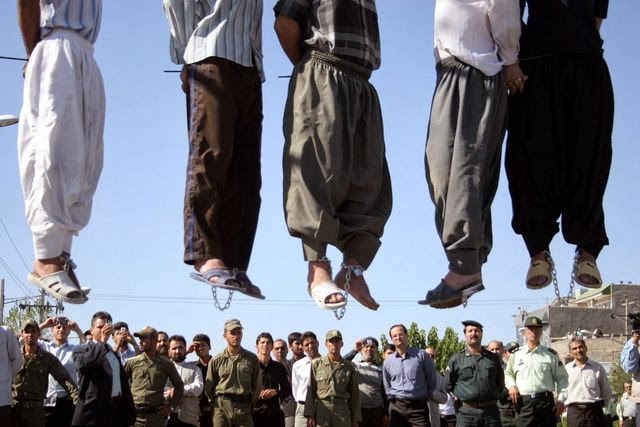
It's an HERBAL cure, too. How humanitarian of Iran to invent this cure! Just think what it means. If you are gay in Iran and have AIDS, the government can cure you, before they hang you:
These two teenage boys didn't have AIDS, but they were hanged for being gay. Iran hangs people for lots of reasons. They hang people who won't convert to Islam. They hang women and girls who have been raped. They've hanged children, even a girl as young as age 9. That's some revolution they've had, isn't it? Just the sort of folks that need the capability to make nuclear bombs.
Iran is also continuing to play it's part in Iraq:
Our problems in Iraq are largely a proxy war with Iran. Since the 1979 revolution, Iran has been nurturing Jihadism as a global movement, aiding it's expansion and strengthening it's reach.
It seems that we keep leaving them out of the equation when trying to deal with Iraq. Yet how much longer will they be ignored? Once they have nuclear capability, they may insist on NOT being ignored.
Nobody wants to deal with Iran, and it's not hard to understand why. No matter what anyone does, it promises to be a messy, deadly situation. The problem is, if we keep doing nothing, it could end in a deadly nuclear mess.
There are forces in Iran, even in the theocratic government, that want Ahmadinejad removed from power. Standing up to him might help bring about his removal, without a war. But will we even try?
UPDATE 02/11/07 11:am I guess it wasn't much of a speech. This following article suggests that Ahmadinejad was told by members of the government to tone it down:
[...] The Iranian leader suggested last week that Tehran would announce that it had begun installing a new assembly of 3,000 centrifuges in an underground portion of its uranium enrichment facility at Natanz — in what would be a major jump in its nuclear program.
It is widely believed, however, that moderates among the ruling Islamic establishment advised him against such a provocative statement.
"After the U.N. Security Council imposed sanctions on Iran last December, Ahmadinejad has come under pressure at home and abroad to moderate his tone. He refused to make that announcement not to further provoke the West at this crucial time," political analyst Iraj Jamshidi said.
The Security Council first imposed limited sanctions in December over Iran's refusal to halt enrichment and has threatened to further sanctions later this month if it continues to refuse to roll back its program.
Ahmadinejad's comments Sunday were part of a speech that was broadcast live during nationwide rallies marking the 28th anniversary of the Islamic Revolution. Hundreds of thousands of Iranians gathered at a Tehran square, chanting slogans including: "Death to America!" [...]
If they really wanted nuclear capability for peaceful purposes only, there would be no need for them to build breeder reactors, which can be used to create nuclear warheads. Their actions don't match their words.
As for Ahmadinejad's toned down speech, there is also this allegation to consider:
The number of executions carried out by Iranian authorities — often hanging dubiously convicted citizens from construction cranes in public — has risen sharply since President Hassan Rouhani took office in August, a surge most likely because of a secret power struggle within Iran’s notoriously veiled political system.
Away from positive news coverage of the Obama administration’s push for nuclear detente with Iran, the Islamic republic is executing about 66 people per month, 19 more per month than during the 2-year period before Mr. Rouhani took office, according to an analysis of figures compiled by nonpartisan groups including Amnesty International, the Iran Human Rights Documentation Center and various Iranian opposition activists in Washington.
Critics of the nuclear deal are citing the executions as evidence that Mr. Rouhani is far from the moderate reformer that many portrayed him to be upon his ascension to the presidency.
But U.S. intelligence sources, human rights advocates and high-level sources on Capitol Hill caution against jumping to that conclusion. In interviews with The Washington Times, several sources said reasons for the surge in executions are complex.
“There are indications that the Iranian regime is executing more people now compared to just a year ago,” one U.S. intelligence official told The Times on the condition of anonymity in order to speak freely about sensitive issues. “But it’s difficult to identify any overarching political strategy behind Tehran’s actions.”
Mr. Rouhani may have a political mandate from Iran’s supreme leader, Ayatollah Ali Khamenei, to thaw relations with the West. But sources say the president may have limited control over the nation’s judiciary, where decisions are made by other players — including Islamist hard-liners with mandates of their own from Ayatollah Khamenei.
A leading theory is that the leader of the Iranian judiciary, Sadeq Larijani, is green-lighting more executions in an attempt to smear Mr. Rouhani’s image as a moderate. The spike in hangings also may result from Ayatollah Khamenei’s desire to hammer home to Iranians that the mullahs’ grip on society remains tight — even if Mr. Rouhani is seen to be spreading the rhetoric of reform on the world stage.
Human rights outrage
Either way, human rights advocates say, Iran is flagrantly violating international law.
After Amnesty International’s claim that 33 people were hanged in a single week last month, the top human rights office at the United Nations noted that “28 women and a number of political prisoners” were among those executed in 2013. The office also said the killings were based on convictions that do not meet the “most serious crimes” threshold under international law.
“The persistent execution of individuals for exercising their rights to freedom of assembly, association and affiliation to minority groups contravenes universally accepted human rights principles and norms,” said Ahmed Shaheed, U.N. special rapporteur for the situation of human rights in Iran.
[...]
Some believe Iran’s executions will derail prospects for a long-term thaw in relations with West.
“Iranian authorities’ attempts to change their international image are meaningless if at the same time executions continue to increase,” said Hassiba Hadj Sahraoui, a deputy director at Amnesty International, which opposes all executions everywhere.
The situation is adding to unease in Washington, where lawmakers are split over the recent push for diplomacy with Tehran. Most Democrats, including Sen. Dianne Feinstein of California, who heads the Senate Select Committee on Intelligence, call for patience while nuclear negotiations proceed.
Many Republicans say Tehran simply can’t be trusted.
“History has taught us that we are not dealing with an honest broker,” Rep. George Holding, North Carolina Republican and member of the House Committee on Foreign Affairs, said on the House floor last week. “The election of President Rouhani does nothing to change the fact that the supreme leader is still in charge.”
Others argue that Mr. Rouhani is under immense pressure, walking a tightrope between easing tensions with the West and preventing disruption inside Iran.
“We’re clearly seeing a power struggle playing out in Iran between the hard-liners, who aren’t willing to compromise an inch on the nuclear program, and Rouhani, who has placed great emphasis on engagement with the West,” said Rep. Eliot L. Engel of New York, the ranking Democrat on the House Committee on Foreign Affairs.
“The hard-liners,” Mr. Engel told The Times, “are willing to do what it takes to sully the image of Rouhani in the eyes of the West.”
The Larijani theory
The U.S. intelligence official said Iranian Judiciary Chief Sadeq Larijani “could be trying to send a message that tolerance has its limits.”
Iranian sources highlight Mr. Larijani as the face of Tehran’s resistance to international criticism over executions. He responded harshly to the United Nations last week, declaring at a meeting with religious and political leaders in Iran that the Islamic republic “will never cave to this type of pressure” from Western-backed entities, according to a report by Al-Monitor, which cited a pro-regime Persian-language website as its source.
There are signs that some in Mr. Rouhani’s inner circle are at odds with Mr. Larijani and have been angered by the executions. As hangings spiked in November, Ali Younesi, a reformist member of Iran’s parliament and Mr. Rouhani’s special assistant in ethnic and minority affairs, said “extremist elements” in the government were responsible.
His comments were cited by the New York-based International Campaign for Human Rights in Iran, which said “sources close to the Rouhani government” privately claimed that some executions were “actions as sabotage.”
According to those sources, the execution surge is “intended to deprive the government of the chance to present a more positive portrayal of Iran on the international arena, and to discredit Rouhani and his team, casting doubt on whether he is able to deliver his campaign promises to safeguard the nation’s basic rights.”
But the extent to which blame should fall on Mr. Larijani is not clear. Another source who spoke with The Times said human rights advocates may be overlooking evidence of closeness between the judiciary chief and Mr. Rouhani.
One of Mr. Larijani’s brothers is parliament Chairman Ali Larijani, who is believed to be closely aligned with Mr. Rouhani in the push for a nuclear deal with the West.
Others point out that Mr. Rouhani named Mostafa Pourmohammadi in August to become justice minister. At the time, Human Rights Watch noted that Mr. Pourmohammadi, previously a deputy intelligence minister, has long been implicated in the government’s 1988 executions of thousands of political dissidents, as well as the assassinations of several intellectuals in 1998.
Supreme leader’s power
Overanalysis of the politics behind the spike in executions may be irrelevant, said some Iran analysts. They said that whatever is playing out in Tehran is occurring beneath the gaze of the supreme leader — the only figure truly capable of changing the nation’s policies.
After Tehran’s violent crackdown on pro-reform demonstrators in 2009, it has been a common perception in Washington that widespread public frustration burns deeply beneath the Islamic republic’s surface.
“At times of widespread popular discontent, the regime in Tehran uses executions, in particular public hanging of convicts, as a means of terrorizing the public and reminding Iranians of the power of the central government,” said Ali Alfoneh, a researcher at the Foundation for Defense of Democracies specializing in the inner workings of the Iranian regime.
“Therefore,” Mr. Alfoneh said, “the rise in the number of executions signifies both popular discontent and the regime’s nervousness.” [...]
While the situation is complex, and there are many factions with competing agendas on all sides, the one constant factor that does not seem to change, is that the Supreme Leader Ayatollah Ali Khamenei is always in charge, and pulling all the strings. And I'll bet he is nervous, lest he end up like Mubarak or Qaddafi or any number of other deposed Dictators.
Iran has a high number of young, restless, unemployed people, who want change. Killing large numbers of them is one way to try to keep them under control. Meanwhile:
As Iran's government and a group of global powers creep forward on talks about easing economic sanctions slapped on that country, the Iranian street is showing signs of breaking free from the economic stagnation that has crippled the country for years.
Iran and the United States, United Kingdom, France, Russia, China and Germany agreed on Thursday to a timeline and framework for further talks next month on restraining the Islamic state's nuclear ambitions. At the same time, United Nations inspectors have reported improved access to Iran's nuclear facilities.
All parties involved continue to warn that serious differences remain in the talks, and hopes for a final deal by July have been called ambitious.
[...]
Despite the market's rise, there are lingering questions about the economy. Inflation has lowered somewhat, but it still comes in at a staggering 35 percent a year. Rabii said he's optimistic, however, that the new government understands the economy and that inflation will be in the 20 percent range next year as a result.
Unemployment is also relatively high: Government estimates put it at 12 percent. However that's much lower than many European countries that were caught up in the financial crisis.
Economists who follow Iran add that it has a young and well-educated population. Because jobs have been hard to come by, many young people have chosen to stay in school and earn higher degrees. Many analysts believe Iran will be eager to attract new foreign investment in order to create jobs for the up-and-coming segment of the population.
Alireza Nader, an Iran expert for the think tank Rand Corp., is one of those analysts. Nader said he sees evidence that Iran's economy has improved since the initial November deal. Still, he noted, most of the sanctions levied against Iran over its nuclear program remain intact.
"Iran is losing more money than it is earning, especially since it can't export all of its oil," Nader said. He agreed with Rabii that confidence in the new government of President Hassan Rouhani is helping the public's mood and giving strength to the Iranian currency, the rial.
Cliff Kupchan, who studies Iran for the Eurasia Group, told CNBC that he sees an immediate improvement in Iran's economy since the initial deal was reached about three months ago. But he said Iran's economic gains would be cut if a nuclear deal falls through and full sanctions are restored.
"The rial would plummet again, Iran's deficit would grow, access to foreign cash reserves would vanish, I think most of the gains Iran has seen would disappear," he said.
Turquoise's Rabii agreed that a deal would help Iran's financial situation more than an impasse would. [...]
I have mixed feeling about all this. On the one hand, if foreign in vestment were to pour into Iran, in theory, that would give the West some leverage with Iran, by tying Irans economy and prosperity in with Western Markets.
I say "in theory", because whatever seems to be happening in Iran, it's always the Supreme Leader who is in charge. He could welcome Western investment in Iran, to build up and strengthen it's economy, and then at some point confiscate those assets and throw the Westerners out, as Iran has done in the past. If they could use those new assets and corresponding strength to then wage war against Iraq, or otherwise gain access to Iraq's oilfields, they could disregard the West completely, as they would then be in a position of great power, and could pursue their nuclear ambitions without restraint.
That is the danger of allowing Iran to strengthen, while the Supreme Leader Khamenei is still in charge. His agenda is his own. It seems to me unwise to risk encouraging or advancing it. And look and see what "reform" means in Iran currently.
We have to ask ourselves, is this is a country we wish to strengthen? We kept pressure on the former Soviet Union until it self-destructed. Should we not do the same here?
Heck, they are always preparing for war, but I mean sometime real soon? This article from Newsmax.com seems to think there are many signs that say yes:
[...] A number of signs indicate that, contrary to the belief President Bush is a lame duck who will not act before he leaves office, the U.S. is poised to strike before Iran can acquire nuclear weapons and carry out the threat of Iranian President Mahmoud Ahmadinejad to “wipe Israel off the map”:
According to intelligence sources, the administration now rejects the National Intelligence Estimate report issued in December that asserted Iran had halted its nuclear weapons program in late 2003.
The French daily Le Monde reported in March that newly surfaced documents show that Iran has continued developing nuclear weapons. In late 2006, U.S. intelligence reportedly intercepted a phone conversation in Iran’s Defense Ministry in which the nuclear weapons program was discussed.
The commander of U.S. forces in the Middle East, Admiral William Fallon, resigned in March amid media reports that he broke with President Bush’s strategy on Iran and did not want to be in the chain of command when the order comes down from the President to launch a strike on the Islamic Republic.
Democrats suggested he had been forced out because of his candor in opposing Bush’s Iran plans, and Esquire magazine contended that Fallon’s departure signaled that the U.S. is preparing to attack Iran.
According to a Tehran-based Iranian news network, Press TV, Saudi Arabia is taking emergency steps in preparing to counter any “radioactive hazards” that may result from an American attack on Iran’s nuclear facilities.
The Saudi newspaper Okaz disclosed that the Saudi government has approved nuclear fallout preparations, and the Iranian network reported that the approval came a day after Cheney met with the kingdom’s high-ranking officials, further stating that the U.S. “is now informing its Arab allies of a potential war.”
The American commander in Iraq, Gen. David Petraeus, has stepped up criticism of Iran, telling Congress last week that Iranian support for Shiite militias posed the most serious threat to Iraq’s stability. He told senators : “Iran has fueled the violence in a particularly damaging way.” Last week, the U.S. said Iran was providing insurgents with missiles that were killing Americans and hitting targets within the U.S. occupied Green Zone in Baghdad.
MSNBC Commentator Pat Buchanan said Petraeus’ remarks to Congress lay the groundwork for a U.S. attack on Iran.
President Bush said in a speech at the White House on April 10 that Iran, along with al-Qaida, are “two of the greatest threats to America.”
He said Iran “can live in peace with its neighbors,” or “continue to arm and train and fund illegal militant groups which are terrorizing the Iraqi people … If Iran makes the wrong choice, America will act to protect our interests and our troops and our Iraqi partners.” [...]
These are just some of the reasons given, there's more details in the article. I've seen articles like this before though. It's easy to speculate, but harder to predict what actually will happen. Much depends on what any of the players do. The potential is certainly there. I've also read arguments about why it won't happen, but I don't think it's a certainty either way.
Ahmadinejad has been preparing for war for years, and has many reasons for wanting it to happen, based on his strong apocalyptic religious beliefs. As long as he is in power, war seems likely sooner or later. If Iran gets Nuclear weapons, Saudi Arabia will want them too, and Turkey will feel compelled to have them as well, etc etc. If war happens THEN, it will be much worse than anything that happens now. If war is going to happen sooner or later, there may be advantages to having it sooner. It could be the lesser of two evils.
Hat tip to Cox and Forkum for the cartoon. You can read their related commentary HERE.
The frightening truth of why Iran wants a bomb By Amir Taheri. An excerpt:
Last Monday, just before he announced that Iran had gatecrashed "the nuclear club", President Mahmoud Ahmadinejad disappeared for several hours. He was having a khalvat (tête-à-tête) with the Hidden Imam, the 12th and last of the imams of Shiism who went into "grand occultation" in 941.
According to Shia lore, the Imam is a messianic figure who, although in hiding, remains the true Sovereign of the World. In every generation, the Imam chooses 36 men, (and, for obvious reasons, no women) naming them the owtad or "nails", whose presence, hammered into mankind's existence, prevents the universe from "falling off". Although the "nails" are not known to common mortals, it is, at times, possible to identify one thanks to his deeds. It is on that basis that some of Ahmad-inejad's more passionate admirers insist that he is a "nail", a claim he has not discouraged. For example, he has claimed that last September, as he addressed the United Nations' General Assembly in New York, the "Hidden Imam drenched the place in a sweet light".
Last year, it was after another khalvat that Ahmadinejad announced his intention to stand for president. Now, he boasts that the Imam gave him the presidency for a single task: provoking a "clash of civilisations" in which the Muslim world, led by Iran, takes on the "infidel" West, led by the United States, and defeats it in a slow but prolonged contest that, in military jargon, sounds like a low intensity, asymmetrical war.
In Ahmadinejad's analysis, the rising Islamic "superpower" has decisive advantages over the infidel. Islam has four times as many young men of fighting age as the West, with its ageing populations. Hundreds of millions of Muslim "ghazis" (holy raiders) are keen to become martyrs while the infidel youths, loving life and fearing death, hate to fight. Islam also has four-fifths of the world's oil reserves, and so controls the lifeblood of the infidel. More importantly, the US, the only infidel power still capable of fighting, is hated by most other nations...
(bold emphasis mine) Ahmadinejad sounds about as sane as... Hitler. No doubt Hitler does sound sane, if you are a totalitarian. Perhaps that is why liberals in the west are bending over backwards in Ahmadinejad's defense, saying Iran NEEDS nukes, to protect themselves from the REAL bad guys... us?
Four and a half years after September 11 which was supposed to awaken us to the threat of devastating attacks by state-sponsored terrorists America is finally beginning to confront the world's largest and most dangerous state sponsor of terrorism: the Islamic Republic of Iran.
For the past week, newspapers and magazines have been filled with discussion of possible military action against Iran. The debate, so far, is between those who merely want to "threaten" the use of force, and those who argue that the Iranian threat is illusory. No one is yet willing to face the fact that Iran is already at war with the United States and that Iran is the central enemy we have to defeat if we are going to win the War on Terrorism.
In all of the obfuscation generated by the backward-looking debate over what happened to Saddam Hussein's weapons of mass destruction, it has been easy for some to claim that the Iranian threat is being blown out of proportion by the Bush administration. But grasping the case against Iran doesn't depend on secret dossiers and obscure intelligence reports. All it requires is that you open up your newspaper and read the pronouncements of Iran's own leaders...
Iran is emboldened to behave as it does, because it sees the west as too weak and too divided to act.
Why does Iran want to enrich uranium? Ahmadinejad isn't interested so much in joining a nuclear club as he is in wielding a nuclear club. He has openly boasted that Iran wants to "wipe Israel off the map." Is Ahmadinejad just a wild-eyed "radical," out of touch with the rest of the Iranian regime? A few years ago, Ayatollah Hashemi Rafsanjani a man considered "moderate" by the standards of the Iranian regime boasted that "a single atomic bomb has the power to completely destroy Israel." In case you don't think they're serious, Iran's religious establishment recently released a fatwa sanctioning the use of nuclear weapons...
(bold emphasis mine)They have been making their intentions quite clear. Our inaction merely confirms their belief in our weakness and inability, or lack of will, to respond.
There is no need to invoke the doctrine of pre-emption against Iran. Iran is already fighting a war against the United States. We just haven't been fighting back. We have held our fire as if Iran were protected by a shield of nuclear weapons. How much more aggressive will the Iranians become when they are actually protected by such a nuclear shield?...
Iran actively helps and financially supports numerous terrorist groups in the middle east, and they are spreading their tentacles abroad as well, much closer to home than you think. The rest of the article contains the chilling details.
The whole article is HERE, it's not long but is well worth reading.
Following are excerpts from a dance celebrating Iran's uranium enrichment capabilities, aired on the Iranian news channel on April 11, 2006.
Young men: Allah Akbar. Allah Akbar. Allah Akbar. Allah Akbar.
Speaker: God is great. It has been proven that God is the great supporter of the Iranian people.
Young men: Allah Akbar. Allah Akbar. Allah Akbar. Allah Akbar. Allah Akbar. Allah Akbar.
Speaker: Dear viewers, guests, and listeners, this is the cry of Allah Akbar by the zealous young men of the Iranian people. These young people here represent various ethnic groups of the Iranian people.
Young men: Allah Akbar. Allah Akbar. Allah Akbar. Allah Akbar. Allah Akbar. Allah Akbar. Allah Akbar. Allah Akbar. Allah Akbar. Allah Akbar. Allah Akbar.
Speaker: On the cold nights, when we were feverishly striving for the triumph of the Islamic revolution, we used to say Allah Akbar. In all moments of collective steadfastness we shouted Allah Akbar. Now we repeat the same eternal slogan: Allah Akbar. Is this not your slogan? Don't you say Allah Akbar?
Young men and crowd: Allah Akbar. Allah Akbar. Allah Akbar. Allah Akbar. Allah Akbar. Allah Akbar. Allah Akbar. Allah Akbar.
Speaker:I'd like to invite the deputy supervisor of the Imam Reza Shrine, my honorable brother, Mr. Alavi, who proudly wears the uniform of the Imam Reza Shrine. I would like to call him to the stage. He will be presented with a container with the first nuclear product of the Islamic Republic of Iran.
Mr. Alavi, if you please. Please honor this occasion by reciting prayers to the Prophet and his family.
With the permission of the supervisor of the Imam Reza Shrine... Deputy Supervisor of the Imam Reza Shrine, Mr. Alavi, will now come to the stage and receive a container with UF6, produced in the nuclear facilities of the Islamic Republic of Iran. Oh honorable people, and all who witness this occasion, remember that we have no mystery besides Allah Akbar, and we have no secret besides the greatness of God and this conviction. Mr. Alavi, if you please. Honor this occasion by saying Allah Akbar.
Crowd: Allah Akbar. Allah Akbar. Allah Akbar. Allah Akbar. Allah Akbar. Allah Akbar. Allah Akbar. Allah Akbar. Allah Akbar.
It would seem there is a good deal of religion involved in Iran's quest for nuclear weapons capability. They do keep saying it's for peaceful purposes. But then why are they concentrating on breeder reactors, which can be used to make atomic bombs? They also talk extensively about sharing this technology with other Muslim countries.
According to Jim Baker's Iraq Study Group, these are the folks we need to reach out to, to help us get out of Iraq. But is that really such a good idea? Consider this:
#1288 - Iranian President Mahmoud Ahmadinejad: As Soon as Iran Achieves Advanced Technologies, It Has the Capacity to Become an Invincible Global Power. 9/28/2006 - 00:07:34
#1314 - Iranian Revolutionary Guards Corps Commander Yahya Safavi: We Have Thousands of Martyrdom-Seekers; We Can Give Missiles to Friendly and Neighboring Countries. Al-'Alam TV (Iran) - 11/5/2006 - 00:03:31
#1241 - Iranian President Mahmoud Ahmadinejad: The U.S and England Are Not Worthy of Security Council Membership. Those Who Want Good Relations with the Iranian People Should Bow and Surrender to its Right and Might. IRINN (Iran) - 8/13/2006 - 00:03:21
#1168 - Former Iranian Diplomat Mohammad Javad Larijani, Brother of Top Iranian Nuclear Negotiator: We Are Interested in Nuclear Cooperation with Arab and Muslim Countries; the Americans Will Need Our Assistance to Withdraw from Iraq. Iran Ch.2 - 5/30/2006 - 00:03:03
#1140 - Leader of Muslim Brotherhood Mahdi 'Akef: Arab and Islamic Countries Should Obtain Nuclear Technology "For Military Purposes". Al-'Alam TV (Iran) - 5/14/2006 - 00:01:18
#1081 - Iranian Leader Ali Khamenei: The Slogan "Death to America" Is No Longer Chanted Only by the Iranians. Iran Ch.2 - 3/21/2006 - 00:03:04
#716 - Ayatollah Jannati at a Tehran Friday Sermon: By Voting You Will Be Shouting a Gigantic "Death to America". Iran Ch.1 - 6/10/2005 - 00:01:15
#252 - Iranian Revolutionary Guard Official in Tehran University Lecture (Part II): We Plan To Target US Nuclear Warheads on US Soil; Should Take Over England. The Internet - 5/23/04 - 00:06:33 [NOT a TV source]
We have offered to supply Iran with what they need for peaceful uses of nuclear power. They are not interested. So what do you suppose they ARE intrested in? Here is a hint for you:
#919 - "Death to America" Chants in Iranian "Jerusalem Day" Demonstrations. Iran ch.3 - 10/28/2005 - 00:01:55
The transcript:
"Death to America" Chants in Iranian "Jerusalem Day" Demonstrations
Following are excerpts from the broadcasts of channel 3 of the Iranian TV on “Jerusalem Day,” which was celebrated on October 28, 2005
Man: Death to Israel
Crowd: Death to Israel.
Man: Death to America
Crowd: Death to America.
Man: These dear people have practiced especially for this. People here in the square, and you, dear viewers throughout Iran, are all watching this. Are you ready? Show that you’re ready with a loud “death to Israel”
Crowd: Death to Israel.
Man: Raise your flag.
Another man: Death to America
Crowd: Death to America
Another man: Death to America
Crowd: Death to America
Another man: Say it out loud
Crowd: Death to America
Another man: Say it out loud
Crowd: Death to America
Another man: Don’t be afraid, man.
Crowd: Death to America
Another man: Say it out loud
Crowd: Death to America
Another man: (America) is worthless.
Crowd: Death to America
Another man: Say it out loud
Crowd: Death to America
Another man: Death to America
Crowd: Death to America
Another man: The leader says:
Crowd: Death to America
Another man: The leader says:
Crowd: Death to America
Another man: The parliament says:
Crowd: Death to America
Another man: The parliament says:
Crowd: Death to America
Another man: The Basij members say:
Crowd: Death to America
Another man: The Basij members say:
Crowd: Death to America
Another man: The clerks say:
Crowd: Death to America
Another man: The laborers say:
Crowd: Death to America
Another man: Everybody says:
Crowd: Death to America
Another man: Everybody says:
Crowd: Death to America
Another man: America itself says:
Crowd: Death to America
Another man: America says:
Crowd: Death to America
Another man: America says:
Crowd: Death to America
Another man: Israel says:
Crowd: Death to America
Another man: Israel says:
Crowd: Death to America…
Man: Everybody, join the chant:
Another man: Death to Israel.
Crowd: Death to Israel.
Another man: Death to Israel.
Man: All together now: Death to Israel.
Crowd: Death to Israel.
What part of "Death to America" don't we understand? The policies advocated by the Baker group are the failed policies that brought us to 9-11; placating tyrants for short term peace, leaving them to strike at us later. Haven't we had enough of that? Or do we need events worse than 9-11 before we understand what "Death to America" means?
Terrorists with nukes are bad enough. But what about bombs, nuclear and non-nuclear, that create an Electromagnetic pulse (EMP)?
I had mentioned in my earlier post the American Starfish Prime 1.44 megaton nuclear test explosion in 1962, in space above the earth's atmosphere, and it's EMP effect on Hawaii. That same year, the Soviets did a similar test over Kazakhstan. Their bomb was only 300 kilotons, about one fifth the size of the Starfish Prime bomb, yet the EMP damage was more extensive. Why? Because they did it above a heavily populated area, and because it was also in the northern hemisphere where the Earth's magnetic field was very strong, which amplified the EMP effects, giving the smaller explosion a much stronger EMP!
An atomic bomb detonated high in or above the Earth's atmosphere could be used in a northern location to take advantage of the strength of the Earth's magnetic field to amplify the effect and spread it southward. The diagram below illustrates what such an EMP spread pattern might look like:
The above diagram shows us something called the Compton effect. The scenario it illustrates in this particular picture, is similar to one I read about recently in the September 2008 issue of Hillsdale college's Imprimis:
[...] Consider Iran. President Ahmadinejad and his Iranian Revolutionary Guard Corps (IRGC) have control of key strategic parts of the Iranian government, and the IRGC is capable of operating as a terrorist training unit both inside and outside of Iran (witness Iran’s support of Hezbollah in Lebanon and its backing of lethal attacks on Americans in Iraq). For the past decade, Iran—with the assistance of Russia, China, and North Korea—has been developing missile technology. It is believed that the Iranians have produced hundreds of Shahab-3 missiles. This is not the most sophisticated missile in the world, but it is capable of carrying a payload to Israel or—if launched from a ship—to an American city.
The current controversy over Iran’s nuclear production is really about whether it can produce an industrial infrastructure that would be capable of producing nuclear warheads. It has sought nuclear capability since the time of the Shah, as most nations do, since nuclear weapons bestow on a country great military and political power. Even a fully democratic and pro-western Iran would want such weapons.
Mr. Ahmadinejad said in 2005: “Is it possible for us to witness a world without America and Zionism? But you had best know that this slogan and this goal are attainable, and surely can be achieved.” What about this do we not get?
Consider this scenario: An ordinary-looking freighter ship heading toward New York City or Los Angeles launches a missile from its hull or from a canister lowered into the sea. The missile hits a densely populated area and a million people are incinerated. The ship is sunk and no one claims responsibility. There is no firm evidence as to who sponsored the attack, and thus no one against whom to launch a counterstrike.
But as terrible as that scenario sounds, consider a second one: Let us say the freighter ship launches a nuclear-armed Shahab-3 missile off the coast of the U.S. and it explodes 300 miles over Chicago, creating an electromagnetic pulse. Gamma rays scatter in what is called the Compton effect, and three separate pulses disable consumer electronics, some automobiles, and, most importantly, the hundreds of large transformers that distribute power throughout the U.S. All of our lights, refrigerators, TVs and radios stop running. We have no communication. This is what is referred to as an EMP attack, and such an attack would effectively throw America back into the early nineteenth century. Perhaps hundreds of millions of us will die from lack of food and water and as a result of social breakdown.
Opponents of missile defense call such scenarios far fetched, on the basis that the U.S. would launch a nuclear attack against whatever nation attacks us. That is, they continue to rely on the doctrine of mutually-assured destruction that our leaders prior to Reagan relied on during the Cold War. But in my scenarios, we would not know who attacked us, so that doctrine is no help. And in any case, even if Iran could be identified as the attacker, who is to say that it wouldn’t gladly sacrifice itself to destroy the Great Satan? As the Ayatollah Khomeini said in 1979, during the American hostage crisis: “I say let [Iran] go up in smoke, provided Islam emerges triumphant in the world.”
I do not use the word “destroy” lightly: An EMP attack on the U.S. would mean the end of American civilization, and dropping nuclear weapons on or retaliating against whoever caused the attack will not bring our civilization back. Nor is this science fiction. Twice, in the Caspian Sea, the Iranians have tested their ability to launch ballistic missiles in a way to set off an EMP. And the congressionally-mandated EMP Commission, including some of America’s finest scientists, has released its findings and issued two separate reports, the most recent in July, describing the effects of such an attack on the U.S. [...]
It goes on to describe the steps we could take to protect ourselves from such an attack. And the reasons we are not taking them.
Both China and Russia see America as an obstacle to expanding their global influence. Both are working on and advancing space weapons that could be used against us. We could be working on space based missile defense systems, but we are told we must not, because it could "upset" China and Russia.
As if that is not bad enough, we have increased our own vulnerability needlessly. Computer chip Technology, which is highly vulnerable to EMP forces, has been incorporated into many items what previously worked fine without them.
Take automobiles, for instance. Cars made before 1985, that don't use computer chips, would be largely impervious to an EMP attack. Cars made after that date would be rendered useless. Cars don't conceptually NEED computer chips to function, but the way they are designed and made now, they depend on them. Computer chips are now even being incorporated into the most ordinary things, even light switches. They are in almost everything. It's become a needless liability of our own making.
And to be effective, an EMP attack doesn't even have to be as large scale as the attack pictured in the diagram. Even one attack on a city on our coastline, or on a city anywhere in the world, would create panic and instability in an already unstable global market place. Several attacks, even more so.
People often think our civilization could only end from a massive war. But in truth, it could be more like "Death by a thousand cuts". Multiple, continuous small EMP attacks could impair our ability to function normally, till we no longer can.
It should be obvious why it's important to curtail rogue states who are attempting to acquire these weapons, and the countries that support them. And there is so much more we could do to defend ourselves. But will we? Or are the majority of us going to keep living our lives like we're in some unreal TV drama, living and breathing BS, until one day the lights go out, perhaps for decades, and we have a very rude awakening?
Our President should take note of some relevant facts about Russia, such as Russia's quickly shifting demographics, that demonstrate that the country will soon have a Muslim majority, making it a Muslim nation. With access to all of Russia's weapons technology and resources.
Pakistan already has nuclear technology, and it is inevitable that other Muslim nations will obtain it as well. I don't say that all Muslim states with nuclear capabilities are a threat to us, but clearly some rogue states like Iran are not only a threat to us but to the stability of the Middle East. As this technological capability spreads throughout the world, we are going to need every advantage available to us to contain it among peaceful nations, and protect ourselves as much as is humanly possible.
Now is not the time to back down on missile defense systems. We should in fact, be doing every thing we can do develop it quickly. We should also be doing all we can to make our electrical infrastructure less vulnerable to EMP attacks.
I've said generally that foreign policy has not been a strong point for Democrats, and I can't say that I like what I've seen from them so far. But I live in hope. A strong Democrat that gets the job done on these issues? That would be A Change I Could Believe In. For all our sakes.
[...] The electromagnetic pulse was first observed during high-altitude nuclear weapon detonations.
Electromagnetic weapons are still mostly classified and research surrounding them is highly secret. Military speculators and experts generally think that E-bombs use explosively pumped flux compression generator technology as their power source, though a relatively small (10 kt) nuclear bomb, exploded between 30 and 300 miles in the atmosphere could send out enough power to damage electronics from coast to coast in the US. The US Army Corps of Engineers issued a publicly available pamphlet in the late 1990s that discusses in detail how to harden a facility against "HEMP" - high frequency electromagnetic pulse. It describes how water pipes, antennas, electrical lines, and windows allow EMP to enter a building.
According to some reports, the U.S. Navy used experimental E-bombs during the 1991 Gulf War. These bombs utilized warheads that converted the energy of conventional explosives into a pulse of radio energy.[2] CBS News also reported that the U.S. dropped an E-bomb on Iraqi TV during the 2003 invasion of Iraq, but this has not been confirmed.[3]
The Soviet Union conducted significant research into producing nuclear weapons specially designed for upper atmospheric detonations, a decision that was later followed by the United States and the United Kingdom. Only the Soviets ultimately produced any significant quantity of such warheads, most of which were disarmed following the Reagan-era arms talks. [citation needed] EMP-specialized nuclear weapon designs belong to the third generation of nuclear weapons. [...]
"Most" of them were disarmed? Have some been sold? Has the technology to build new ones been sold? Who would be interested in building and using new ones? Take a guess.
The effects of such devices are sometimes exaggerated and/or misrepresented in fiction and bad journalism. Much depends on the power of the the device, the type of bomb, it's altitude and it's location in the Earth's magnetic field.
Follow the link for a definition of EMP bombs, nuclear and non-nuclear, and the details of the effects of such devices.
Some videos on Youtube.com, parts 1 and 2. Both are about 7 minutes long:
This video has some startling information about EMPs. It seems that since the end of the Cold War, the US military has really slacked off on protecting military installations and equipment from EMP forces, and our society in general has become more reliant on highly vulnerable technologies.
The Russians had developed EMP bombs as small as a beer can. Not all of them have been accounted for since the demise of the USSR. Such devices could be used in a busy airport, to blind air traffic, or in the NYC stock exchange, causing trillions of dollars in losses. It's a new world with new threats, but are we keeping up?
This 2nd video illustrates my point above, about modern automobiles. You get to see what happens to a modern car driven under an EMP pulse device, that simulates a high altitude pulse.
After the pulse, the car stops. It won't start. But it's battery is still working; the electric windows work, because they are simple motors. A few lights in the dashboard work, but everything else is dead, because they are needlessly tied into either transistors or computer chips. A vehicle that could be impervious is made unnecessarily vulnerable. Can't we change this?
I've been reading a lot in the past few months about the internal and external pressures Iran is facing. Could it be that all the aggression and bravado that we are seeing is actually a sign of weakness? Iran has been evolving ever since it's 1979 revolution, and created plenty of problems for itself along the way.
They've run their economy into the ground, they have high unemployment, over half the population are under the age of 25, with few job prospects. There are rampant illegal drug use problems. The government isn't in complete control of everything, nor are they in complete agreement among themselves. And now they have their President Ahmadinejad, acting like a mad chimp. What's it all about?
A recent post by James Lewis at the American Thinker blog has a look at Ahmadinejad's behavior, and posits that it might be more about insecurity than strength. Some excerpts:
[...] Mahmoud Ahmadi-nejad, has been hopping around like a male chimp performing a threat display --- pant-hooting, baring his big canine teeth, and tearing off branches to impress the hell out of all the other apes. He's obviously trying to get a rise out of us.
[...]
So who is Ahmadi-nejad trying to impress?
It's a puzzle. The serious players in the world probably have a reasonable idea of real Iranian nuclear technology. They are not going to be affected by all the pant-hooting hullaballoo. His internal enemies are not going to be affected either, except maybe getting scared of being evaporated in a nuclear Armageddon ad majorem dei gloriam --- for the greater glory of Allah. That's not their style. They want nukes, but they think it's idiotic to make a big public fuss about it.
So what's the answer? My guess is that, like the pant-hooting chimp, Ahmadi-nejad is trying to control his own anxiety. Here's a man who preaches over and over again that he wants to conquer the world for Allah --- if necessary, by martyring himself and the people of Iran in a nuclear exchange with Israel and America. But his whole life experience is of cultural inferiority. The mullahs are reactionary throw-backs living in the 21st century, and live with an incredible of cognitive dissonance. They know their actual level of incapability. How do you cope? Well, you can only try to bluff and steal their toys.
Nuclear weapons are supposed to be the great equalizer, of course, which will make up for all those feelings of inferiority. But nukes are much more likely to end up as the great vaporizer of the regime itself. Ahmadi-nejad is a little man trying to act like a big man, and using displays of fearful power to succeed --- as he always has, in his tiny, closed world of ayatollahs and their fantasies. According to the MK (Marxist) rebels against Tehran, Ahmadi-nejad started as a prison interrogator and executioner for Khomeini. He has dealt with helpless opponents all his life.
Inspiring terror has always worked for him.
Ahmadi-nejad is quite ignorant about the larger world. On his recent visit to Saudi Arabia he was unable to talk directly with the King because he does not even speak Arabic --- the sacred language of the Koran. Apparently he left Saudi Arabia in a huff because the King told him what kind of danger he was creating for his own people. The Saudis must view him as a dangerous ignoramus. By comparison, many of the surrounding rulers, like King Abdullah of Jordan, are worldly and sophisticated. Even Bashar Assad went to school in France and Britain.
[...]
One hypothesis is that Ahmadi-nejad is engaging in a grand provokatsya, trying to trigger an emotional reaction from the West --- either retreat, or an unsustainable attack. Now that's not going to work with Bush and Cheney, who are pretty good poker players. It's not going to work with Tony Blair, in spite of the depressing recent performance of the Royal Navy. It's not going to work with Israel, which will fight all out, but only when it absolutely must. Oddly enough, these chimp displays only work to scare the Western public, especially on the Left, which may be slowly emerging out of its state of denial by seeing Ahmadi-nejad doing his nuclear song and dance.
Strategically, any action against this hair-raising regime must occur at a time and place of our choosing.
If and when we go for regime change in Tehran, it must be fast, clean, and evoked by clear and present danger.
Well, Ahmadi-nejad is helping to set the stage. Already 52 percent of Europeans, not famous for thinking clearly about rogue regimes, believe that violence may be justified to overthrow the Khomeinist regime. That's a couple of years after most of them threw screaming fits about the overthrow of Saddam. Ahmadi-nejad's chimp display seems to be having the opposite effect he intended. [...]
(bold emphasis mine) I think this chimp theory does explain a lot. And it's not hard to see how Ahmadinejad's terror techniques as interrogator would not play well on the world stage, and could even backfire.
I remember the Soviet Union being quite full of bravado, right up until it's collapse. Could we be witnessing something similar with Iran? Many people also believe that Iran exaggerates it's technological prowess and progress, but that is debatable. Because they are so secretive, it's difficult to know exactly how far they have advanced. Yet even the Soviet Union, which already had nuclear bombs and technology, crumbled none the less. Weapons and technology couldn't save them from their self-created internal problems.
Iran is still a very real potential danger, but will it continue in it's current form long enough to bring Ahmadinejad's plans to fruition? James Lewis looks in detail at the dynamics at work in and around Iran, and the pressures bearing on them. The West may indeed have good reasons for not using military force just yet. I recommend reading the whole article.
Amadinejad supports Pop Islam, Iranian nationalism, to serve the goal of Martydom In the 1979 Iranian revolution, the Ayatollah Khomeini crushed Iranian nationalism in order to bring about a completely Muslim State. But now Iranian President Ahmadinejad is trying to revive Iranian Nationalism, to advance his nuclear program and to rally the Iranian people for war and Martyrdom. Will it work?
Iraq in the Balance Iran and Iraq have the largest populations of Shia Muslims. Shia Islam is a strong dynamic at work in both countries, and however we deal with one country will affect the other. Shia domination of Iraq is inevitable. What will that mean for Iraq, Iran, the Middle East, and the rest of the world?
[...] Is Israel bluffing? Israeli leaders have been claiming Iran is pursuing nuclear weapons since the early 1990s, and defense officials have issued a series of ever-changing estimates on how close Iran is to the bomb. But the saber-rattling has become much more direct and vocal.
[...]
Israel views Iran as a mortal threat, citing Iranian calls for Israel's destruction, Iran's support for anti-Israel militant groups and Iranian missile technology capable of hitting Israel.
On Friday, Iran's supreme leader, Ayatollah Ali Khamenei, called Israel a "cancerous tumor that should be cut and will be cut," and boasted of supporting any group that will challenge the Jewish state.
When faced with such threats, Israeli has a history of lashing out in the face of world opposition. That legacy that includes the game-changing 1967 Middle East war, which left Israel in control of vast Arab lands, a brazen 1981 airstrike that destroyed an unfinished Iraqi nuclear reactor, and a stealthy 2007 airstrike in Syria that is believed to have destroyed a nuclear reactor in the early stages of construction.
Armed with a fleet of ultramodern U.S.-made fighter planes and unmanned drones, and reportedly possessing intermediate-range Jericho missiles, Israel has the capability to take action against Iran too, though it would carry grave risks.
It would require flying over Jordan, Saudi Arabia, Iraq, Syria or Turkey. It is uncertain whether any of these Muslim countries would knowingly allow Israel to use their airspace.
With targets some 1,000 miles (1,600 kilometers) away, Israeli planes would likely have the complicated task of refueling in flight. Iran's antiquated air force, however, is unlikely to provide much of a challenge.
Many in the region cannot believe Israel would take such a step without a green light from the United States, its most important ally. That sense is deepened by the heightened stakes of a U.S. election year and the feeling that if Israel acts alone, the West would not escape unscathed.
The U.S. has been trying to push both sides, leading the charge for international sanctions while also pressing Israel to give the sanctions more time. In recent weeks, both the U.S. and European Union have imposed harsher sanctions on Iran's oil sector, the lifeblood of its economy, and its central bank. Israeli officials say they want the sanctions to be imposed faster and for more countries to join them.
Last week, The Associated Press reported that officials in Israel — all of whom spoke on condition of anonymity because they were not authorized to discuss Iran — were concerned that the measures, while welcome, were constraining Israel in its ability to act because the world expected the effort to be given a chance.
Even a limited Israeli operation could well unleash regionwide fighting. Iran could launch its Shihab 3 missiles at Israel, and have its local proxies, Hezbollah in Lebanon and Hamas in the Gaza Strip, unleash rockets. Israel's military intelligence chief, Aviv Kochavi, warned last week that Israel's enemies possess some 200,000 rockets.
While sustained rocket and missile fire would certainly make life uncomfortable in Israel, Barak himself has said he believes casualties would be low — suggesting it would be in the hundreds.
Iran might also try to attack Western targets in the region, including the thousands of U.S. forces based in the Gulf with the 5th Fleet.
An Israeli attack might have other unintended consequences. A European diplomat based in Pakistan, permitted to speak only under condition of anonymity, said that if Israel attacks, Islamabad will have no choice but to support any Iranian retaliation. That raises the specter of putting a nuclear-armed Pakistan at odds with Israel, widely believed to have its own significant nuclear arsenal.
To some, the greatest risk is to the moribund world economy.
Analysts believe an Israeli attack would cause oil prices to spike, since global markets so far have largely dismissed the Israeli threats and not "price in" the threat. According to one poll conducted by the Rapidan Group, an energy consulting firm in Bethesda, Maryland, prices would surge by $23 a barrel. The price of oil settled Friday at $97.84 a barrel.
"Traders don't believe there's anything but bluster going on," said Robert McNally, president of Rapidan and an energy adviser to former President George W. Bush. "A potential Israeli attack on Iran is different than almost every scenario that we've seen before."
McNally said Iran could rattle oil markets by targeting oil fields in southern Iraq or export facilities in Saudi Arabia or Qatar — and withhold sales of its own oil and natural gas from countries not boycotting.
Iran also could attempt to carry out its biggest threat: to shut the Strait of Hormuz, a strategic waterway through which a fifth of the world's oil passes. That could send oil prices soaring beyond $200 a barrel. But analysts note Iran's navy is overmatched.
If a surge in oil prices proved lasting, financial markets would probably plummet on concerns that global economic growth would slow and on the fear that any conflict could worsen and spread.
For the U.S. economy, higher gasoline prices would likely result in lower consumer spending, which accounts for 70 percent of U.S. economic activity. That could have devastating consequences for an incumbent president seeking re-election.
Nick Witney, former head of the EU's European Defense Agency, said "the political and economic consequences of an Israeli attack would be catastrophic for Europe" since the likely spike in the price of oil alone "could push the entire EU, including Germany, into recession."
He said this could lead to "messy defaults" by countries like Greece and Italy, and possibly cause a collapse of the already-wobbly euro. Witney, a senior fellow at the European Council on Foreign Relations, added that "the Iranians would probably retaliate against European interests in the region, and conceivably more directly with terrorism aimed at Western countries and societies."
Oil disruptions or higher oil prices will also dent growth in Asia. China, India, South Korea and Japan all buy substantial amounts of Iranian crude and could face temporary shortages.
China's fast-growing economy, which gets 11 percent of its oil from Iran, has urged all sides to avoid disrupting supplies. Any impact on China's economy, the world's second-largest, could send out global shockwaves if it dented Chinese demand for industrial components and raw materials.
Why is the issue coming to a head with such unfortunate timing, with the U.S. election looming and the global economy hanging by a razor's edge?
The urgency is fueled by a belief in Israel that Iran is moving centrifuges and key installations deep underground by the summer — combined with doubts about whether either Israel or the United States have the bunker-busting capacity to act effectively thereafter. [...]
But the global repercussions of trying to stop it, are enormous. Could the be a case of the cure being worse than the disease?
The cover story there is Robert Tracinski's article: Five Minutes to Midnight. Cox and Forkum offer this excerpt:
Observing the events of today—the hesitation and uncertainty, the stubborn clinging to the fantasy that the enemy can be appeased if we just keep talking and find the right diplomatic solution—I now feel that, for the first time, I really understand the leaders of the 1930s. Their illusion that Hitler could be appeased has always seemed, in historical hindsight, to be such a willful evasion of the facts that I have never grasped how it was possible for those men to deceive themselves. But I can now see how they clung to their evasions because they could not imagine anything worse than a return to the mass slaughter of the First World War. They wanted to believe that something, anything could prevent a return to war. What they refused to imagine is that, in trying to avoid the horrors of the previous war, they were allowing Hitler to unleash the much greater horrors of a new war.
Today's leaders and commentators have less excuse. The "horror" they are afraid of repeating is the insurgency we're fighting in Iraq—a war whose cost in lives, dollars, and resolve is among the smallest America has ever had to pay. And it takes no great feat of imagination to project how much more horrible the coming conflict will be if we wait on events long enough for Iran to arm itself with nuclear technology. Among the horrific consequences is the specter of a new Holocaust, courtesy of an Iranian nuclear bomb.
(bold emphasis mine) We have a window of opportinuity here to stop this. If we let that window close, and Iran obtains nukes, what would happen? Neal Boortz today speculates on just such a scenario:
...Let's spend just a few moments thinking of what happens when Iran gets the bomb. There are several scenarios. A nuclear strike on Israel is one, of course. Would the West retaliate? Perhaps. Remember, though ... Ahmadinejad and his Islamic fascist pals don't really care how many of their countrymen are killed in any retaliation. They way they look at it, they're fighting and dying for Allah, and this guarantees their place in paradise. Kill infidels, or die trying to kill infidels. It make no difference. In their twisted vision of their religious duty, it's all the same.
So ... Iran makes a few nuclear weapons. They then use the porous border between the U.S. and Mexico to bring one of those bombs into the U.S. Perhaps in the well-shielded back of a minivan. They park the minivan in a garage of some ordinary house in an obscure neighborhood in some mid-sized American city. Then they conduct a nuclear test in Iran. Surprise! We have the bomb!
As the world is reacting to the Iranian nuclear test, some deranged Mullah steps up to the microphones to inform the world that there is a bomb just like the one they tested somewhere in the United States. There's another in some Western European country. The world is then informed that both of these bombs will be detonated unless certain Islamic demands are met.
What demands? Well, let's start with the removal of all U.S. and Western troops out of the Middle East. Then all Jews are told to leave Israel or face annihilation. The U.S. is told that if we dare to defend Israel, the bomb will be detonated. In short order the Islamic fascists have complete control over the entire Middle East. All moderate Arab governments will fall. The Persians of Iran will rule. All oil supplies to the Western world will be held hostage to Iranian demands.
Now ... is there anything in this scenario thus far that you think is absurd? Can you not see things playing out pretty much this way? Sure, there are as many possibilities are there are people capable of dreaming them up. Any way you look at it, Iran with a nuclear bomb isn't a warm and fuzzy thought.
So .. what do we do?
There are three main alternatives.
1. Diplomacy 2. Sanctions against Iran 3. Military action...
(bold emphasis mine) Boortz goes on to examine each of these three alternatives in detail. He starts with an excellent analysis of Diplomacy, and how the left has undermined our efforts in this area to the point where it is now practically worthless. Sanctions would also be undermined by the left and the media, and as for a military solution... it's a new game, with new rules, and it's pretty ugly. And the left once again, plays it's part. There's much more, I recommend reading the whole thing. There is also an opinion poll with the article, where you can vote on the alternative you think would be best.
I generally like to think optimistically about world affairs. I like to think that no matter how screwed up a situation becomes, that it can be reversed or corrected later. But there are some instances where that's extremely unlikely. Iran, nuclear weapons technology and Amadinejad are a prime example.
[...] While all sorts of gushing is going on in the media, and posturing is going on in politics, the biggest national sponsor of terrorism in the world-- Iran-- is moving step by step toward building a nuclear bomb.
The point when they get that bomb will be the point of no return. Iran's nuclear bomb will be the terrorists' nuclear bomb-- and they can make 9/11 look like child's play.
All the options that are on the table right now will be swept off the table forever. Our choices will be to give in to whatever the terrorists demand-- however outrageous those demands might be-- or to risk seeing American cities start disappearing in radioactive mushroom clouds.
All the things we are preoccupied with today, from the price of gasoline to health care to global warming, will suddenly no longer matter.
Just as the Nazis did not find it enough to simply kill people in their concentration camps, but had to humiliate and dehumanize them first, so we can expect terrorists with nuclear weapons to both humiliate us and force us to humiliate ourselves, before they finally start killing us.
They have already telegraphed their punches with their sadistic beheadings of innocent civilians, and with the popularity of videotapes of those beheadings in the Middle East.
They have already telegraphed their intention to dictate to us with such things as Osama bin Laden's threats to target those places in America that did not vote the way he prescribed in the 2004 elections. He could not back up those threats then but he may be able to in a very few years.
The terrorists have given us as clear a picture of what they are all about as Adolf Hitler and the Nazis did during the 1930s-- and our "leaders" and intelligentsia have ignored the warning signs as resolutely as the "leaders" and intelligentsia of the 1930s downplayed the dangers of Hitler.
We are much like people drifting down the Niagara River, oblivious to the waterfalls up ahead. Once we go over those falls, we cannot come back up again.
What does this have to do with today's presidential candidates? It has everything to do with them. [...]
(bold emphasis mine) As much as I like to be optimistic, I also believe in being a realist. Hitler did not have the Atom Bomb, and we defeated him before he got it. If he had succeeded in getting the Atom Bomb... can you imagine the horror?
We are facing a very similar situation now. The term of our next president will likely be the last window of opportunity to stop this. Will we? If we don't, Sowell is right, nothing else we're fussing about now is going to matter.
Sowell is not a McCain fan. But Sowell compares McCain to Obama on the Iran issue, and makes a compelling case as to why it's important not to "sit this one out". Now is not the time for moral paralysis. We need to support the Republican candidate now, more than ever. Our very lives may depend on it.
The UN's nuclear watchdog has asked Iran to explain evidence suggesting that Iranian scientists have experimented with an advanced nuclear warhead design, the Guardian has learned.
The very existence of the technology, known as a "two-point implosion" device, is officially secret in both the US and Britain, but according to previously unpublished documentation in a dossier compiled by the International Atomic Energy Agency (IAEA), Iranian scientists may have tested high-explosive components of the design. The development was today described by nuclear experts as "breathtaking" and has added urgency to the effort to find a diplomatic solution to the Iranian nuclear crisis.
The sophisticated technology, once mastered, allows for the production of smaller and simpler warheads than older models. It reduces the diameter of a warhead and makes it easier to put a nuclear warhead on a missile.
Documentation referring to experiments testing a two-point detonation design are part of the evidence of nuclear weaponisation gathered by the IAEA and presented to Iran for its response. [...]
Such warheads could be used on missiles they already have, and would greatly increase their ability to devastate with EMP attacks, without a single bomb hitting the ground.
Perhaps it's no coincidence that Russia is suddenly more supportive of sanctions:
Russia has spoken out more strongly than ever against Iran, warning that it may consider tougher sanctions against the country should it fail to accept a Western-backed nuclear proposal.
In an interview with the German weekly Der Spiegel on Saturday, Russian President Dmitry Medvedev said that, much to his reluctance, he would be forced to sign off on US-led sanctions on Iran.
"I do not want that all this ends up with the adopting of international sanctions because sanctions, as a rule, lead in a complex and dangerous direction," AFP quoted Medvedev as saying. [...]
They are within striking distance. But when you include missiles launched from ships, and EMP attacks as the goal, then most of the worlds populations are within striking distance.
Hat tip to Cox and Forkum for the cartoon. You can read their related commentary and links HERE.
Parts of Ahmadinejad's letter to America sound like our Democrats talking points. He also uses a lot of flowery language about peace, etc. He says we share the same values. But how true is that?
It's interesting to look at what President Ahmadinejad says on Iran's state-controled national TV. The website MEMRI.ORG has thousands of on line video clips from Middle Eastern TV, from various countries, on multiple subjects. The clips come with transcripts in English. I'll start with the most recent ones from Iran.
Here is a sample of what Ahmadinejad says about America to the Iranian people:
#1328 - Iranian President Mahmoud Ahmadinejad: America's Straw-Like Strength and Satanic Rule over the World Is about to Be Annihilated Iran Ch.1 - 11/27/2006 - 00:03:30
No suprise there. He has said this before, and makes no secret of it.
#1301 - Iranian President Mahmoud Ahmadinejad: The Western Countries Should Pick Up the Zionist Regime by the Arms and Legs and Remove It from the Region; U.N. Resolutions Are Illegitimate; America and England Are the Enemies of the Iranian Nation IRIB/Jaam-E-Jam1 (Iran) - 10/20/'2006 - 00:10:41
That doesn't sound too warm and fuzzy.
#1241 - Iranian President Mahmoud Ahmadinejad: The U.S and England Are Not Worthy of Security Council Membership. Those Who Want Good Relations with the Iranian People Should Bow and Surrender to its Right and Might IRINN (Iran) - 8/13/2006 - 00:03:21
"Bow and Surrender to it's Right and Might"? I guess when he talks about "peace", it means that we surrender. And don't forget, Islam means "peace".
#1216 - Iranian President Mahmoud Ahmadinejad: The Iranian People Is the Owner of Nuclear Technology. Talking to Iran in Language of Threats Is a Bitter Mistake. IRINN (Iran) - 8/1/2006 - 00:15:14
Of course, they only want nuclear technology for PEACEFUL purposes. Sounds like it, doesn't it?
#1187 - Iranian President Mahmoud Ahmadinejad: When the Muslim Peoples' Rage Explodes, the Waves Will Reach the Corrupt Forces in the World RINN (Iran) - 7/11/2006 - 00:01:24
You mean it hasn't exploded yet? I guess the best is yet to come...
This is just a sample, there's more. If you go to www.memritv.org, you can click on "search" and enter the # for any of these clips to view them. There are links with each clip for transcripts of the content in English.
There has been some interesting news, that Iran's parliament wants Ahmadinejad out. That may not be as good as it sounds. I fear that they don't want him out because they disagree with him; they want him out because they fear he is being too candid to the international community about Iran's intentions.
[...] Here's an "or else" scenario from Nawaf Obaid, an adviser to the Saudi government, that actually sounds promising -- not a term that usually springs to my mind to describe Saudi scenarios. Contemplating what he would call an unwelcome American withdrawal from Iraq, Mr. Obaid writes that the Saudi government just might fill the breach out of "religious responsibility" to Iraq's Sunni minority. Saudi Arabia, "the de facto leader of the world's Sunni community," Mr. Obaid writes, just might decide to support Iraq's Sunni fighters, just as Iran has been supporting Iraq's Shi'ite fighters, to avert a possible "full-blown ethnic cleansing."
Imagine: Sunni Saudi Arabia vs. Shi'ite Iran -- and nary an American soldier ordered to pull his PC punches in the crossfire. But there's more. Mr. Obaid continues: King Abdullah might also "decide to strangle Iranian funding of the [Shi'ite] militias through oil policy. If Saudi Arabia boosted production and cut the price of oil in half, the kingdom could still finance its current spending. But it would be devastating to Iran, which is facing economic difficulties ...The result would be to limit Tehran's ability to continue funneling hundreds of millions each year to Shi'ite militias is Iraq and elsewhere."
I like. If Saudi Arabia "strangled" Iran's economy, that would also strangle Iran's capacity to fund its nuclear blackmail program, not to mention Hezbollah and other murderous proxies. And what was that the Saudi adviser said about cutting the price of crude oil in half? [...]
(bold emphasis mine) It's an interesting Idea. But not everyone agrees that it's that simple:
[...] I'd be quite surprised if, in the absence of a U.S. presence in Iraq, the Saudis would be able to counter-balance Iran there. It strikes me as more likely that al Qaeda, if anyone, would serve that function (not that the Saudis and al Qaeda necessarily represent an "either-or"). I'd also be surprised if, without substantial assistance from the U.S., the Saudis or anyone else would be able to check Iranian power in the region as a whole. [...]
I know that militarily, the Saudi's have depended on the U.S. to look after their interests. Without that support, how much could they help the Iraq Sunnis? If the Saudis cut oil prices, would it really affect Iran that badly? I can only wonder if they would put it to the test.


 Iran head: No end to uranium enrichment