Showing posts sorted by date for query iran tv. Sort by relevance Show all posts

Sunday, May 15, 2016

Elites in Both Parties Created Trump's Triumph

Here are three articles from Salon.com that make interesting observations:

We can’t vote for either one: On world stage, Clinton and Trump present different, but serious, dangers
It is pathetically impossible to determine which one would be worse, the only metric we have left. It's OK to pass
[...] The best that can be said of this political season is that the fixed framework of American politics appears to be fracturing. This will be a fine thing if it proves to be so, and I view this development as especially important in its medium-term potential on the foreign policy side. The question is whether things will truly fall apart, or at least begin to do so. Two policies hang in the balance above all others—the relationship with Israel and our fomented confrontation with Russia—and I will return to them.

For now we must accept that the process of coming apart, while desirable, could never be other than messy. And neither could we rightly expect to define its form. Political irruptions of the kind we witness are almost always uncontrollable during certain stages. Nobody knows where the water will go when the river overflows its banks. In this case, we have an egregious candidate who stands outside the political superstructure, apparently prompting paroxysms within the policy cliques and what we call the deep state, and an egregious candidate whose priority in all spheres is to reinforce both. I leave readers to assess the implications here as they might, but there is no denying it is a hard call.

[...]

Clinton, we have to conclude without qualification, holds out zero promise of an altered direction in American foreign policy. So far as I can make out, she has never once in her decades of public service evinced any modicum of imagination or original thought on a foreign policy question. This applies to means as well as ends. Clinton is shoulder-to-shoulder with Defense Secretary Carter on every question wherein their views have intersected and aired: NATO’s eastward thrust, the power transformation in the western Pacific, Syria, Iraq, the Middle East altogether. She could comfortably reappoint Carter as President Obama reappointed the hawkish Robert M. Gates (to the astonishment and dismay of many). There has been talk she could name Vicky Nuland secretary of state—more feminist progress, we would be advised in such an eventuality.

Clinton famously declared a “reset” in Russian relations during her early years as Obama’s secretary of state—amateurishly sending Sergei Lavrov some cutie-pie button so marked. (The Russian foreign minister must have looked at the ceiling half in despair.) We understood—or the Russians did, anyway—what this meant quickly enough: Let’s get back to the Yeltsin-era subservience. Vladimir Putin’s sin lies solely in his refusal; the rest is Washington’s expertise in crowd control—we being the crowd—and the Pentagon’s desire to keep defense contractors in double-digit profits.

[...]

My starting point with Trump is his position on American exceptionalism. It is implicit but discernible. He plainly considers America the greatest of great nations, fine, but he runs on the premise that it is great no longer. As the TomDispatch web site pointed out Thursday, “The Donald is the first American presidential candidate to openly campaign on a platform of American decline, while Hillary is still stuck in a world of too-many-superlatives for the waning American century.”

[...]

Here he is last Wednesday on the O’Reilly Factor, the Fox News program, when asked about the Pentagon’s recent allegations that Russian jets flew imprudently close to American ships in the Baltic. I would have said American ships sail imprudently close to Russian waters, but never mind:

“If it were me, I will tell you, I would call him [Putin] and say, ‘Don’t do it. Just stop it. Don’t do it.’ … Let’s go. Come on. We’re going to have a good relationship. Don’t do it.’”

“Don’t do it,” as an Irish journalist named Danielle Ryan has since pointed out, “is not some revolutionary position on Russia.” Of course not, and one would never select The Don to quarterback any genuine reset in Washington’s relations with Moscow. But it is impossible, simply impossible, to ignore the core thoughts: Trump takes us back to the pre-Bush II era, that time long ago when American presidents and State Department secretaries did not refuse contact with adversaries or those with alternative views. Trump would talk, not bomb, shell, sanction or subvert. He is not phobic with regard to the Russians. He does not demonize others with other perspectives. This is a positive value out of anyone’s mouth. Excellent he has introduced it into the conversation.

[...]

Hillary Clinton derives from a tradition from which American policy must break. Donald Trump by definition derives from no tradition. One cannot vote for the former, but it does not follow one therefore votes for the latter. Sanders supporters and various stripes of Hillary-haters who now contemplate voting for Trump—and one hears of many—should take note. Too many problems attaching to Trump.

To call Trump’s foreign policy thinking inchoate is too indulgent, given it implies he is doing his thinking and is not yet finished. I do not see that he has or is. In my read he still draws from the raw instinct that has propelled him in business, wherever that may be. He is a seat-of-the-pants man as yet. So we do not truly know what he would do in any given case.

He does not grasp the reality of complexity, let’s say. As noted in a previous column, there is some likelihood that the policy cliques will shove him into a crash course on the orthodoxy and the deep state’s protocol now that he is unambiguously the Republican candidate. But we do not know this yet, either.

We do not know much, in short. I confess to liking Trump’s capacity to connect with undercurrents in American society and culture that the elites of both parties have ignored with impunity for decades now. Deprivation and abuse among muddled-thinking people—political, social, economic—is no different from deprivation and abuse among the clear-minded. But this is not the same as elevating ignorance, xenophobia and “America First” nationalism to a position requiring respect.

All this puts him well beyond the pale. No vote for Trump, then.[...]
So don't vote at all? Usually I say, vote for the one who would do the least damage. Is it impossible to tell? Difficult, I concede, but I'm not entirely convinced that not voting is the answer. Though living on the West coast as I do, I have to say that I have lost any confidence that my vote has counted in any presidential election ever. Before the polls even close in the West, the Media is on the air announcing the winner. People East of the Mississippi pick the president, the rest of us... not so much.

I believe Governor's make better Presidential candidates, because they have held elected office and you can see how they chose to govern. But where are they in this election cycle? Gone. Which leaves us with:

Our awful elites gutted America. Now they dare ring alarms about Trump, Sanders — and cast themselves as saviors
Both parties ignored workers, spewed hate, enriched themselves, hollowed out democracy. Now the problem's populism?
[...] Elites on both sides insisted on not addressing the root causes of economic dissatisfaction, hence the long-foreseen rise of Trump. Paul Krugman, a Hillary acolyte, is nothing more than a neoliberal, whose prescriptions always stay strictly within orthodox parameters. Yet he was construed as some sort of a liberal lion during the Bush and Obama years. Not for him any of Bernie’s “radical” measures to ensure economic justice and fairness. Oh no, we have to stay within the orthodoxies of the economics profession. Now he’s all offended about Trump!

The worst offenders of all are the American left’s cultural warriors, who daily wage some new battle over some imagined cultural offense, which has nothing to do with the lives of normal people but only the highly tuned sensibilities of those in the academic, publishing, and media ecospheres.

The Hillary supporters have the authoritarian mentality of small property owners. They are the mirror image of the “realist” Trump supporters, the difference being that the Trump supporters fall below the median income level, and are distressed and insecure, while the Hillary supporters stand above the median income level, and are prosperous but still insecure.

To manipulate them, the Democratic and Republican elites have both played a double game for forty years and have gotten away with it. They have incrementally yet quite comprehensively seized all economic and political power for themselves. They have perverted free media and even such basics of the democratic process as voting and accountability in elections. Elites on both sides have collaborated to engineer a revolution of economic decline for the working person, until the situation has reached unbearable proportions. The stock market may be doing well, and unemployment may theoretically be low, but people can’t afford housing and food, they can’t pay back student loans and other debts, their lives, wherever they live in this transformed country, are full of such misery that there is not a single word that an establishment candidate like Hillary Clinton or Jeb Bush says that makes sense to them.

This time, I truly believe, there’s not a dime’s worth of difference between them. When they did have a difference to choose from—i.e., the clear progressive choice, Bernie over Hillary, who consistently demonstrates beating Trump by double the margins Hillary does—the elites went for Hillary, even though she poses the greater risk of inaugurating Trump as president. And now you want us to listen to your panic alarms?

The game, for the elites, is over. This is true no matter what happens with the Sanders campaign. The Republican party as we have known it since the Reagan consensus (dating back to 1976) is over. The Democratic party doesn’t know it yet, but Bill Clinton’s neoliberalism (and what followed in his wake with complicity with Bush junior, and the continuation of Bush junior’s imperialist policies with Barack Obama) is also over, or well on its way to being over. The elites are in a cataclysmic state of panic, they don’t know whether to look right or left, they have no idea what to do with Trump, they don’t know what to do with the Bernie diehards, they have no idea how to put Humpty Dumpty together again.

[...]

The election of Trump would end the Republican party as we know it, but more refreshingly it would also end the Democratic party as we know it. The limits of the academic left’s distracting cultural discourse in keeping economic dissatisfaction in check would be fully exposed. Trump threatens the stability of the fearmongering discourse of Sullivan and his like. The threat to their monopoly of discourse is the real reason for the panic.

Oh, and Hillary, good luck fighting Trump with your poll-tested reactions. Your calculated “offenses” against his offensiveness against women or minorities or Muslims are going to be as successful as the sixteen Republicans who’ve already tried it. You won’t be able to take on Trump because you do not speak the truth, you speak only elite mumbo-jumbo. Trump doesn’t speak the truth either, but he’s responding to something in the air that has an element of truth, and you don’t even go that far, you speak to a state of affairs—a meritocratic, democratic, pluralist America—that doesn’t even exist. [...]
The election of Trump ending BOTH parties as we know them? In a way that does sound good... but what would they be replaced with? A Viking Raider, perhaps? Read on:

It’s not about sexism: Camille Paglia on Trump, Hillary’s “restless bitterness” and the end of the elites
We don't know if Trump can morph into a statesman. We do know the media/political class fears his threat to Hillary
[...] In our current campaign, the obvious strategy by Democratic operatives to disrupt Donald Trump’s rallies and link him to brewing fascism (via lurid media images of wild-eyed brawlers) has backfired with a bang. The seething demonstrators who blocked Trump’s motorcade at last week’s state GOP convention in Burlingame, California, forcing him and his retinue to ditch their vehicles and sprint to a rear entrance on foot, managed to alienate mainstream voters, boost Trump’s national momentum, and guarantee his sweeping victory in this week’s Indiana primary. With the withdrawal of Ted Cruz, Trump is now the presumptive GOP nominee. Great job, Dem wizards!

The helicopter TV footage of Trump and his Secret Service detail on the move was certainly surreal. All those beefy men in shiny, dark suits rapidly filing through narrow concrete barriers (like cattle chutes at a rodeo) and then scrambling up a grassy knoll! [...] The optics of the aerial photos made Trump look like a late Roman emperor being hustled to safety by the Praetorian Guard, which over time had become a kingmaker, supplanting the authority of the Senate and the old patrician class.

Trump has knocked the stilts out from the GOP establishment and crushed the pretensions of a battalion of political commentators on both the Left and Right. Portraying him as a vile racist, illiterate boob, or the end of civilization as we know it hasn’t worked because his growing supporters are genuinely motivated by rational concerns about border security and bad trade deals. Whether Trump, with his erratic impulses and gratuitous crudities, can morph toward statesmanship remains to be seen.

[...]

The aerial view of Trump at Burlingame gave me a moment of gender vertigo. His odd, brassy blonde hairdo, which I normally think of as a retro Bobby Rydell quiff, looked from behind like a smoothly backcombed 1960’s era woman’s bouffant. Shelley Winters flashed into my mind, and then it hit me: “It’s all about his mother!” I had never seen photos of Mary MacLeod Trump (who died at 88 in 2000) and immediately looked for them. Of course, there it was—the puffy blonde bouffant to which Trump pays daily homage in his impudent straw thatch.

In their focus on Trump’s real-estate tycoon father, the media seem to have missed that the teetotaling Trump’s deepest connection was probably to his strong-willed, religious mother. Born in the stark, wind-swept Hebrides Islands off the western coast of Scotland (the next North Atlantic stop is Iceland), she was one tough cookie. She and her parents were Gaelic speakers, products of a history extending back to the medieval Viking raids. I suddenly realized that that is Trump’s style. He’s not a tribal Highlander, celebrated in Scotland’s long battle for independence from England, but a Viking, slashing, burning, and laughing at the carnage in his wake. (Think Kirk Douglas flashing his steely smile in the 1958 Hollywood epic, The Vikings.) Trump takes savage pleasure in winning for its own sake—an attribute that speaks directly to the moment, when a large part of the electorate feels that the U.S. has become timid and uncertain and made far too many humiliating concessions to authoritarian foreign powers like China, Saudi Arabia and Iran.

Despite their show of bravado, most savvy Democratic strategists have surely known for months that Trump was by far the most formidable of Hillary Clinton’s potential opponents—which is why they’ve been playing the race and riot cards against him to the max. Hillary has skimmed along in her bouncing gender bubble, virtually untouched by her too chivalrous Democratic rivals. Far from Hillary (in this election cycle or the last) having a harder time as a woman candidate, she has been habitually shielded by her gender. At the early debates, for example, Martin O’Malley was paralyzed by his deference to her sacred womanhood and hardly dared raise his voice to contest her brazen untruths from three feet away. Meanwhile, in debate after debate, unconstrained by the sycophantic media moderators, Hillary rudely interrupted, talked over both O’Malley and Bernie Sanders, and hogged airtime like it was going out of style. Not until CNN’s April 14 debate in Brooklyn on the eve of the New York primary did moderators forcibly put a lid on Hillary’s obnoxious filibustering.

The most pernicious aspect of this Democratic campaign is the way the field was cleared long in advance for Hillary, a flawed candidate from the get-go, while an entire generation of able Democratic politicians in their 40s was muscled aside, on pain of implied severance from future party support. It is glaringly obvious, given how well Bernie Sanders (my candidate) has done despite a near total media blackout for the past year, that Hillary would never have survived to the nomination had she had younger, more well-known, and centrist challengers. Hillary’s front-runner status has been achieved by DNC machinations and an army of undemocratic super-delegate insiders, whose pet projects will be blessed by the Clinton golden hoard. Hillary has also profited from Sanders’ too-gentlemanly early tactics, when he civilly refrained from pushing back at key moments, such as the questionable Iowa and Nevada caucuses, which he probably would have won had there not been last-minute monkey business by party operatives. [...]
And so it grinds on. I do agree with the one author though, that Trump's success is a direct result of the actions of the political establishment that is attacking him. In a sense, they created his success by the things they have done over the past decades. Are the majority of Americans turning against the political establishment "Elites" in both parties?

Perhaps we shall see in November. Meanwhile, people on both sides can sing "It's My Party And I'll Cry If I Want To".
     

Saturday, February 22, 2014

A more moderate Iran?

That's the Image they are trying to project on the world stage. But what's going on at home?


Iranian executions spiking despite thaw with West, ‘moderate president’
Sources say could mean power struggle in Tehran
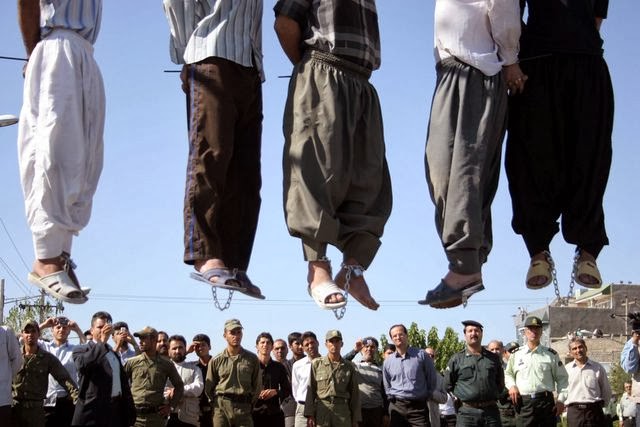
The number of executions carried out by Iranian authorities — often hanging dubiously convicted citizens from construction cranes in public — has risen sharply since President Hassan Rouhani took office in August, a surge most likely because of a secret power struggle within Iran’s notoriously veiled political system.

Away from positive news coverage of the Obama administration’s push for nuclear detente with Iran, the Islamic republic is executing about 66 people per month, 19 more per month than during the 2-year period before Mr. Rouhani took office, according to an analysis of figures compiled by nonpartisan groups including Amnesty International, the Iran Human Rights Documentation Center and various Iranian opposition activists in Washington.

Critics of the nuclear deal are citing the executions as evidence that Mr. Rouhani is far from the moderate reformer that many portrayed him to be upon his ascension to the presidency.

But U.S. intelligence sources, human rights advocates and high-level sources on Capitol Hill caution against jumping to that conclusion. In interviews with The Washington Times, several sources said reasons for the surge in executions are complex.

“There are indications that the Iranian regime is executing more people now compared to just a year ago,” one U.S. intelligence official told The Times on the condition of anonymity in order to speak freely about sensitive issues. “But it’s difficult to identify any overarching political strategy behind Tehran’s actions.”

Mr. Rouhani may have a political mandate from Iran’s supreme leader, Ayatollah Ali Khamenei, to thaw relations with the West. But sources say the president may have limited control over the nation’s judiciary, where decisions are made by other players — including Islamist hard-liners with mandates of their own from Ayatollah Khamenei.

A leading theory is that the leader of the Iranian judiciary, Sadeq Larijani, is green-lighting more executions in an attempt to smear Mr. Rouhani’s image as a moderate. The spike in hangings also may result from Ayatollah Khamenei’s desire to hammer home to Iranians that the mullahs’ grip on society remains tight — even if Mr. Rouhani is seen to be spreading the rhetoric of reform on the world stage.

Human rights outrage

Either way, human rights advocates say, Iran is flagrantly violating international law.

After Amnesty International’s claim that 33 people were hanged in a single week last month, the top human rights office at the United Nations noted that “28 women and a number of political prisoners” were among those executed in 2013. The office also said the killings were based on convictions that do not meet the “most serious crimes” threshold under international law.

“The persistent execution of individuals for exercising their rights to freedom of assembly, association and affiliation to minority groups contravenes universally accepted human rights principles and norms,” said Ahmed Shaheed, U.N. special rapporteur for the situation of human rights in Iran.

[...]

Some believe Iran’s executions will derail prospects for a long-term thaw in relations with West.

“Iranian authorities’ attempts to change their international image are meaningless if at the same time executions continue to increase,” said Hassiba Hadj Sahraoui, a deputy director at Amnesty International, which opposes all executions everywhere.

The situation is adding to unease in Washington, where lawmakers are split over the recent push for diplomacy with Tehran. Most Democrats, including Sen. Dianne Feinstein of California, who heads the Senate Select Committee on Intelligence, call for patience while nuclear negotiations proceed.

Many Republicans say Tehran simply can’t be trusted.

“History has taught us that we are not dealing with an honest broker,” Rep. George Holding, North Carolina Republican and member of the House Committee on Foreign Affairs, said on the House floor last week. “The election of President Rouhani does nothing to change the fact that the supreme leader is still in charge.”

Others argue that Mr. Rouhani is under immense pressure, walking a tightrope between easing tensions with the West and preventing disruption inside Iran.

“We’re clearly seeing a power struggle playing out in Iran between the hard-liners, who aren’t willing to compromise an inch on the nuclear program, and Rouhani, who has placed great emphasis on engagement with the West,” said Rep. Eliot L. Engel of New York, the ranking Democrat on the House Committee on Foreign Affairs.

“The hard-liners,” Mr. Engel told The Times, “are willing to do what it takes to sully the image of Rouhani in the eyes of the West.”

The Larijani theory

The U.S. intelligence official said Iranian Judiciary Chief Sadeq Larijani “could be trying to send a message that tolerance has its limits.”

Iranian sources highlight Mr. Larijani as the face of Tehran’s resistance to international criticism over executions. He responded harshly to the United Nations last week, declaring at a meeting with religious and political leaders in Iran that the Islamic republic “will never cave to this type of pressure” from Western-backed entities, according to a report by Al-Monitor, which cited a pro-regime Persian-language website as its source.

There are signs that some in Mr. Rouhani’s inner circle are at odds with Mr. Larijani and have been angered by the executions. As hangings spiked in November, Ali Younesi, a reformist member of Iran’s parliament and Mr. Rouhani’s special assistant in ethnic and minority affairs, said “extremist elements” in the government were responsible.

His comments were cited by the New York-based International Campaign for Human Rights in Iran, which said “sources close to the Rouhani government” privately claimed that some executions were “actions as sabotage.”

According to those sources, the execution surge is “intended to deprive the government of the chance to present a more positive portrayal of Iran on the international arena, and to discredit Rouhani and his team, casting doubt on whether he is able to deliver his campaign promises to safeguard the nation’s basic rights.”

But the extent to which blame should fall on Mr. Larijani is not clear. Another source who spoke with The Times said human rights advocates may be overlooking evidence of closeness between the judiciary chief and Mr. Rouhani.

One of Mr. Larijani’s brothers is parliament Chairman Ali Larijani, who is believed to be closely aligned with Mr. Rouhani in the push for a nuclear deal with the West.

Others point out that Mr. Rouhani named Mostafa Pourmohammadi in August to become justice minister. At the time, Human Rights Watch noted that Mr. Pourmohammadi, previously a deputy intelligence minister, has long been implicated in the government’s 1988 executions of thousands of political dissidents, as well as the assassinations of several intellectuals in 1998.

Supreme leader’s power

Overanalysis of the politics behind the spike in executions may be irrelevant, said some Iran analysts. They said that whatever is playing out in Tehran is occurring beneath the gaze of the supreme leader — the only figure truly capable of changing the nation’s policies.

After Tehran’s violent crackdown on pro-reform demonstrators in 2009, it has been a common perception in Washington that widespread public frustration burns deeply beneath the Islamic republic’s surface.

“At times of widespread popular discontent, the regime in Tehran uses executions, in particular public hanging of convicts, as a means of terrorizing the public and reminding Iranians of the power of the central government,” said Ali Alfoneh, a researcher at the Foundation for Defense of Democracies specializing in the inner workings of the Iranian regime.

“Therefore,” Mr. Alfoneh said, “the rise in the number of executions signifies both popular discontent and the regime’s nervousness.” [...]
While the situation is complex, and there are many factions with competing agendas on all sides, the one constant factor that does not seem to change, is that the Supreme Leader Ayatollah Ali Khamenei is always in charge, and pulling all the strings. And I'll bet he is nervous, lest he end up like Mubarak or Qaddafi or any number of other deposed Dictators.

Iran has a high number of young, restless, unemployed people, who want change. Killing large numbers of them is one way to try to keep them under control. Meanwhile:


Iran stocks are booming, and nuclear talks are why
As Iran's government and a group of global powers creep forward on talks about easing economic sanctions slapped on that country, the Iranian street is showing signs of breaking free from the economic stagnation that has crippled the country for years.

Iran and the United States, United Kingdom, France, Russia, China and Germany agreed on Thursday to a timeline and framework for further talks next month on restraining the Islamic state's nuclear ambitions. At the same time, United Nations inspectors have reported improved access to Iran's nuclear facilities.

All parties involved continue to warn that serious differences remain in the talks, and hopes for a final deal by July have been called ambitious.

[...]

Despite the market's rise, there are lingering questions about the economy. Inflation has lowered somewhat, but it still comes in at a staggering 35 percent a year. Rabii said he's optimistic, however, that the new government understands the economy and that inflation will be in the 20 percent range next year as a result.

Unemployment is also relatively high: Government estimates put it at 12 percent. However that's much lower than many European countries that were caught up in the financial crisis.

Economists who follow Iran add that it has a young and well-educated population. Because jobs have been hard to come by, many young people have chosen to stay in school and earn higher degrees. Many analysts believe Iran will be eager to attract new foreign investment in order to create jobs for the up-and-coming segment of the population.

Alireza Nader, an Iran expert for the think tank Rand Corp., is one of those analysts. Nader said he sees evidence that Iran's economy has improved since the initial November deal. Still, he noted, most of the sanctions levied against Iran over its nuclear program remain intact.

"Iran is losing more money than it is earning, especially since it can't export all of its oil," Nader said. He agreed with Rabii that confidence in the new government of President Hassan Rouhani is helping the public's mood and giving strength to the Iranian currency, the rial.

Cliff Kupchan, who studies Iran for the Eurasia Group, told CNBC that he sees an immediate improvement in Iran's economy since the initial deal was reached about three months ago. But he said Iran's economic gains would be cut if a nuclear deal falls through and full sanctions are restored.

"The rial would plummet again, Iran's deficit would grow, access to foreign cash reserves would vanish, I think most of the gains Iran has seen would disappear," he said.

Turquoise's Rabii agreed that a deal would help Iran's financial situation more than an impasse would. [...]
I have mixed feeling about all this. On the one hand, if foreign in vestment were to pour into Iran, in theory, that would give the West some leverage with Iran, by tying Irans economy and prosperity in with Western Markets.

I say "in theory", because whatever seems to be happening in Iran, it's always the Supreme Leader who is in charge. He could welcome Western investment in Iran, to build up and strengthen it's economy, and then at some point confiscate those assets and throw the Westerners out, as Iran has done in the past. If they could use those new assets and corresponding strength to then wage war against Iraq, or otherwise gain access to Iraq's oilfields, they could disregard the West completely, as they would then be in a position of great power, and could pursue their nuclear ambitions without restraint.

That is the danger of allowing Iran to strengthen, while the Supreme Leader Khamenei is still in charge. His agenda is his own. It seems to me unwise to risk encouraging or advancing it. And look and see what "reform" means in Iran currently.

We have to ask ourselves, is this is a country we wish to strengthen? We kept pressure on the former Soviet Union until it self-destructed. Should we not do the same here?


Some of my previous posts about Iran:


Is it time for regime change in Iran yet?

Iran, under the surface... is it crumbling?

Hangings in Iran increase, to silence dissent

Iran's pressing needs and Iraq's vulnerability.

Purging Western Influences from Islamic minds

Iranian Fashion Police Publicly Bludgeon Women

Amadinejad talks crazy on Iranian TV, with help from a "Death to Amercia" chorus

Amadinejad supports Pop Islam, Iranian nationalism, to serve the goal of Martydom


Sunday, October 18, 2009

Iran's Guards get Suicide Bombed

And of course, they blame the US:

Suicide bomber attacks Iran's Guards, kills 31
Reporting from Cairo and Tehran - In a brazen attack on Iran's military elite, a suicide bomber today killed five Islamic Revolutionary Guard Corps commanders and 26 others at a gathering of tribal leaders in a southeastern province near the Pakistan border that's known for drug running and religious extremism, according to the official Iranian news agency.

The assault was carried out by a lone man who reportedly disguised himself in tribal dress and detonated an explosives belt at a gymnasium in the city of Pisheen in the Sistan-Baluchistan province, a harsh land plagued by heroin smuggling and ethnic animosities. At least 28 people were wounded in the carnage, images of which were broadcast across a stunned nation.

Iran state-owned Press TV reported that a simultaneous second bombing targeted another group of Revolutionary Guard officers traveling in a convoy near Pisheen. There were no numbers on casualties, and the report could not be independently confirmed.

State media said the Sunni Muslim militant group Jundallah, or Soldiers of God, which operates along the Iran-Pakistan border, claimed responsibility for the attack. The organization, part of a regional Sunni insurgency in Shiite-dominated Iran, has for years killed and kidnapped Iranian soldiers and police officers.

[...]

Iran's post-election unrest also may have inspired today's bloodshed. Jundallah had vowed to take revenge on the Revolutionary Guard for cracking down on protestors marching against the disputed June re-election of President Mahmoud Ahmadinejad. The peaceful opposition movement led by vanquished presidential candidate Mir Hossein Mousavi never associated itself with Jundallah, but some analysts suggest the group had plotted the attack to exploit the political turmoil at a time when the Revolutionary Guard is tightening its hold on the country.

"It was a measure to show that IRGC is susceptible and penetrable. A suicide bomber infiltrated a gathering that was supposedly held under tight security because of the presence of the high-ranking IRGC commanders," said Mashaallah Shamsul Waezin , a political analyst in Tehran. "And, secondly, the timing was important because IRGC is associated with the heavy crackdown against post-election protesters, so the terrorist attack can be an intensified echo of public opinion."

[...]

The Revolutionary Guard and hard-line politicians blamed "global arrogance" for the bombing and said the U.S. was funding and arming Jundallah and other militant groups to overthrow the Ahmadinejad government. The accusations came the day before officials from the U.S. and other world powers were to meet in Vienna on Monday with Iranian delegates over Tehran's nuclear program. [...]

The Iranian theocracy blaming foreigners is predictable. But they have a lot of internal turmoil being generated by their own actions, and I expect their troubles are only just beginning.

And speaking of Iran's internal problems, Iranian blogger Azarmehr has an interesting post, comparing the pre-revolutionary political trials conducted by the Shah, with the trials happening under the current theocratic Theocracy:

Political Trials under the Shah and in Islamic Republic

Most notable is the coerced, scripted confessions.


Related Links:

Solidarity with Hengameh

Five Death Sentences Now

Our Brother Has Nothing to do with MeK


Thursday, July 09, 2009

Iran: what to expect next?

It's hard to say with any certainty, but George Handlery offers some possibilities:

Duly Noted: From the Rule by Consent to the Rule by Fear
[...] 1. Any reaction to the days past must include Iran. The need is clear. Having witnessed the collapse of several systems, an attraction to follow comparable events develops. Admittedly, in some of its details, the wobbling of Iran’s theocratic dictatorship differs from the writer’s experience. Iran’s system is not supported by the probable intervention of a great power. The security organs of the régime are still obeying orders. Furthermore, a significant segment of the public not only tolerates, but also supports the system. Regardless of the caveats, one can foretell much about the years to come.

A. Iran might be one country but it harbors two societies. Their gears match badly. One of these is rural and pre-industrial. It is mired in an obscurantist traditionalism supported by lacking knowledge. It is also badly educated in areas that determine the modern world. The other society is urban, possesses modern knowledge and skills. Therefore, it can fearlessly connect to the modern world.

B. On the long run, the ruling system is threatened, as it must base its ideology-driven power grab on the weapons-hardware contributions of relative progressives. This means that, the internal enemy’s support is needed to implement the foreign policy the regime’s extremist supporters demand.

C. The political ambitions of the reactionary rulers demand that the contribution to the armaments demanded by their foreign policy and contributed by the modernist group be emphasized. Its will to cooperate will prove to be fickle.

D. The rulers’ ideology makes them not to want to participate in and comprehend the processes that shape our time. Ignoring a suspected process and blocking it at home will still not stop global transformation.

F. The retrograde system, even if, for the sake of utility it decides to enter the modern world, is unfit to survive the consequences of its needed modernization. Ultimate success demands reforms. However, these reforms are not system-compatible. Thus, forces are unleashed that the system cannot accommodate. As in the case of the Soviet Union, to reform the system you need to abolish it.

G. Challenged at home, the clerics will need its hard core constituency’s support. Accordingly, the US attempt to cozy up to them will be resisted.


2. Iran’s rulers, self-deputized to rule in the name of the Almighty, might be able to club down their more moderate opposition. Today the struggle is not yet between freedom and theocratic tyranny. So far, only senseless servitude and the cause of a better dictatorship confront each other. The ruling prophets may disapprove, but the dispute is still about the improvement of the existing system. Characteristically for a pre-revolutionary situation, the leadership is developing fissures. Supporters are mobilized and the masses are appealed to for support. However, as long as the instruments of the power-monopoly (army, police and “party army” thugs) are not yet infiltrated by the doubts that divide the clerical elite, the troglodytes will prevail. This victory will fundamentally change the real agenda of the opposition that will evolve within a decade. The reform’s failure and indications that the system can not be reformed, will create an opposition with a program that is adjusted accordingly. Regardless of the formal terms used in public, the next time the goal will not be reform but revolution. Ultimately, unfolding events will convince a minority as it grows into a majority that clerical rule, whether exercised by bad, good or indifferent mullahs, is unsuited to solve their nation’s problems.[...]

There's more if you want to read it. Good stuff.


There was also this interesting report from a blog, about Amadinejad's speech being interrupted by a power failure, created by a protest launched by twitter users during the speech:

Blackout! The Repression will not be Televised
Ahmadinejad TV speech met by rooftop cries, power blackouts

I couldn't verify the power outage though, in any other media reports.


Saturday, June 13, 2009

Election Fraud. Has the sh*t hit the fan in Iran?


Clashes erupt in Iran over disputed election
TEHRAN, Iran – Supporters of the main election challenger to Mahmoud Ahmadinejad clashed with police and set up barricades of burning tires Saturday as authorities claimed the hard-line president was re-elected in a landslide. The rival candidate said the vote was tainted by widespread fraud and his followers responded with the most serious unrest in the capital in a decade.

By nightfall, cell phone service appeared to have been cut in the capital Tehran. And Ahmadinejad, in a nationally televised victory speech, accused the foreign media of coverage that harms the Iranian people. There was more rioting at night and fires continued to burn on the streets of Tehran.

Several hundred demonstrators — many wearing the trademark green colors of pro-reform candidate Mir Hossein Mousavi's campaign — chanted "the government lied to the people" and gathered near the Interior Ministry as the final count from Friday's presidential election was announced.

It gave 62.6 percent of the vote to Ahmadinejad and 33.75 to Mousavi — a former prime minister who has become the hero of a youth-driven movement seeking greater liberties and a gentler face for Iran abroad.

Iran's supreme leader, Ayatollah Ali Khamenei, closed the door on any chance he could use his limitless powers to intervene in the disputes from Friday's election. In a message on state TV, he urged the nation to unite behind Ahmadinejad, calling the result a "divine assessment."

Mousavi rejected the result as rigged and urged his supporters to resist a government of "lies and dictatorship."

"I'm warning that I won't surrender to this manipulation," said a statement on Mousavi's Web site. "The outcome of what we've seen from the performance of officials ... is nothing but shaking the pillars of the Islamic Republic of Iran's sacred system and governance of lies and dictatorship," it added.

Mousavi warned "people won't respect those who take power through fraud." The headline on one of his Web sites read: "I won't give in to this dangerous manipulation."

Mousavi appealed directly to Khamenei to intervene and stop what he said were violations of the law. Khamenei, who is not elected, holds ultimate political authority in Iran and controls all major policy decisions.

Mousavi and key aides could not be reached by phone. [...]

Read the rest for more details of the rioting that is breaking out, and photos and video of the same.

None of this really surprises me. Iran's Theocratic rulers are not interested in Democracy. The internal pressures in Iran will continue to build, as the population's hardships continue to increase.

Iran's Controversial Election Results Raises Questions Over Its Relations to U.S.


Related Links:

Iran's minorities may bring about regime change

Reformist Azeri Couple Challenge Iran's Amadinejad in Upcoming June Elections


Friday, May 29, 2009

Reformist Azeri Couple Challenge Iran's Amadinejad in Upcoming June Elections


Reform candidate's wife new political star in Iran
TABRIZ, Iran (AP) — Presidential hopeful Mir Hossein Mousavi waited in the wings as his wife warmed up the crowd. Zahra Rahnavard quickly had them roaring in approval — and her husband beaming — as she ticked off her demands for women's rights and other reforms.

"We love you, Rahnavard!" shouted the Tabriz University students, as Mousavi clapped.

While the political power couple is a common fixture in the West, Rahnavard is rewriting the role of political spouse in conservative Iran — and could give a boost to her husband's candidacy in the June 12 presidential election.

With her sharp wit and fluid oratory, Rahnavard has fast become a political draw on her own, as well as an important asset to her husband's campaign as the main pro-reform challenger to President Mahmoud Ahmadinejad.

Masoud Heidari, a rights activist, said the country "needs to respond to accumulated demands from women and Rahnavard is playing a deservedly good role in that direction."

She brings a rare mix: the liberal cry to fire up reformers, paired with the revolutionary credentials that bring grudging respect from hard-liners.

Even her outfit gives a nod in both directions — an ultraconservative head-to-toe black chador, with a colorful head scarf peeking out and a bag made by traditional village weavers.

[...]

"Rahnavard is reviving hopes that women will get part of their social rights ... Women's rights and freedoms went backward during Ahmadinejad's four years in office. We hope a reformist win will create new hopes for greater freedoms for women," said a supporter, Sima Honarvar.

Rahnavard is not the first high-profile woman in Iranian affairs. Human rights lawyer Shirin Ebadi won the Nobel Peace Prize in 2003 and Masoumeh Ebtekar was a vice president in Khatami's government.

But Rahnavard is the first spouse to take a major campaign role — and promise to keep her public voice if her husband becomes president. By comparison, Khatami's wife was only rarely in the public eye and almost nothing is officially known about Ahmadinejad's wife.

In almost every campaign rally, Rahnavard speaks before her husband.

In Tabriz, 300 miles northwest of Tehran, she questioned why students are imprisoned for expressing their opinions and why liberal-minded professors are forcefully retired.

"It was expected that our universities would be independent. But they are not. Why are students jailed for speaking their minds?" she asked, prompting chants of "political prisoners must be released."

Iran's third-largest city, Tabriz is populated mostly by Iran's Azeri minority. It is Mousavi's hometown, and both he and his wife began their campaign appearance by making a few remarks in the local Azeri-Turkish language before switching to Farsi. [...]

In June of 2006, a cartoon in a state run newspaper sparked massive protests, because it depicted the Azeri (who make up about 25% of Iran's population) as cockroaches. So it's interesting to see a major opposition candidate from the Azeri community, who is popular and has revolutionary credentials. AND a feminist wife, who was a college dean until she was dismissed from that position by Iran's conservatives.

She has quite a bit to say about free speech and women's rights in Iran, which have actually suffered setbacks in recent years. See the rest of the article for more details about the reforms she and her husband are pushing for.

Prior elections in Iran seemed to be rigged, with ballot stuffing, districts reporting 800% voter turn out. However, there is a lot of pressure on with this election, and hopes are high. The economy is in bad shape, unemployment is high, and there are many young people with no job prospects.

If Amadinejad, with his nutty apocalyptic beliefs is defeated, I think it could only be a good thing. Many Iranians who are leary of the controversial fringe Muslim sect he belongs to, would like to see him out of power.


Related Links:


Is it time for regime change in Iran yet?

Iran, under the surface... is it crumbling?

Hangings in Iran increase, to silence dissent

Iran's pressing needs and Iraq's vulnerability.

Purging Western Influences from Islamic minds

Iranian Fashion Police Publicly Bludgeon Women

Amadinejad talks crazy on Iranian TV, with help from a "Death to Amercia" chorus

Amadinejad supports Pop Islam, Iranian nationalism, to serve the goal of Martydom
     

Tuesday, April 21, 2009

Miss North Dakota is Under Arrest in Iran

They are accusing the 31-year-old journalist of being an American spy:

Roxana Saberi was born in the U.S.
and grew up in Fargo, North Dakota.

The former Beauty Queen became a journalist, and had been living in Iran for the past 6 years. Her father is from Iran, and she holds duel citizenship in America and Iran. Her mother is of Japanese ansestory.


Roxana Saberi working in Iran


Unfortunately she has become a pawn in the game Iranian President Amadinejad is playing. And as a western woman, it must be difficult culturally.

Iran president urges full defense for US reporter
[...] Saberi was arrested in January and initially accused of working without press credentials. But earlier this month, an Iranian judge leveled a more serious allegation that she was passing classified information to U.S. intelligence services.

She told her father in a phone conversation that she was arrested after buying a bottle of wine.
Her father said she had been working on a book about Iranian culture and hoped to finish it and return to the U.S. this year.

Saberi, who was 1997 Miss North Dakota, had been living in Iran for six years and worked as a freelance reporter for news organizations including National Public Radio and the British Broadcasting Corp. Because Saberi's father was born in Iranian, she received Iranian citizenship.

Her parents, who live in Fargo, traveled to Iran to seek her release. Her father, Reza Saberi, has said his daughter wasn't allowed a proper defense during her one-day trial behind closed doors a week ago. He said no evidence has been made public, and his daughter was tricked into making incriminating statements by officials who told her they would free her if she did.

He told CNN on Sunday that her trial lasted only 15 minutes. "It was a mock trial," he said.


One Iranian analyst said Ahmadinejad's letter was politically motivated and suggested Iran could be using Saberi's case to gain leverage with the U.S.

"Iran can use Saberi's case as a bargaining card in possible negotiations with the U.S.," said analyst Saeed Leilaz. [...]

What they call a "trial" in Iran is often a brief appearance before an Imam, who makes a decision after a few words. Calling it a "trial" would be generous.

Saberi's parents in Fargo, North Dakota


I think the real reason this is happening now is explained later in the article:

[...] Saberi's conviction also comes about two months ahead of key presidential elections in June that are pitting hard-liners against reformists, who support better relations with Washington. Ahmadinejad is seeking re-election, but the hard-liner's popularity has waned and he's been trying to draw support away from reformists. [...]

They are also holding a Canadian-Iranian blogger in custody. Read the whole thing for all the details.

Amadinejad is controversial even in his own country. If the reformists have their way, he would be forced out. Naturally he is doing everything he can to prevent that. Roxana Saberi and Canadian Hossein Derakhshan are being used a hostages.

Free and genuine elections in Iran could fix quite a few things. It's their best hope, but I don't see how that can happen with Amadinejad in charge.


UPDATE 05-11-09

Iran frees U.S.-born journalist accused of spying

The finally released her, but still insist the bogus charges are true. And now for releasing her, they will expect... what? No doubt we'll find out soon.

No word on the status of Canadian blogger Hossein Derakhshan, who was also being held. This article in fact says that 14 other blogger and journalists are still being held prisoner. It sure isn't over for them.


Related Links:

Iran, under the surface... is it crumbling?

Iranian Fashion Police Publicly Bludgeon Women

Amadinejad talks crazy on Iranian TV, with help from a "Death to Amercia" chorus
     

Wednesday, March 04, 2009

EMP Vulnerability: Could Advanced Electronics be the Achilles' Heel of our Western Civilization?

Terrorists with nukes are bad enough. But what about bombs, nuclear and non-nuclear, that create an Electromagnetic pulse (EMP)?

I had mentioned in my earlier post the American Starfish Prime 1.44 megaton nuclear test explosion in 1962, in space above the earth's atmosphere, and it's EMP effect on Hawaii. That same year, the Soviets did a similar test over Kazakhstan. Their bomb was only 300 kilotons, about one fifth the size of the Starfish Prime bomb, yet the EMP damage was more extensive. Why? Because they did it above a heavily populated area, and because it was also in the northern hemisphere where the Earth's magnetic field was very strong, which amplified the EMP effects, giving the smaller explosion a much stronger EMP!

An atomic bomb detonated high in or above the Earth's atmosphere could be used in a northern location to take advantage of the strength of the Earth's magnetic field to amplify the effect and spread it southward. The diagram below illustrates what such an EMP spread pattern might look like:


The above diagram shows us something called the Compton effect. The scenario it illustrates in this particular picture, is similar to one I read about recently in the September 2008 issue of Hillsdale college's Imprimis:

Ballistic Missile Defense is Not Yet Reality
[...] Consider Iran. President Ahmadinejad and his Iranian Revolutionary Guard Corps (IRGC) have control of key strategic parts of the Iranian government, and the IRGC is capable of operating as a terrorist training unit both inside and outside of Iran (witness Iran’s support of Hezbollah in Lebanon and its backing of lethal attacks on Americans in Iraq). For the past decade, Iran—with the assistance of Russia, China, and North Korea—has been developing missile technology. It is believed that the Iranians have produced hundreds of Shahab-3 missiles. This is not the most sophisticated missile in the world, but it is capable of carrying a payload to Israel or—if launched from a ship—to an American city.

The current controversy over Iran’s nuclear production is really about whether it can produce an industrial infrastructure that would be capable of producing nuclear warheads. It has sought nuclear capability since the time of the Shah, as most nations do, since nuclear weapons bestow on a country great military and political power. Even a fully democratic and pro-western Iran would want such weapons.

Mr. Ahmadinejad said in 2005: “Is it possible for us to witness a world without America and Zionism? But you had best know that this slogan and this goal are attainable, and surely can be achieved.” What about this do we not get?

Consider this scenario: An ordinary-looking freighter ship heading toward New York City or Los Angeles launches a missile from its hull or from a canister lowered into the sea. The missile hits a densely populated area and a million people are incinerated. The ship is sunk and no one claims responsibility. There is no firm evidence as to who sponsored the attack, and thus no one against whom to launch a counterstrike.

But as terrible as that scenario sounds, consider a second one: Let us say the freighter ship launches a nuclear-armed Shahab-3 missile off the coast of the U.S. and it explodes 300 miles over Chicago, creating an electromagnetic pulse. Gamma rays scatter in what is called the Compton effect, and three separate pulses disable consumer electronics, some automobiles, and, most importantly, the hundreds of large transformers that distribute power throughout the U.S. All of our lights, refrigerators, TVs and radios stop running. We have no communication. This is what is referred to as an EMP attack, and such an attack would effectively throw America back into the early nineteenth century. Perhaps hundreds of millions of us will die from lack of food and water and as a result of social breakdown.

Opponents of missile defense call such scenarios far fetched, on the basis that the U.S. would launch a nuclear attack against whatever nation attacks us. That is, they continue to rely on the doctrine of mutually-assured destruction that our leaders prior to Reagan relied on during the Cold War. But in my scenarios, we would not know who attacked us, so that doctrine is no help. And in any case, even if Iran could be identified as the attacker, who is to say that it wouldn’t gladly sacrifice itself to destroy the Great Satan? As the Ayatollah Khomeini said in 1979, during the American hostage crisis: “I say let [Iran] go up in smoke, provided Islam emerges triumphant in the world.”

I do not use the word “destroy” lightly: An EMP attack on the U.S. would mean the end of American civilization, and dropping nuclear weapons on or retaliating against whoever caused the attack will not bring our civilization back. Nor is this science fiction. Twice, in the Caspian Sea, the Iranians have tested their ability to launch ballistic missiles in a way to set off an EMP. And the congressionally-mandated EMP Commission, including some of America’s finest scientists, has released its findings and issued two separate reports, the most recent in July, describing the effects of such an attack on the U.S. [...]

It goes on to describe the steps we could take to protect ourselves from such an attack. And the reasons we are not taking them.

Both China and Russia see America as an obstacle to expanding their global influence. Both are working on and advancing space weapons that could be used against us. We could be working on space based missile defense systems, but we are told we must not, because it could "upset" China and Russia.

As if that is not bad enough, we have increased our own vulnerability needlessly. Computer chip Technology, which is highly vulnerable to EMP forces, has been incorporated into many items what previously worked fine without them.

Take automobiles, for instance. Cars made before 1985, that don't use computer chips, would be largely impervious to an EMP attack. Cars made after that date would be rendered useless. Cars don't conceptually NEED computer chips to function, but the way they are designed and made now, they depend on them. Computer chips are now even being incorporated into the most ordinary things, even light switches. They are in almost everything. It's become a needless liability of our own making.

And to be effective, an EMP attack doesn't even have to be as large scale as the attack pictured in the diagram. Even one attack on a city on our coastline, or on a city anywhere in the world, would create panic and instability in an already unstable global market place. Several attacks, even more so.

People often think our civilization could only end from a massive war. But in truth, it could be more like "Death by a thousand cuts". Multiple, continuous small EMP attacks could impair our ability to function normally, till we no longer can.

It should be obvious why it's important to curtail rogue states who are attempting to acquire these weapons, and the countries that support them. And there is so much more we could do to defend ourselves. But will we? Or are the majority of us going to keep living our lives like we're in some unreal TV drama, living and breathing BS, until one day the lights go out, perhaps for decades, and we have a very rude awakening?

President Obama wants to drop our shield plan in order to placate Russia, in hopes they will assist us in containing Iran. Russia clearly has other plans, and is indicating that it wants nothing to do with that idea.

Our President should take note of some relevant facts about Russia, such as Russia's quickly shifting demographics, that demonstrate that the country will soon have a Muslim majority, making it a Muslim nation. With access to all of Russia's weapons technology and resources.

Pakistan already has nuclear technology, and it is inevitable that other Muslim nations will obtain it as well. I don't say that all Muslim states with nuclear capabilities are a threat to us, but clearly some rogue states like Iran are not only a threat to us but to the stability of the Middle East. As this technological capability spreads throughout the world, we are going to need every advantage available to us to contain it among peaceful nations, and protect ourselves as much as is humanly possible.

Now is not the time to back down on missile defense systems. We should in fact, be doing every thing we can do develop it quickly. We should also be doing all we can to make our electrical infrastructure less vulnerable to EMP attacks.

I've said generally that foreign policy has not been a strong point for Democrats, and I can't say that I like what I've seen from them so far. But I live in hope. A strong Democrat that gets the job done on these issues? That would be A Change I Could Believe In. For all our sakes.


More information from Wikipedia: Electromagnetic bomb
[...] The electromagnetic pulse was first observed during high-altitude nuclear weapon detonations.

Electromagnetic weapons are still mostly classified and research surrounding them is highly secret. Military speculators and experts generally think that E-bombs use explosively pumped flux compression generator technology as their power source, though a relatively small (10 kt) nuclear bomb, exploded between 30 and 300 miles in the atmosphere could send out enough power to damage electronics from coast to coast in the US. The US Army Corps of Engineers issued a publicly available pamphlet in the late 1990s that discusses in detail how to harden a facility against "HEMP" - high frequency electromagnetic pulse. It describes how water pipes, antennas, electrical lines, and windows allow EMP to enter a building.

According to some reports, the U.S. Navy used experimental E-bombs during the 1991 Gulf War. These bombs utilized warheads that converted the energy of conventional explosives into a pulse of radio energy.[2] CBS News also reported that the U.S. dropped an E-bomb on Iraqi TV during the 2003 invasion of Iraq, but this has not been confirmed.[3]

The Soviet Union conducted significant research into producing nuclear weapons specially designed for upper atmospheric detonations, a decision that was later followed by the United States and the United Kingdom. Only the Soviets ultimately produced any significant quantity of such warheads, most of which were disarmed following the Reagan-era arms talks. [citation needed] EMP-specialized nuclear weapon designs belong to the third generation of nuclear weapons. [...]

"Most" of them were disarmed? Have some been sold? Has the technology to build new ones been sold? Who would be interested in building and using new ones? Take a guess.

The effects of such devices are sometimes exaggerated and/or misrepresented in fiction and bad journalism. Much depends on the power of the the device, the type of bomb, it's altitude and it's location in the Earth's magnetic field.

Follow the link for a definition of EMP bombs, nuclear and non-nuclear, and the details of the effects of such devices.

Some videos on Youtube.com, parts 1 and 2. Both are about 7 minutes long:


This video has some startling information about EMPs. It seems that since the end of the Cold War, the US military has really slacked off on protecting military installations and equipment from EMP forces, and our society in general has become more reliant on highly vulnerable technologies.

The Russians had developed EMP bombs as small as a beer can. Not all of them have been accounted for since the demise of the USSR. Such devices could be used in a busy airport, to blind air traffic, or in the NYC stock exchange, causing trillions of dollars in losses. It's a new world with new threats, but are we keeping up?


This 2nd video illustrates my point above, about modern automobiles. You get to see what happens to a modern car driven under an EMP pulse device, that simulates a high altitude pulse.

After the pulse, the car stops. It won't start. But it's battery is still working; the electric windows work, because they are simple motors. A few lights in the dashboard work, but everything else is dead, because they are needlessly tied into either transistors or computer chips. A vehicle that could be impervious is made unnecessarily vulnerable. Can't we change this?


Related Links:

High altitude nuclear explosion

High-Altitude Electromagnetic Pulse (HEMP): A Threat to Our Way of Life

Starfish Prime: A 1962 Nuclear Experiment with new relevance for contemporary technology
     

Sunday, September 21, 2008

Iran: No neckties, no Barbies, no fun


The above comic is about the Saudi Religious Police, but it seems Iran also has a serious "Barbie" problem. Here's a few articles that came out earlier this year, about the "No Fun" Fashion Police in Iran. It's interesting what the Iranian government chooses to see as serious problems:

Iran's new enemy: Imported ties
Iran's war on neckties: The importation of ties, which "contradict the nature of Iranian culture," must come to an end, a senior Iranian customs official said Thursday.

"We must adopt serious actions in order to put an end to the importation of ties," Iranian Customs Deputy Director Asgar Hamidi was quoted as saying by Iranian news agency Fars. "We must change import laws to that end."

In addition to his customs duties, Hamidi also heads the Iranian program for the "development of culture, modesty, and headdress."

The custom of wearing neckties developed in Iran during the Shah's regime. However, in the wake of the 1979 Islamic revolution, ties were banned by authorities because they were perceived as a sign of westernization. Since then, senior Iranian officials and government ministry employees have shunned ties.

Notably, volunteers for the Iranian Revolutionary Guard walk the streets with scissors in order to cut ties should they encounter them.

'Modesty patrols' doubled
Meanwhile, Iranian police said this week that it will be doubling "modesty patrols" on the country's streets. The patrols are undertaken by special vehicles carrying women wearing black veils and a police officer who reprimand Iranians caught violating modesty regulations. [...]

It goes on about the war to fight western fashions, which Iranians are increasingly exposed to through the internet and satellite TV. Some "problem". Only if you're a control freak.

And of course, the next article follows logically from the first:

Iran launches war on 'Barbie doll invasion'
Iran's toy market is being inundated by models of Barbie, Batman, Spiderman and Harry Potter and the young must be protected from their harmful cultural effects, the prosecutor general was quoted as saying on Sunday.

"Promoting figures like Barbie, Batman, Spiderman and Harry Potter and the uncontrolled import of CDs of video games and films should alarm all the country's officials," Ghorban Ali Dori Najafabadi was quoted as saying by the student ISNA news agency.

"We need to find substitutes to ward off this onslaught, which aims at children and young people whose personality is in the process of being formed," he added.

Dori Najafabadi's comments came in a letter to an Iranian vice president, urging measures to protect "Islamic culture and revolutionary values".

While officials regularly lambast Western culture for polluting the minds of the public, Western toys have become a regular and popular feature on the shelves of toy shops in Iran in recent years. [...]

Read more about this "serious" problem, and the proposed solution.

I think the real problem in Iran is letting a government with this mindset have nuclear weapons. If they freak out over neckties and Barbie dolls, and even publicly bludgeon women and also men who make fashion statements, what are they likely to do with a nuclear bomb?

Most of the Iranian people are quite normal I'm sure, but their current control freak government is far from sane. If a real election ever happened in Iran, they would be thrown out. Which is why they don't allow real elections to happen.


Related Links:

Slaves to Fashion or Fascism?

Is it time for regime change in Iran yet?

Women's rights in Iran; the right to be a penguin

Iranian Fashion Police Publicly Bludgeon Women
     

Sunday, June 08, 2008

Iran, Nukes, and No Second Chances


I generally like to think optimistically about world affairs. I like to think that no matter how screwed up a situation becomes, that it can be reversed or corrected later. But there are some instances where that's extremely unlikely. Iran, nuclear weapons technology and Amadinejad are a prime example.

Thomas Sowell spells it out plain and simple:

Obama and McCain and Iran
[...] While all sorts of gushing is going on in the media, and posturing is going on in politics, the biggest national sponsor of terrorism in the world-- Iran-- is moving step by step toward building a nuclear bomb.

The point when they get that bomb will be the point of no return. Iran's nuclear bomb will be the terrorists' nuclear bomb-- and they can make 9/11 look like child's play.

All the options that are on the table right now will be swept off the table forever. Our choices will be to give in to whatever the terrorists demand-- however outrageous those demands might be-- or to risk seeing American cities start disappearing in radioactive mushroom clouds.

All the things we are preoccupied with today, from the price of gasoline to health care to global warming, will suddenly no longer matter.

Just as the Nazis did not find it enough to simply kill people in their concentration camps, but had to humiliate and dehumanize them first, so we can expect terrorists with nuclear weapons to both humiliate us and force us to humiliate ourselves, before they finally start killing us.

They have already telegraphed their punches with their sadistic beheadings of innocent civilians, and with the popularity of videotapes of those beheadings in the Middle East.

They have already telegraphed their intention to dictate to us with such things as Osama bin Laden's threats to target those places in America that did not vote the way he prescribed in the 2004 elections. He could not back up those threats then but he may be able to in a very few years.

The terrorists have given us as clear a picture of what they are all about as Adolf Hitler and the Nazis did during the 1930s-- and our "leaders" and intelligentsia have ignored the warning signs as resolutely as the "leaders" and intelligentsia of the 1930s downplayed the dangers of Hitler.

We are much like people drifting down the Niagara River, oblivious to the waterfalls up ahead. Once we go over those falls, we cannot come back up again.

What does this have to do with today's presidential candidates? It has everything to do with them. [...]

(bold emphasis mine) As much as I like to be optimistic, I also believe in being a realist. Hitler did not have the Atom Bomb, and we defeated him before he got it. If he had succeeded in getting the Atom Bomb... can you imagine the horror?

We are facing a very similar situation now. The term of our next president will likely be the last window of opportunity to stop this. Will we? If we don't, Sowell is right, nothing else we're fussing about now is going to matter.

Sowell is not a McCain fan. But Sowell compares McCain to Obama on the Iran issue, and makes a compelling case as to why it's important not to "sit this one out". Now is not the time for moral paralysis. We need to support the Republican candidate now, more than ever. Our very lives may depend on it.


Related Links:

Amadinejad talks crazy on Iranian TV, with help from a "Death to Amercia" chorus

Iranian Theocracy prepares the Iranian people for the "Return of the Mahdi"

Iran's pressing needs and Iraq's vulnerability

Why Obama Must Go to Iraq
     

Thursday, June 05, 2008

Amadinejad talks crazy on Iranian TV, with help from a "Death to Amercia" chorus

I suppose you have to give Amadinejad credit for being open about his intentions. From IRINN TV (Iran) - Broadcast June 2, 2008:

Iranian President Mahmoud Ahmadinejad: "The Countdown for the Decline of America's Demonic Power Has Begun. Zionist Germ of Corruption Will Be Wiped off the Face of the Earth."


Here is a link to the Video Clip. Here is a partial transcript. How does one "talk" to such a person in any meaningful way?

So Obama won't meet with our General Petraus, but he does want to meet with Amadinejad. It's not as if nobody else has tried that. What does Obama think he can say that is going to make a difference? What does one say to the New Hilter?

I think Iran would be alright if they were just allowed to have a real election. The ruling party has never allowed it, because they know they would loose their power. If a real election could occur, this lunacy could be stopped, by the Iranians themselves.


Related Links:

TV in Iran: a selection of offerings

Ahmadinejad continues his Lunatic agenda
     

Wednesday, April 16, 2008

Is the Middle East Preparing for War?

Heck, they are always preparing for war, but I mean sometime real soon? This article from Newsmax.com seems to think there are many signs that say yes:

Source: U.S. Strike on Iran Nearing
[...] A number of signs indicate that, contrary to the belief President Bush is a lame duck who will not act before he leaves office, the U.S. is poised to strike before Iran can acquire nuclear weapons and carry out the threat of Iranian President Mahmoud Ahmadinejad to “wipe Israel off the map”:

  • According to intelligence sources, the administration now rejects the National Intelligence Estimate report issued in December that asserted Iran had halted its nuclear weapons program in late 2003.

    The French daily Le Monde reported in March that newly surfaced documents show that Iran has continued developing nuclear weapons. In late 2006, U.S. intelligence reportedly intercepted a phone conversation in Iran’s Defense Ministry in which the nuclear weapons program was discussed.

  • The commander of U.S. forces in the Middle East, Admiral William Fallon, resigned in March amid media reports that he broke with President Bush’s strategy on Iran and did not want to be in the chain of command when the order comes down from the President to launch a strike on the Islamic Republic.

    Democrats suggested he had been forced out because of his candor in opposing Bush’s Iran plans, and Esquire magazine contended that Fallon’s departure signaled that the U.S. is preparing to attack Iran.

  • According to a Tehran-based Iranian news network, Press TV, Saudi Arabia is taking emergency steps in preparing to counter any “radioactive hazards” that may result from an American attack on Iran’s nuclear facilities.

    The Saudi newspaper Okaz disclosed that the Saudi government has approved nuclear fallout preparations, and the Iranian network reported that the approval came a day after Cheney met with the kingdom’s high-ranking officials, further stating that the U.S. “is now informing its Arab allies of a potential war.”

  • The American commander in Iraq, Gen. David Petraeus, has stepped up criticism of Iran, telling Congress last week that Iranian support for Shiite militias posed the most serious threat to Iraq’s stability. He told senators : “Iran has fueled the violence in a particularly damaging way.” Last week, the U.S. said Iran was providing insurgents with missiles that were killing Americans and hitting targets within the U.S. occupied Green Zone in Baghdad.

    MSNBC Commentator Pat Buchanan said Petraeus’ remarks to Congress lay the groundwork for a U.S. attack on Iran.

  • President Bush said in a speech at the White House on April 10 that Iran, along with al-Qaida, are “two of the greatest threats to America.”

    He said Iran “can live in peace with its neighbors,” or “continue to arm and train and fund illegal militant groups which are terrorizing the Iraqi people … If Iran makes the wrong choice, America will act to protect our interests and our troops and our Iraqi partners.” [...]

  • These are just some of the reasons given, there's more details in the article. I've seen articles like this before though. It's easy to speculate, but harder to predict what actually will happen. Much depends on what any of the players do. The potential is certainly there. I've also read arguments about why it won't happen, but I don't think it's a certainty either way.

    Ahmadinejad has been preparing for war for years, and has many reasons for wanting it to happen, based on his strong apocalyptic religious beliefs. As long as he is in power, war seems likely sooner or later. If Iran gets Nuclear weapons, Saudi Arabia will want them too, and Turkey will feel compelled to have them as well, etc etc. If war happens THEN, it will be much worse than anything that happens now. If war is going to happen sooner or later, there may be advantages to having it sooner. It could be the lesser of two evils.