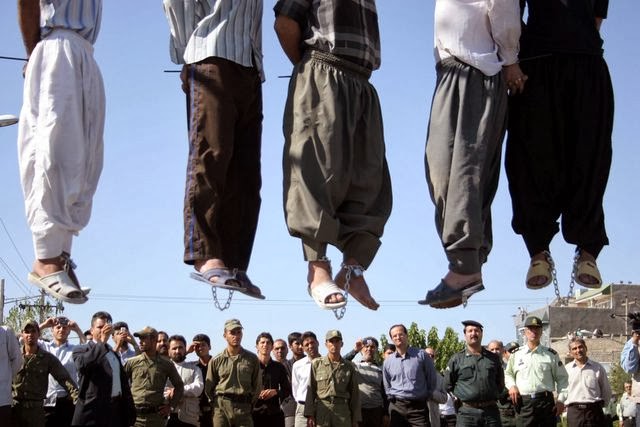
Iranian executions spiking despite thaw with West, ‘moderate president’
Sources say could mean power struggle in Tehran
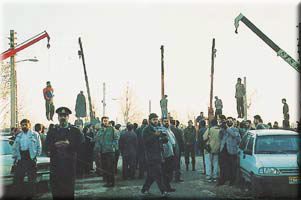
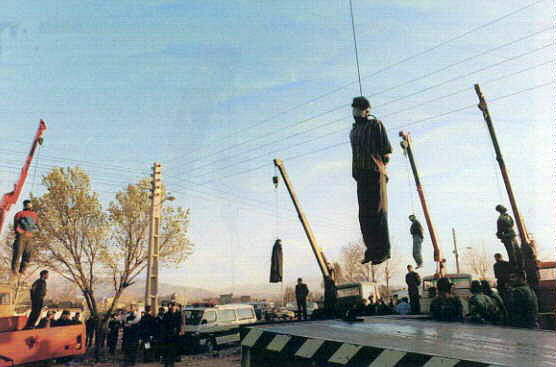
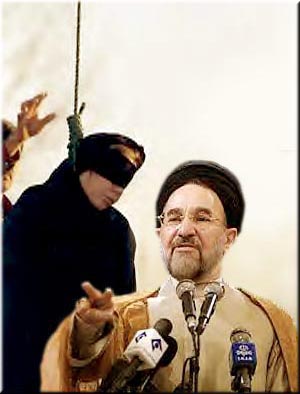
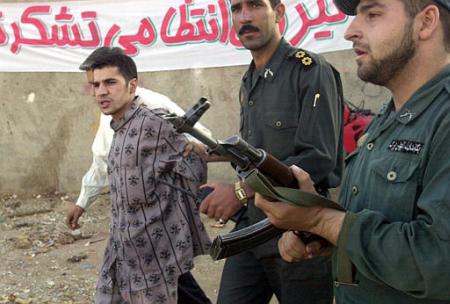
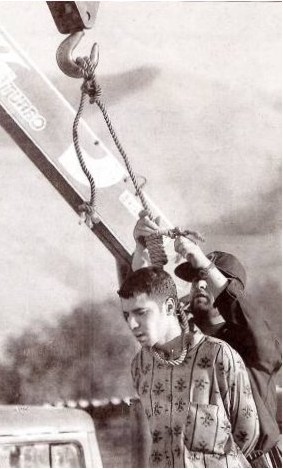
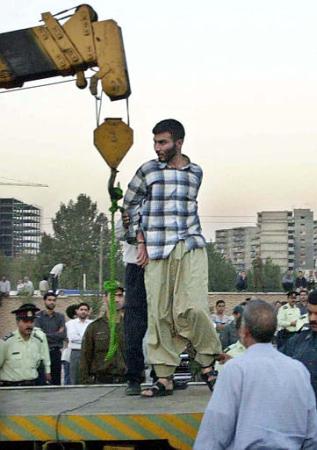
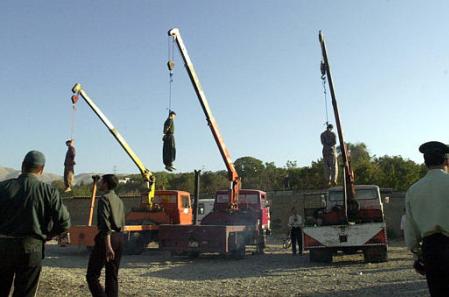
The number of executions carried out by Iranian authorities — often hanging dubiously convicted citizens from construction cranes in public — has risen sharply since President Hassan Rouhani took office in August, a surge most likely because of a secret power struggle within Iran’s notoriously veiled political system.While the situation is complex, and there are many factions with competing agendas on all sides, the one constant factor that does not seem to change, is that the Supreme Leader Ayatollah Ali Khamenei is always in charge, and pulling all the strings. And I'll bet he is nervous, lest he end up like Mubarak or Qaddafi or any number of other deposed Dictators.
Away from positive news coverage of the Obama administration’s push for nuclear detente with Iran, the Islamic republic is executing about 66 people per month, 19 more per month than during the 2-year period before Mr. Rouhani took office, according to an analysis of figures compiled by nonpartisan groups including Amnesty International, the Iran Human Rights Documentation Center and various Iranian opposition activists in Washington.
Critics of the nuclear deal are citing the executions as evidence that Mr. Rouhani is far from the moderate reformer that many portrayed him to be upon his ascension to the presidency.
But U.S. intelligence sources, human rights advocates and high-level sources on Capitol Hill caution against jumping to that conclusion. In interviews with The Washington Times, several sources said reasons for the surge in executions are complex.
“There are indications that the Iranian regime is executing more people now compared to just a year ago,” one U.S. intelligence official told The Times on the condition of anonymity in order to speak freely about sensitive issues. “But it’s difficult to identify any overarching political strategy behind Tehran’s actions.”
Mr. Rouhani may have a political mandate from Iran’s supreme leader, Ayatollah Ali Khamenei, to thaw relations with the West. But sources say the president may have limited control over the nation’s judiciary, where decisions are made by other players — including Islamist hard-liners with mandates of their own from Ayatollah Khamenei.
A leading theory is that the leader of the Iranian judiciary, Sadeq Larijani, is green-lighting more executions in an attempt to smear Mr. Rouhani’s image as a moderate. The spike in hangings also may result from Ayatollah Khamenei’s desire to hammer home to Iranians that the mullahs’ grip on society remains tight — even if Mr. Rouhani is seen to be spreading the rhetoric of reform on the world stage.
Human rights outrage
Either way, human rights advocates say, Iran is flagrantly violating international law.
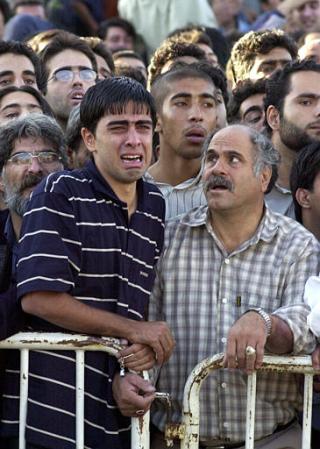
After Amnesty International’s claim that 33 people were hanged in a single week last month, the top human rights office at the United Nations noted that “28 women and a number of political prisoners” were among those executed in 2013. The office also said the killings were based on convictions that do not meet the “most serious crimes” threshold under international law.
“The persistent execution of individuals for exercising their rights to freedom of assembly, association and affiliation to minority groups contravenes universally accepted human rights principles and norms,” said Ahmed Shaheed, U.N. special rapporteur for the situation of human rights in Iran.
[...]
Some believe Iran’s executions will derail prospects for a long-term thaw in relations with West.
“Iranian authorities’ attempts to change their international image are meaningless if at the same time executions continue to increase,” said Hassiba Hadj Sahraoui, a deputy director at Amnesty International, which opposes all executions everywhere.
The situation is adding to unease in Washington, where lawmakers are split over the recent push for diplomacy with Tehran. Most Democrats, including Sen. Dianne Feinstein of California, who heads the Senate Select Committee on Intelligence, call for patience while nuclear negotiations proceed.
Many Republicans say Tehran simply can’t be trusted.
“History has taught us that we are not dealing with an honest broker,” Rep. George Holding, North Carolina Republican and member of the House Committee on Foreign Affairs, said on the House floor last week. “The election of President Rouhani does nothing to change the fact that the supreme leader is still in charge.”
Others argue that Mr. Rouhani is under immense pressure, walking a tightrope between easing tensions with the West and preventing disruption inside Iran.
“We’re clearly seeing a power struggle playing out in Iran between the hard-liners, who aren’t willing to compromise an inch on the nuclear program, and Rouhani, who has placed great emphasis on engagement with the West,” said Rep. Eliot L. Engel of New York, the ranking Democrat on the House Committee on Foreign Affairs.
“The hard-liners,” Mr. Engel told The Times, “are willing to do what it takes to sully the image of Rouhani in the eyes of the West.”
The Larijani theory
The U.S. intelligence official said Iranian Judiciary Chief Sadeq Larijani “could be trying to send a message that tolerance has its limits.”
Iranian sources highlight Mr. Larijani as the face of Tehran’s resistance to international criticism over executions. He responded harshly to the United Nations last week, declaring at a meeting with religious and political leaders in Iran that the Islamic republic “will never cave to this type of pressure” from Western-backed entities, according to a report by Al-Monitor, which cited a pro-regime Persian-language website as its source.
There are signs that some in Mr. Rouhani’s inner circle are at odds with Mr. Larijani and have been angered by the executions. As hangings spiked in November, Ali Younesi, a reformist member of Iran’s parliament and Mr. Rouhani’s special assistant in ethnic and minority affairs, said “extremist elements” in the government were responsible.
His comments were cited by the New York-based International Campaign for Human Rights in Iran, which said “sources close to the Rouhani government” privately claimed that some executions were “actions as sabotage.”
According to those sources, the execution surge is “intended to deprive the government of the chance to present a more positive portrayal of Iran on the international arena, and to discredit Rouhani and his team, casting doubt on whether he is able to deliver his campaign promises to safeguard the nation’s basic rights.”
But the extent to which blame should fall on Mr. Larijani is not clear. Another source who spoke with The Times said human rights advocates may be overlooking evidence of closeness between the judiciary chief and Mr. Rouhani.
One of Mr. Larijani’s brothers is parliament Chairman Ali Larijani, who is believed to be closely aligned with Mr. Rouhani in the push for a nuclear deal with the West.
Others point out that Mr. Rouhani named Mostafa Pourmohammadi in August to become justice minister. At the time, Human Rights Watch noted that Mr. Pourmohammadi, previously a deputy intelligence minister, has long been implicated in the government’s 1988 executions of thousands of political dissidents, as well as the assassinations of several intellectuals in 1998.
Supreme leader’s power
Overanalysis of the politics behind the spike in executions may be irrelevant, said some Iran analysts. They said that whatever is playing out in Tehran is occurring beneath the gaze of the supreme leader — the only figure truly capable of changing the nation’s policies.
After Tehran’s violent crackdown on pro-reform demonstrators in 2009, it has been a common perception in Washington that widespread public frustration burns deeply beneath the Islamic republic’s surface.
“At times of widespread popular discontent, the regime in Tehran uses executions, in particular public hanging of convicts, as a means of terrorizing the public and reminding Iranians of the power of the central government,” said Ali Alfoneh, a researcher at the Foundation for Defense of Democracies specializing in the inner workings of the Iranian regime.
“Therefore,” Mr. Alfoneh said, “the rise in the number of executions signifies both popular discontent and the regime’s nervousness.” [...]
Iran has a high number of young, restless, unemployed people, who want change. Killing large numbers of them is one way to try to keep them under control. Meanwhile:

Iran stocks are booming, and nuclear talks are why
As Iran's government and a group of global powers creep forward on talks about easing economic sanctions slapped on that country, the Iranian street is showing signs of breaking free from the economic stagnation that has crippled the country for years.I have mixed feeling about all this. On the one hand, if foreign in vestment were to pour into Iran, in theory, that would give the West some leverage with Iran, by tying Irans economy and prosperity in with Western Markets.
Iran and the United States, United Kingdom, France, Russia, China and Germany agreed on Thursday to a timeline and framework for further talks next month on restraining the Islamic state's nuclear ambitions. At the same time, United Nations inspectors have reported improved access to Iran's nuclear facilities.
All parties involved continue to warn that serious differences remain in the talks, and hopes for a final deal by July have been called ambitious.
[...]
Despite the market's rise, there are lingering questions about the economy. Inflation has lowered somewhat, but it still comes in at a staggering 35 percent a year. Rabii said he's optimistic, however, that the new government understands the economy and that inflation will be in the 20 percent range next year as a result.
Unemployment is also relatively high: Government estimates put it at 12 percent. However that's much lower than many European countries that were caught up in the financial crisis.
Economists who follow Iran add that it has a young and well-educated population. Because jobs have been hard to come by, many young people have chosen to stay in school and earn higher degrees. Many analysts believe Iran will be eager to attract new foreign investment in order to create jobs for the up-and-coming segment of the population.
Alireza Nader, an Iran expert for the think tank Rand Corp., is one of those analysts. Nader said he sees evidence that Iran's economy has improved since the initial November deal. Still, he noted, most of the sanctions levied against Iran over its nuclear program remain intact.
"Iran is losing more money than it is earning, especially since it can't export all of its oil," Nader said. He agreed with Rabii that confidence in the new government of President Hassan Rouhani is helping the public's mood and giving strength to the Iranian currency, the rial.
Cliff Kupchan, who studies Iran for the Eurasia Group, told CNBC that he sees an immediate improvement in Iran's economy since the initial deal was reached about three months ago. But he said Iran's economic gains would be cut if a nuclear deal falls through and full sanctions are restored.
"The rial would plummet again, Iran's deficit would grow, access to foreign cash reserves would vanish, I think most of the gains Iran has seen would disappear," he said.
Turquoise's Rabii agreed that a deal would help Iran's financial situation more than an impasse would. [...]
I say "in theory", because whatever seems to be happening in Iran, it's always the Supreme Leader who is in charge. He could welcome Western investment in Iran, to build up and strengthen it's economy, and then at some point confiscate those assets and throw the Westerners out, as Iran has done in the past. If they could use those new assets and corresponding strength to then wage war against Iraq, or otherwise gain access to Iraq's oilfields, they could disregard the West completely, as they would then be in a position of great power, and could pursue their nuclear ambitions without restraint.
That is the danger of allowing Iran to strengthen, while the Supreme Leader Khamenei is still in charge. His agenda is his own. It seems to me unwise to risk encouraging or advancing it. And look and see what "reform" means in Iran currently.
We have to ask ourselves, is this is a country we wish to strengthen? We kept pressure on the former Soviet Union until it self-destructed. Should we not do the same here?
Some of my previous posts about Iran:
Is it time for regime change in Iran yet?
Iran, under the surface... is it crumbling?
Hangings in Iran increase, to silence dissent
Iran's pressing needs and Iraq's vulnerability.
Purging Western Influences from Islamic minds
Iranian Fashion Police Publicly Bludgeon Women
Amadinejad talks crazy on Iranian TV, with help from a "Death to Amercia" chorus
Amadinejad supports Pop Islam, Iranian nationalism, to serve the goal of Martydom