Showing posts sorted by date for query iran nuclear. Sort by relevance Show all posts

Monday, January 18, 2016

Is this what successful foreign policy looks like?

Yes. Successful for Iran:
This humiliating Iran photo says it all
The Obama administration, the mainstream media and Democrats more generally vastly underestimate the potency of the photos and videos showing our Navy sailors on their knees with hands behind their heads as they are taken into custody by the Iranians. It is the perfect embodiment of what many Americans see as the humiliation suffered by the United States under this president as our adversities defy us and take advantage at every turn. To then have the utterly tone-deaf Secretary of State John Kerry insist that we did not apologize, but then publicly thank Iran, is even worse. And to top it off, we have film of our sailors held captive, compelled to apologize. The sole female sailor apparently was compelled to don a head covering.

This, according to President Obama and Hillary Clinton, is what a successful Iran policy looks like. No wonder Donald Trump, who speaks to the rage Americans feel about our declining respect in the world, is striking a chord.

[...]

The White House won’t dream of making a fuss, not when it so desperately wants to lift sanctions on Iran and push forward on the Iran nuclear deal, the very deal that has emboldened Iran to engage in stunts like this one. Oh, the administration is going to be “looking into the videos and would respond if the U.S. determined that the sailors were treated inappropriately.” Don’t hold your breath.

This is a propaganda bonanza for Tehran, one that it will exploit to the hilt to make clear to its allies and those it seeks to intimidate that the United States is weak, unreliable and useless. It furthers their ambitions in the region and demoralizes those resisting Iranian aggression. For countries and individuals on the fence (e.g. the Sunni tribes), the message is clear: You really want to stick your neck out for the Americans?

Bizarrely, Kerry thinks this shows how terrific our new relationship with Iran is because, you know, we got our people back. By continuing to act in effect as a PR flack for Tehran, Kerry invites further aggression and endangers our own troops and those of our allies. Be prepared to see Iran’s conduct become infinitely more audacious once it has pocketed more than $100 billion in sanctions relief. [...]
Read the whole thing for links and more. And get used to it. It's the Democrats Foreign Policy, and it's not going to change anytime soon.


Saturday, August 23, 2014

USB Devices and Malware Attacks

New Flaws in USB Devices Let Attackers Install Malware: Black Hat
[...] In a blog post providing more insight into the talk, Nohl and Lell reveal that the root trigger for their USB exploitation technique is by abusing and reprogramming the USB controller chips, which are used to define the device type. USB is widely used for all manner of computer peripherals as well as in storage devices. The researchers alleged that the USB controller chips in most common flash drives have no protection against reprogramming.

"Once reprogrammed, benign devices can turn malicious in many ways," the researchers stated.

Some examples they provide include having an arbitrary USB device pretend to be a keyboard and then issue commands with the same privileges as the logged-in user. The researchers contend that detecting the malicious USB is hard and malware scanner similarly won't detect the issue.

I'm not surprised, and no one else should be, either. After all, this isn't the first time researchers at a Black Hat USA security conference demonstrated how USB can be used to exploit users.

Last year, at the Black Hat USA 2013 event, security researchers demonstrated the MACTANS attack against iOS devices. With MACTANS, an Apple iOS user simply plugs in a USB plug in order to infect Apple devices. Apple has since patched that flaw.

In the MACTANS case, USB was simply used as the transport cable for the malware, but the point is the same. Anything you plug into a device, whether it's a USB charger, keyboard or thumb drive has the potential to do something malicious. A USB thumb drive is widely speculated to be the way that the Stuxnet virus attacked Iran's nuclear centrifuges back in 2010. The U.S. National Security Agency (NSA) allegedly has similar USB exploitation capabilities in its catalog of exploits, leaked by whistleblower Edward Snowden.

While the Security Research Labs researchers claim there are few defenses, the truth is somewhat different.

A reprogrammed USB device can have certain privileges that give it access to do things it should not be able to do, but the bottom line is about trust. On a typical Windows system, USB devices are driven by drivers that are more often than not signed by software vendors. If a warning pops up on a user's screen to install a driver, or that an unsigned driver is present, that should be a cause for concern.

As a matter of best practice, don't plug unknown USB devices into your computing equipment. It's just common sense, much like users should not open attachments that look suspicious or click on unknown links. The BadUSB research at this year's Black Hat USA conference is not as much a wake-up call for USB security as it is a reminder of risks that have been known for years


Saturday, February 22, 2014

A more moderate Iran?

That's the Image they are trying to project on the world stage. But what's going on at home?


Iranian executions spiking despite thaw with West, ‘moderate president’
Sources say could mean power struggle in Tehran
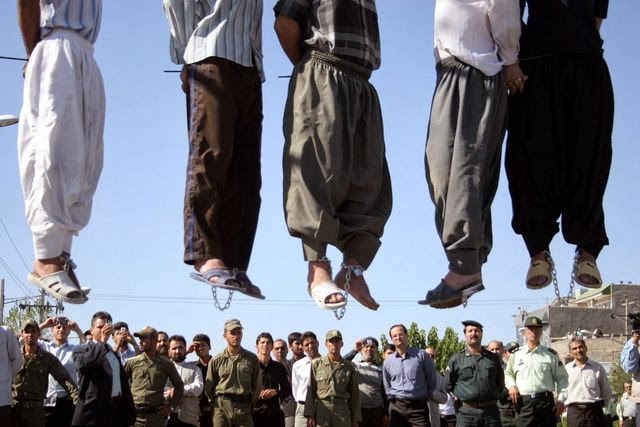
The number of executions carried out by Iranian authorities — often hanging dubiously convicted citizens from construction cranes in public — has risen sharply since President Hassan Rouhani took office in August, a surge most likely because of a secret power struggle within Iran’s notoriously veiled political system.

Away from positive news coverage of the Obama administration’s push for nuclear detente with Iran, the Islamic republic is executing about 66 people per month, 19 more per month than during the 2-year period before Mr. Rouhani took office, according to an analysis of figures compiled by nonpartisan groups including Amnesty International, the Iran Human Rights Documentation Center and various Iranian opposition activists in Washington.

Critics of the nuclear deal are citing the executions as evidence that Mr. Rouhani is far from the moderate reformer that many portrayed him to be upon his ascension to the presidency.

But U.S. intelligence sources, human rights advocates and high-level sources on Capitol Hill caution against jumping to that conclusion. In interviews with The Washington Times, several sources said reasons for the surge in executions are complex.

“There are indications that the Iranian regime is executing more people now compared to just a year ago,” one U.S. intelligence official told The Times on the condition of anonymity in order to speak freely about sensitive issues. “But it’s difficult to identify any overarching political strategy behind Tehran’s actions.”

Mr. Rouhani may have a political mandate from Iran’s supreme leader, Ayatollah Ali Khamenei, to thaw relations with the West. But sources say the president may have limited control over the nation’s judiciary, where decisions are made by other players — including Islamist hard-liners with mandates of their own from Ayatollah Khamenei.

A leading theory is that the leader of the Iranian judiciary, Sadeq Larijani, is green-lighting more executions in an attempt to smear Mr. Rouhani’s image as a moderate. The spike in hangings also may result from Ayatollah Khamenei’s desire to hammer home to Iranians that the mullahs’ grip on society remains tight — even if Mr. Rouhani is seen to be spreading the rhetoric of reform on the world stage.

Human rights outrage

Either way, human rights advocates say, Iran is flagrantly violating international law.

After Amnesty International’s claim that 33 people were hanged in a single week last month, the top human rights office at the United Nations noted that “28 women and a number of political prisoners” were among those executed in 2013. The office also said the killings were based on convictions that do not meet the “most serious crimes” threshold under international law.

“The persistent execution of individuals for exercising their rights to freedom of assembly, association and affiliation to minority groups contravenes universally accepted human rights principles and norms,” said Ahmed Shaheed, U.N. special rapporteur for the situation of human rights in Iran.

[...]

Some believe Iran’s executions will derail prospects for a long-term thaw in relations with West.

“Iranian authorities’ attempts to change their international image are meaningless if at the same time executions continue to increase,” said Hassiba Hadj Sahraoui, a deputy director at Amnesty International, which opposes all executions everywhere.

The situation is adding to unease in Washington, where lawmakers are split over the recent push for diplomacy with Tehran. Most Democrats, including Sen. Dianne Feinstein of California, who heads the Senate Select Committee on Intelligence, call for patience while nuclear negotiations proceed.

Many Republicans say Tehran simply can’t be trusted.

“History has taught us that we are not dealing with an honest broker,” Rep. George Holding, North Carolina Republican and member of the House Committee on Foreign Affairs, said on the House floor last week. “The election of President Rouhani does nothing to change the fact that the supreme leader is still in charge.”

Others argue that Mr. Rouhani is under immense pressure, walking a tightrope between easing tensions with the West and preventing disruption inside Iran.

“We’re clearly seeing a power struggle playing out in Iran between the hard-liners, who aren’t willing to compromise an inch on the nuclear program, and Rouhani, who has placed great emphasis on engagement with the West,” said Rep. Eliot L. Engel of New York, the ranking Democrat on the House Committee on Foreign Affairs.

“The hard-liners,” Mr. Engel told The Times, “are willing to do what it takes to sully the image of Rouhani in the eyes of the West.”

The Larijani theory

The U.S. intelligence official said Iranian Judiciary Chief Sadeq Larijani “could be trying to send a message that tolerance has its limits.”

Iranian sources highlight Mr. Larijani as the face of Tehran’s resistance to international criticism over executions. He responded harshly to the United Nations last week, declaring at a meeting with religious and political leaders in Iran that the Islamic republic “will never cave to this type of pressure” from Western-backed entities, according to a report by Al-Monitor, which cited a pro-regime Persian-language website as its source.

There are signs that some in Mr. Rouhani’s inner circle are at odds with Mr. Larijani and have been angered by the executions. As hangings spiked in November, Ali Younesi, a reformist member of Iran’s parliament and Mr. Rouhani’s special assistant in ethnic and minority affairs, said “extremist elements” in the government were responsible.

His comments were cited by the New York-based International Campaign for Human Rights in Iran, which said “sources close to the Rouhani government” privately claimed that some executions were “actions as sabotage.”

According to those sources, the execution surge is “intended to deprive the government of the chance to present a more positive portrayal of Iran on the international arena, and to discredit Rouhani and his team, casting doubt on whether he is able to deliver his campaign promises to safeguard the nation’s basic rights.”

But the extent to which blame should fall on Mr. Larijani is not clear. Another source who spoke with The Times said human rights advocates may be overlooking evidence of closeness between the judiciary chief and Mr. Rouhani.

One of Mr. Larijani’s brothers is parliament Chairman Ali Larijani, who is believed to be closely aligned with Mr. Rouhani in the push for a nuclear deal with the West.

Others point out that Mr. Rouhani named Mostafa Pourmohammadi in August to become justice minister. At the time, Human Rights Watch noted that Mr. Pourmohammadi, previously a deputy intelligence minister, has long been implicated in the government’s 1988 executions of thousands of political dissidents, as well as the assassinations of several intellectuals in 1998.

Supreme leader’s power

Overanalysis of the politics behind the spike in executions may be irrelevant, said some Iran analysts. They said that whatever is playing out in Tehran is occurring beneath the gaze of the supreme leader — the only figure truly capable of changing the nation’s policies.

After Tehran’s violent crackdown on pro-reform demonstrators in 2009, it has been a common perception in Washington that widespread public frustration burns deeply beneath the Islamic republic’s surface.

“At times of widespread popular discontent, the regime in Tehran uses executions, in particular public hanging of convicts, as a means of terrorizing the public and reminding Iranians of the power of the central government,” said Ali Alfoneh, a researcher at the Foundation for Defense of Democracies specializing in the inner workings of the Iranian regime.

“Therefore,” Mr. Alfoneh said, “the rise in the number of executions signifies both popular discontent and the regime’s nervousness.” [...]
While the situation is complex, and there are many factions with competing agendas on all sides, the one constant factor that does not seem to change, is that the Supreme Leader Ayatollah Ali Khamenei is always in charge, and pulling all the strings. And I'll bet he is nervous, lest he end up like Mubarak or Qaddafi or any number of other deposed Dictators.

Iran has a high number of young, restless, unemployed people, who want change. Killing large numbers of them is one way to try to keep them under control. Meanwhile:


Iran stocks are booming, and nuclear talks are why
As Iran's government and a group of global powers creep forward on talks about easing economic sanctions slapped on that country, the Iranian street is showing signs of breaking free from the economic stagnation that has crippled the country for years.

Iran and the United States, United Kingdom, France, Russia, China and Germany agreed on Thursday to a timeline and framework for further talks next month on restraining the Islamic state's nuclear ambitions. At the same time, United Nations inspectors have reported improved access to Iran's nuclear facilities.

All parties involved continue to warn that serious differences remain in the talks, and hopes for a final deal by July have been called ambitious.

[...]

Despite the market's rise, there are lingering questions about the economy. Inflation has lowered somewhat, but it still comes in at a staggering 35 percent a year. Rabii said he's optimistic, however, that the new government understands the economy and that inflation will be in the 20 percent range next year as a result.

Unemployment is also relatively high: Government estimates put it at 12 percent. However that's much lower than many European countries that were caught up in the financial crisis.

Economists who follow Iran add that it has a young and well-educated population. Because jobs have been hard to come by, many young people have chosen to stay in school and earn higher degrees. Many analysts believe Iran will be eager to attract new foreign investment in order to create jobs for the up-and-coming segment of the population.

Alireza Nader, an Iran expert for the think tank Rand Corp., is one of those analysts. Nader said he sees evidence that Iran's economy has improved since the initial November deal. Still, he noted, most of the sanctions levied against Iran over its nuclear program remain intact.

"Iran is losing more money than it is earning, especially since it can't export all of its oil," Nader said. He agreed with Rabii that confidence in the new government of President Hassan Rouhani is helping the public's mood and giving strength to the Iranian currency, the rial.

Cliff Kupchan, who studies Iran for the Eurasia Group, told CNBC that he sees an immediate improvement in Iran's economy since the initial deal was reached about three months ago. But he said Iran's economic gains would be cut if a nuclear deal falls through and full sanctions are restored.

"The rial would plummet again, Iran's deficit would grow, access to foreign cash reserves would vanish, I think most of the gains Iran has seen would disappear," he said.

Turquoise's Rabii agreed that a deal would help Iran's financial situation more than an impasse would. [...]
I have mixed feeling about all this. On the one hand, if foreign in vestment were to pour into Iran, in theory, that would give the West some leverage with Iran, by tying Irans economy and prosperity in with Western Markets.

I say "in theory", because whatever seems to be happening in Iran, it's always the Supreme Leader who is in charge. He could welcome Western investment in Iran, to build up and strengthen it's economy, and then at some point confiscate those assets and throw the Westerners out, as Iran has done in the past. If they could use those new assets and corresponding strength to then wage war against Iraq, or otherwise gain access to Iraq's oilfields, they could disregard the West completely, as they would then be in a position of great power, and could pursue their nuclear ambitions without restraint.

That is the danger of allowing Iran to strengthen, while the Supreme Leader Khamenei is still in charge. His agenda is his own. It seems to me unwise to risk encouraging or advancing it. And look and see what "reform" means in Iran currently.

We have to ask ourselves, is this is a country we wish to strengthen? We kept pressure on the former Soviet Union until it self-destructed. Should we not do the same here?


Some of my previous posts about Iran:


Is it time for regime change in Iran yet?

Iran, under the surface... is it crumbling?

Hangings in Iran increase, to silence dissent

Iran's pressing needs and Iraq's vulnerability.

Purging Western Influences from Islamic minds

Iranian Fashion Police Publicly Bludgeon Women

Amadinejad talks crazy on Iranian TV, with help from a "Death to Amercia" chorus

Amadinejad supports Pop Islam, Iranian nationalism, to serve the goal of Martydom


Saturday, September 08, 2012

Canada severing ties with Iran

Canada closes embassy in Iran, gives Iranian diplomats in Canada 5 days to leave
TORONTO — Canada shut its embassy in Tehran on Friday, severed diplomatic relations and ordered Iranian diplomats to leave, accusing the Islamic Republic of being the most significant threat to world peace. The surprise action reinforces the Conservative government’s close ties with Tehran’s arch foe Israel but also removes some of Washington’s eyes and ears inside the Iranian capital.

[...]
Baird said Canada was officially designating Iran a state sponsor of terrorism and gave a long list of reasons for Canada’s decision, including Tehran’s support for Syria’s embattled President Bashar Assad in that country’s civil war.
“The Iranian regime is providing increasing military assistance to the Assad regime; it refuses to comply with U.N. resolutions pertaining to its nuclear program; it routinely threatens the existence of Israel and engages in racist anti-Semitic rhetoric and incitement to genocide,” Baird said in a statement. “It is among the world’s worst violators of human rights; and it shelters and materially supports terrorist groups.”
Baird said he also was worried about the safety of diplomats in Tehran following attacks on the British embassy there.
Britain downgraded ties with Iran following an attack on its embassy in Tehran in November 2011, which it insists was sanctioned by the Islamic Republic’s ruling elite. After the attack, Britain pulled all of its diplomats out of Iran and expelled Iranian diplomats from U.K. soil.
Most European countries maintain a diplomatic presence in Tehran despite increased tensions over European Union sanctions that block imports of Iranian oil. The Swiss represent diplomatic interests of the United States, which broke ties with Tehran after protesters stormed the U.S. Embassy in the chaotic months following the Islamic Revolution in 1979. Fifty-two Americans were held for 444 days. [...]
   

Sunday, February 05, 2012

Is lsrael really ready to strike Iran? Why now?

Just a bluff? Fears grow of Israeli attack on Iran
[...] Is Israel bluffing? Israeli leaders have been claiming Iran is pursuing nuclear weapons since the early 1990s, and defense officials have issued a series of ever-changing estimates on how close Iran is to the bomb. But the saber-rattling has become much more direct and vocal.

[...]

Israel views Iran as a mortal threat, citing Iranian calls for Israel's destruction, Iran's support for anti-Israel militant groups and Iranian missile technology capable of hitting Israel.

On Friday, Iran's supreme leader, Ayatollah Ali Khamenei, called Israel a "cancerous tumor that should be cut and will be cut," and boasted of supporting any group that will challenge the Jewish state.

When faced with such threats, Israeli has a history of lashing out in the face of world opposition. That legacy that includes the game-changing 1967 Middle East war, which left Israel in control of vast Arab lands, a brazen 1981 airstrike that destroyed an unfinished Iraqi nuclear reactor, and a stealthy 2007 airstrike in Syria that is believed to have destroyed a nuclear reactor in the early stages of construction.

Armed with a fleet of ultramodern U.S.-made fighter planes and unmanned drones, and reportedly possessing intermediate-range Jericho missiles, Israel has the capability to take action against Iran too, though it would carry grave risks.

It would require flying over Jordan, Saudi Arabia, Iraq, Syria or Turkey. It is uncertain whether any of these Muslim countries would knowingly allow Israel to use their airspace.

With targets some 1,000 miles (1,600 kilometers) away, Israeli planes would likely have the complicated task of refueling in flight. Iran's antiquated air force, however, is unlikely to provide much of a challenge.

Many in the region cannot believe Israel would take such a step without a green light from the United States, its most important ally. That sense is deepened by the heightened stakes of a U.S. election year and the feeling that if Israel acts alone, the West would not escape unscathed.

The U.S. has been trying to push both sides, leading the charge for international sanctions while also pressing Israel to give the sanctions more time. In recent weeks, both the U.S. and European Union have imposed harsher sanctions on Iran's oil sector, the lifeblood of its economy, and its central bank. Israeli officials say they want the sanctions to be imposed faster and for more countries to join them.

Last week, The Associated Press reported that officials in Israel — all of whom spoke on condition of anonymity because they were not authorized to discuss Iran — were concerned that the measures, while welcome, were constraining Israel in its ability to act because the world expected the effort to be given a chance.

Even a limited Israeli operation could well unleash regionwide fighting. Iran could launch its Shihab 3 missiles at Israel, and have its local proxies, Hezbollah in Lebanon and Hamas in the Gaza Strip, unleash rockets. Israel's military intelligence chief, Aviv Kochavi, warned last week that Israel's enemies possess some 200,000 rockets.

While sustained rocket and missile fire would certainly make life uncomfortable in Israel, Barak himself has said he believes casualties would be low — suggesting it would be in the hundreds.

Iran might also try to attack Western targets in the region, including the thousands of U.S. forces based in the Gulf with the 5th Fleet.

An Israeli attack might have other unintended consequences. A European diplomat based in Pakistan, permitted to speak only under condition of anonymity, said that if Israel attacks, Islamabad will have no choice but to support any Iranian retaliation. That raises the specter of putting a nuclear-armed Pakistan at odds with Israel, widely believed to have its own significant nuclear arsenal.

To some, the greatest risk is to the moribund world economy.

Analysts believe an Israeli attack would cause oil prices to spike, since global markets so far have largely dismissed the Israeli threats and not "price in" the threat. According to one poll conducted by the Rapidan Group, an energy consulting firm in Bethesda, Maryland, prices would surge by $23 a barrel. The price of oil settled Friday at $97.84 a barrel.

"Traders don't believe there's anything but bluster going on," said Robert McNally, president of Rapidan and an energy adviser to former President George W. Bush. "A potential Israeli attack on Iran is different than almost every scenario that we've seen before."

McNally said Iran could rattle oil markets by targeting oil fields in southern Iraq or export facilities in Saudi Arabia or Qatar — and withhold sales of its own oil and natural gas from countries not boycotting.

Iran also could attempt to carry out its biggest threat: to shut the Strait of Hormuz, a strategic waterway through which a fifth of the world's oil passes. That could send oil prices soaring beyond $200 a barrel. But analysts note Iran's navy is overmatched.

If a surge in oil prices proved lasting, financial markets would probably plummet on concerns that global economic growth would slow and on the fear that any conflict could worsen and spread.

For the U.S. economy, higher gasoline prices would likely result in lower consumer spending, which accounts for 70 percent of U.S. economic activity. That could have devastating consequences for an incumbent president seeking re-election.

Nick Witney, former head of the EU's European Defense Agency, said "the political and economic consequences of an Israeli attack would be catastrophic for Europe" since the likely spike in the price of oil alone "could push the entire EU, including Germany, into recession."

He said this could lead to "messy defaults" by countries like Greece and Italy, and possibly cause a collapse of the already-wobbly euro. Witney, a senior fellow at the European Council on Foreign Relations, added that "the Iranians would probably retaliate against European interests in the region, and conceivably more directly with terrorism aimed at Western countries and societies."

Oil disruptions or higher oil prices will also dent growth in Asia. China, India, South Korea and Japan all buy substantial amounts of Iranian crude and could face temporary shortages.

China's fast-growing economy, which gets 11 percent of its oil from Iran, has urged all sides to avoid disrupting supplies. Any impact on China's economy, the world's second-largest, could send out global shockwaves if it dented Chinese demand for industrial components and raw materials.

Why is the issue coming to a head with such unfortunate timing, with the U.S. election looming and the global economy hanging by a razor's edge?

The urgency is fueled by a belief in Israel that Iran is moving centrifuges and key installations deep underground by the summer — combined with doubts about whether either Israel or the United States have the bunker-busting capacity to act effectively thereafter. [...]

But the global repercussions of trying to stop it, are enormous. Could the be a case of the cure being worse than the disease?
     

Tuesday, October 25, 2011

The Next Level of Cyber Terrorism?

Are we there yet? See what you think:

Science fiction-style sabotage a fear in new hacks
[...] For years, ill-intentioned hackers have dreamed of plaguing the world's infrastructure with a brand of sabotage reserved for Hollywood. They've mused about wreaking havoc in industrial settings by burning out power plants, bursting oil and gas pipelines, or stalling manufacturing plants.

But a key roadblock has prevented them from causing widespread destruction: they've lacked a way to take remote control of the electronic "controller" boxes that serve as the nerve centers for heavy machinery.

The attack on Iran changed all that. Now, security experts — and presumably, malicious hackers — are racing to find weaknesses. They've found a slew of vulnerabilities.

Think of the new findings as the hacking equivalent of Moore's Law, the famous rule about computing power that it roughly doubles every couple of years. Just as better computer chips have accelerated the spread of PCs and consumer electronics over the past 40 years, new hacking techniques are making all kinds of critical infrastructure — even prisons — more vulnerable to attacks.

One thing all of the findings have in common is that mitigating the threat requires organizations to bridge a cultural divide that exists in many facilities. Among other things, separate teams responsible for computer and physical security need to start talking to each other and coordinate efforts.

Many of the threats at these facilities involve electronic equipment known as controllers. These devices take computer commands and send instructions to physical machinery, such as regulating how fast a conveyor belt moves.

They function as bridges between the computer and physical worlds. Computer hackers can exploit them to take over physical infrastructure. Stuxnet, for example, was designed to damage centrifuges in the nuclear plant being built in Iran by affecting how fast the controllers instructed the centrifuges to spin. Iran has blamed the U.S. and Israel for trying to sabotage what it says is a peaceful program.

Security researcher Dillon Beresford said it took him just two months and $20,000 in equipment to find more than a dozen vulnerabilities in the same type of electronic controllers used in Iran. The vulnerabilities, which included weak password protections, allowed him to take remote control of the devices and reprogram them.

"What all this is saying is you don't have to be a nation-state to do this stuff. That's very scary," said Joe Weiss, an industrial control system expert. "There's a perception barrier, and I think Dillon crashed that barrier."

One of the biggest makers of industrial controllers is Siemens AG, which made the controllers in question. The company said it has alerted customers, fixed some of the problems and is working closely with CERT, the cybersecurity arm of the U.S. Department of Homeland Security.

Siemens said the issue largely affects older models of controllers. Even with those, the company said, a hacker would have to bypass passwords and other security measures that operators should have in place. Siemens said it knows of no actual break-ins using the techniques identified by Beresford, who works in Austin, Texas, for NSS Labs Inc.,

Yet because the devices are designed to last for decades, replacing or updating them isn't always easy. And the more research that comes out, the more likely attacks become.

One of the foremost Stuxnet experts, Ralph Langner, a security consultant in Hamburg, Germany, has come up with what he calls a "time bomb" of just four lines of programming code. He called it the most basic copycat attack that a Stuxnet-inspired prankster, criminal or terrorist could come up with.

"As low-level as these results may be, they will spread through the hacker community and will attract others who continue digging," Langer said in an email.

The threat isn't limited to power plants. Even prisons and jails are vulnerable. [...]

The complications of the modern age. Our Brave New World.
     

Wednesday, March 31, 2010

Germany Exercises it's Political Muscles

Germany Awakes. Rules of the Game Are Changing in Europe
[...] Germany is refusing to bail out Greece. Earlier this week, Chancellor Merkel told the Bundestag that Greece should be expelled from the eurozone if its financial problems risk dragging the euro down. France and the European Commission in Brussels reacted furiously to this suggestion. Barroso dismissed Merkel’s words as “absurd.” Paris and Brussels insist that the EU come to the financial rescue of Athens. Since most of the money for a rescue operation will have to come from Germany, however, such a decision cannot be taken without Berlin’s approval.

Bullying Berlin does not seem to be a clever move. Merkel’s Bundestag declaration followed shortly after Greek Deputy Prime Minister Theodoros Pangalos had accused the Germans of exploiting the Greek debt crisis for their own financial and economic benefit. “By speculating on Greek bonds at the expense of your friend and partner, by allowing [German] credit institutions to participate in this deplorable game, some people are making money,” the Greek Socialist said. “A cheap euro makes the south of Europe suffer, while German exports benefit.”

Last month, Pangalos had angered the Germans by demanding that Berlin pay reparations for Nazi crimes. “The Nazis took away the Greek gold that was in the Bank of Greece and they never gave it back,” he said. The German Foreign Ministry responded that in 1960 Germany paid Athens 115m German marks in compensation for the Nazi occupation and that “parallel to this, since 1960 Germany has paid around 33bn marks in aid to Greece both bilaterally and in the context of the EU.”

The Germans no longer accept being required to be the EU’s paymasters to atone for their Nazi past. There is also an increase in euroscepticism in German public opinion. While Germany introduced austerity measures and trimmed down its welfare system, countries such as Greece refused to do so, relying on the fact that the EU (read: Germany) would bail them out when they got in trouble in order to save the euro.

In Europe, the political rules of the game are changing. An editorial in Wednesday’s Frankfurter Allgemeine Zeitung (FAZ), Germany’s most influential newspaper, drew attention to the fact that “The biggest member state, which has for so long silently been the guarantee of the EU, has now openly expressed that it is no longer prepared to pay any price for European unification. The present Euro crisis is more than a monetary matter. … The image of [Germany as] the paymaster of Europe, the caricature of the Brussels bureaucracy, and the growing displeasure with the loss of [German] Sovereignty has shaped a eurosceptic fundamental sentiment, into which the Greek debacle has landed like a bomb. No German government today can afford to put the European interest before the German interest, especially not in core issues as monetary policy. And even if it tried, it can reckon on being opposed in the German Constitutional Court.” [...]

Meanwhile, Angela Merkel is making a state visit to Turkey:

Merkel tells Turkey EU talks 'open-ended'
ANKARA — German Chancellor Angela Merkel told Turkey Monday that its membership talks with the European Union did not guarantee accession and urged it to grant trade privileges to EU-member Cyprus.

"The rules of the game have changed" since Turkey first applied to become a member of the bloc five decades ago, Merkel said through an interpreter after talks with Turkish Prime Minister Recep Tayyip Erdogan.

"The (accession) negotiations are an open-ended process. We should now pursue this open-ended process," she added, suggesting that Turkey's integration with the bloc does not have to be full membership.

Along with French President Nicolas Sarkozy, Merkel remains one of the staunchest opponents of Turkey's bid to join the European Union, arguing that a vast, relatively poor country with a mainly Muslim 71-million population has no place in Europe.

She has instead proposed a "privileged partnership" between Turkey and the bloc, an alternative Ankara flatly rejects.

Merkel however stressed the immediate task for Ankara was to open its ports to vessels from Cyprus -- an EU member Ankara does not recognize -- under a customs union accord with the Union.

"The most important issue is the implementation of the protocol... We have to deal with the Cyprus issue. That would be to the benefit of us all," she said.

Turkey's refusal to grant trade privileges to Cyprus has led Brussels to freeze talks in eight of the 35 chapters that candidates must successfully negotiate prior to membership.

Since starting the talks in 2005, Turkey has so far succeeded in opening only 12 chapters.

Merkel also pushed Turkey on Iran, urging it to back Western allies in imposing a possible fresh set of sanctions over Tehran's suspect nuclear activities. [...]

She's pushing for quite a few things. Turkey is still voting against sanctions on Iran. Merkel has made an interesting concession, regarding Turkish schools in Germany. As for Cypress and the rest... it will be interesting to see if she gets anywhere.
     

Thursday, February 11, 2010

Iran continues crushing all opposition

Iran crushes opposition protests with violence
ran’s regime thwarted the opposition’s hopes of turning the 31st anniversary celebrations of the Islamic revolution into another massive protest today.

It out-manoeuvred the so-called Green movement by swamping the official proceedings with huge numbers of its own supporters, preventing the media from covering anything else and blanketing the rest of the capital with security forces who forcefully suppressed the opposition’s relatively muted demonstrations.

President Ahmadinejad also sought to grab the headlines and divert attention from the protests by announcing that Iran had produced its first stock of 20 per cent-enriched uranium. He declared that Iran was now a “nuclear state”.

Opposition websites claimed a young woman named Leila Zareii, was killed and many others were wounded or arrested. The opposition leaders Mehdi Karroubi and Mohammed Khatami - a former president - were attacked, as was Zahra Rahnavard, wife of the Green Movement’s other leader, Mir Hossein Mousavi.

Even Zahra Eshraghi, granddaughter of Ayatollah Ruhollah Khomeini, leader of the 1979 revolution, was briefly arrested. She and her brother, Hassan, are both opposition sympathisers and she is married to Mr Khatami’s brother.

[...]

Opposition websites said Revolutionary Guards and basiji militiamen were stationed everywhere and that they moved swiftly and violently to break up opposition demonstrations.

They claimed the security forces used live ammunition, knives, teargas and paintballs that would enable them to identify protesters later and that they were beating and arresting women as well as men. They were backed up by water canon, new Chinese anti-riot vehicles and helicopters. Some, wearing plain clothes, infiltrated the protesters. The mobile telephone, internet and text messaging systems were seriously disrupted. [...]

Here is further reporting from an Iranian blogger:

Full Account of What Happened to Karroubi the Lion Heart This Morning
Many of Karroubi's known supporters and associates were rounded up in recent days, some were imprisoned and some were forced to make written pledges not to take part in the protests today. Karroubi himself had received such a letter. Despite all this intimidation Karroubi set out to join the protesters at Sadeghieh Sq. at 10:00 am Tehran time as he had promised. From 8:00 am this morning however there were heavy clashes between people and the repressive forces around Sadeghieh Sq. The special units kept dispersing the people but the people kept returning.

Approaching Sadeghieh Sq. Karroubi decided to get out of his car and walk the rest of the way to Sadeghieh Sq. due to heavy car traffic. Around 500 people spontaneously started walking behind Karoubi without any chanting. After they had walked for 200 metres, a large group of hired thugs and Special Units on motor bikes attacked Karroubi and the people around him using machetes, knives and truncheons. They also used tear gas and shot people with paint pellets so that the paint marks would identify them later. The clashes were very severe and lasted 4 to 5 minutes. One of Karroubi's bodyguards was hurt very badly and is in critical condition in hospital. Karroubi was finally whisked away and a car driver offered to take Karroubi away. Hired thugs then spotted the car driver and smashed his windscreen and windows but the driver put his foot down on the accelerator and managed to get away. [...]

Of course the Western Leftists turn a blind eye to it all:

More Treachery by UK Universities

The Iranian regime has many enablers among Western Leftists.
     

Monday, November 16, 2009

"2012" and the on-going End of The World theme

The latest offering, the movie "2012", is out now. Here's a trailer:


Well that's one way to end California's budget crisis. I have to admit, the special effects are great, really stunning. However, you have to wonder; with Hollywood adding to all the "end of the world" hype that the History Channel is also propagating, what is 2012 actually going to be like, with so many people being encouraged to think about it in such a negative, fearful way?

I keep hearing that the Mayan Calender "ends" in 2012. That is the premise for the movie, and much of the blathering on the History Channel. Yet I've also heard, from people who purport to know about such things, that the Mayan calendar runs in cycles, and that 2012 is merely the end of one cycle, and the beginning of another. You sure aren't hearing that from the folks flogging the "end of the world" scenario.

How much "science" is in all of this end of the world twaddle, anyway, where the earth turns on itself, the poles shift, etc.? None that I can see.

Now if you want to talk about HUMAN made problems, 2012 should be an interesting year. Many different sources I've read about the world's financial problems, are coincidentally all predicting a global economic depression and/or collapse, around 2012. And Iran, exporter of terrorism worldwide, should have it's nuclear weapons capability by 2012. And don't forget North Korea.

Unlike phony New Age threats, these are plausible real-world threats. And unlike the bad science of Hollywood movies, these threats can be averted, if we would only pay attention and do what's needed. What are the chances of that?

It seems we'd rather scare ourselves with alarmist New Age rubbish.
     

Wednesday, November 11, 2009

Iran's objectives, and internal political struggle

Here is an interview for CNN with Fareed Zakaria, author and foreign affairs analyst. It starts off about the hikers/hostages, but then Zakaria has some interesting things to say about Iran's internal politics:

Zakaria: No one thinks hikers are spies
[...]

CNN: It's been reported that Ahmadinejad said the U.S. must abandon support for Israel to move ahead on better relations with Iran.

Zakaria: This has been a consistent theme of Ahmadinejad's. We read it too much as an expression of some kind of ideology. What it really is is Ahmadinejad's effort to appropriate, to take over the core central issue of the Arab world -- the Palestinian issue -- and make it his own. Iran is trying to become the dominant power of the Middle East.

It makes it very difficult for Arab countries to be critical of Iran because, on the Arab street, Ahmadinejad is seen as the great upholder of the Palestinian cause. He is trying to keep the Arabs on the defensive by constantly reminding people that he is the great opponent of Israel in the region. It's a very clever political calculation.

CNN: How can the Obama administration negotiate with Iran when it seems their stance on the nuclear issue is constantly shifting?

[...]

It's worth reading the whole thing, it's not very long.


For updates on current events in Iran, see the blog of Iranian ex-pat Azarmehr:

For a democratic secular Iran. For peace and prosperity in the Middle East.
     

Tuesday, November 10, 2009

Did Iran's Nuke Plans change Russia's mind?

Iran tested advanced nuclear warhead design – secret report
Exclusive: Watchdog fears Tehran has key component to put bombs in missiles
The UN's nuclear watchdog has asked Iran to explain evidence suggesting that Iranian scientists have experimented with an advanced nuclear warhead design, the Guardian has learned.

The very existence of the technology, known as a "two-point implosion" device, is officially secret in both the US and Britain, but according to previously unpublished documentation in a dossier compiled by the International Atomic Energy Agency (IAEA), Iranian scientists may have tested high-explosive components of the design. The development was today described by nuclear experts as "breathtaking" and has added urgency to the effort to find a diplomatic solution to the Iranian nuclear crisis.

The sophisticated technology, once mastered, allows for the production of smaller and simpler warheads than older models. It reduces the diameter of a warhead and makes it easier to put a nuclear warhead on a missile.

Documentation referring to experiments testing a two-point detonation design are part of the evidence of nuclear weaponisation gathered by the IAEA and presented to Iran for its response. [...]

Such warheads could be used on missiles they already have, and would greatly increase their ability to devastate with EMP attacks, without a single bomb hitting the ground.

Perhaps it's no coincidence that Russia is suddenly more supportive of sanctions:

Russia changes tune, may back sanctions on Iran
Russia has spoken out more strongly than ever against Iran, warning that it may consider tougher sanctions against the country should it fail to accept a Western-backed nuclear proposal.

In an interview with the German weekly Der Spiegel on Saturday, Russian President Dmitry Medvedev said that, much to his reluctance, he would be forced to sign off on US-led sanctions on Iran.

"I do not want that all this ends up with the adopting of international sanctions because sanctions, as a rule, lead in a complex and dangerous direction," AFP quoted Medvedev as saying. [...]

They are within striking distance. But when you include missiles launched from ships, and EMP attacks as the goal, then most of the worlds populations are within striking distance.
     

Saturday, November 07, 2009

When Financial Chickens come home to roost

Takuan Seiyo has a long rant.
[...] The Nobel-laureate in economics Gary Becker linked the financial travails of Argentina in the mid-1990s to government spending at more than 30% of GDP. The Swiss economist Peter Bernholz has linked hyperinflation triggers to government deficits exceeding 40% of expenditures. But government spending in Obamerica is 45% of GDP, and its deficit stands at 43.3%. Peronism has acquired a permanent perch in Washington, DC.

But there is more. In a long chain of catastrophic errors and intentional malpractice since the days of Lyndon Johnson, America’s ruling elite of both parties has run up an unpayable debt to its own retirees, to its bondholders, its foreign creditors. Having designed to turn the country into a banana republic demographically, the Club of Crooks and Loons has turned it into a banana republic fiscally too.

[...]

A freefalling dollar cannot help by increasing exports, when you have off-shored your manufacturing, and your main industries are predatory lawsuits, selling shoddy American housing to Salvadorians with faked mortgages, and marketing financial weapons of mass destruction worldwide. And a falling dollar is not a good inducement for the world to keep buying dollar-denominated U.S. debt. The cessation of that buying has such dire consequences to the United States that Chinese strategists have named them “the nuclear option.”

The American people can’t do anything about it either, except mailing tea bags to the crooks and loons who govern them. Their only electoral choice is between the party of demented progressives, and the party of progressive dementia.

[...]

We are ruled by lying clowns, forever trying to postpone the moment of truth. To the next election cycle, next government, next century. They have been destroying the West year by year for 55 years now by mismanaging government finances in order to bribe voters or to buy feel-good, do-good euphoria for their Body Snatcher vanguard. As the deficits grow, productive citizens are taxed up to double the 1/3 ratio of medieval serfs, more money printing and government borrowing is necessary, the value of money erodes and moral hazard gnaws at the foundation.

The government then cooks up “solutions” to the problems it created in the first place through its overspending, incompetence or corruption. The “solutions” camouflage the damage for a while longer and prolong the comforting illusion, just like the frantic “stimulus” to stave off a corrective deflationary depression now -- at a cost of devaluation or hyperinflation later. The “solutions” are often written up in 2000-page bills that nobody reads until their rot crawls out in litigation and 15-figure costs overruns years later.

All such “solutions” just multiply the damage and roll it forward so that the “crack-up boom” (4) boom now but crack up in the future, on somebody else’s watch.

But the future has arrived. It’s piled up all around us in heaps of diversity-enriching primitives from failed cultures bearing European and American passports, or silos full of mad mullahs and NorKor nightmare leprechauns thumbing their noses at the white castrati. It’s in the 24/7 stream of rotten mass culture that the harlots of Nineveh might envy, and in mountains of unnecessary junk purchased with nonexistent money. It’s in the giant vaults full of flimsy dollars worth 2% of their value in 1913, bloated deficits of generations of venal politicians raining borrowed currency onto client voters, and enormous industrial landscapes in China pumping out products that the now-crazed West once made at home and better.

The future is here. It can no longer be rolled over but maybe for a year with respect to Iran, three years with respect to hyperinflation, fifteen years with respect to the reconquest of the West by Muhammad and Montezuma. A delay just long enough for the misruling clowns to cash in their Goldman Sachs stock options, pass veto-proof immunity laws, declare national emergencies, and build for themselves impenetrable bunkers with landing strips in Andorra or Aruba.

[...]

The collapse is by no means over. The Bank for International Settlements estimates the banksters’ total derivative losses at $4.1 trillion. But this is, as such things always are, just a calming nostrum for frayed nerves. In case of a Black Swan event, which such estimates never take under consideration, the $4.1 trillion figure is probably too optimistic by a good-sized fraction of a quadrillion. But what’s a quadrillion or two between friends.

People forget that Adam Smith was not an economist but a moral philosopher. Before he wrote The Wealth of Nations, he had written The Theory of Moral Sentiments. The free market is no place for cutthroats and purse snatchers. [...]

There is a lot more, more financial stuff with links and footnotes... but it's long and rambling, and interspersed with rants about other things.


Related Links:

Has US Currency already "collapsed"?

The euro and the yen have surpassed the dollar as the favored currency by central banks

The Argentina example: are we heading there?

Utopian Socialism and the damage it inflicts


Sunday, October 18, 2009

Iran's Guards get Suicide Bombed

And of course, they blame the US:

Suicide bomber attacks Iran's Guards, kills 31
Reporting from Cairo and Tehran - In a brazen attack on Iran's military elite, a suicide bomber today killed five Islamic Revolutionary Guard Corps commanders and 26 others at a gathering of tribal leaders in a southeastern province near the Pakistan border that's known for drug running and religious extremism, according to the official Iranian news agency.

The assault was carried out by a lone man who reportedly disguised himself in tribal dress and detonated an explosives belt at a gymnasium in the city of Pisheen in the Sistan-Baluchistan province, a harsh land plagued by heroin smuggling and ethnic animosities. At least 28 people were wounded in the carnage, images of which were broadcast across a stunned nation.

Iran state-owned Press TV reported that a simultaneous second bombing targeted another group of Revolutionary Guard officers traveling in a convoy near Pisheen. There were no numbers on casualties, and the report could not be independently confirmed.

State media said the Sunni Muslim militant group Jundallah, or Soldiers of God, which operates along the Iran-Pakistan border, claimed responsibility for the attack. The organization, part of a regional Sunni insurgency in Shiite-dominated Iran, has for years killed and kidnapped Iranian soldiers and police officers.

[...]

Iran's post-election unrest also may have inspired today's bloodshed. Jundallah had vowed to take revenge on the Revolutionary Guard for cracking down on protestors marching against the disputed June re-election of President Mahmoud Ahmadinejad. The peaceful opposition movement led by vanquished presidential candidate Mir Hossein Mousavi never associated itself with Jundallah, but some analysts suggest the group had plotted the attack to exploit the political turmoil at a time when the Revolutionary Guard is tightening its hold on the country.

"It was a measure to show that IRGC is susceptible and penetrable. A suicide bomber infiltrated a gathering that was supposedly held under tight security because of the presence of the high-ranking IRGC commanders," said Mashaallah Shamsul Waezin , a political analyst in Tehran. "And, secondly, the timing was important because IRGC is associated with the heavy crackdown against post-election protesters, so the terrorist attack can be an intensified echo of public opinion."

[...]

The Revolutionary Guard and hard-line politicians blamed "global arrogance" for the bombing and said the U.S. was funding and arming Jundallah and other militant groups to overthrow the Ahmadinejad government. The accusations came the day before officials from the U.S. and other world powers were to meet in Vienna on Monday with Iranian delegates over Tehran's nuclear program. [...]

The Iranian theocracy blaming foreigners is predictable. But they have a lot of internal turmoil being generated by their own actions, and I expect their troubles are only just beginning.

And speaking of Iran's internal problems, Iranian blogger Azarmehr has an interesting post, comparing the pre-revolutionary political trials conducted by the Shah, with the trials happening under the current theocratic Theocracy:

Political Trials under the Shah and in Islamic Republic

Most notable is the coerced, scripted confessions.


Related Links:

Solidarity with Hengameh

Five Death Sentences Now

Our Brother Has Nothing to do with MeK


Thursday, July 09, 2009

Obama, the Russians, and Iran. No Democracy.

From the British Telegraph Newspaper:

Barack Obama holds a fire sale of America's nuclear defences in Moscow
[...] It was always in Russia that Obama threatened to do most damage and, as Nile Gardiner has rightly pointed out, these forebodings have been fulfilled. His supposed missile deal with Vladimir Putin (let’s cut straight to the organ-grinder and by-pass Medvedev, the monkey) is very satisfactory to Russian ambitions and realpolitik.

The nuclear power balance, as at 2007, was a Russian superiority of 2,146 land-launched nuclear warheads to 1,600 US; this was counterbalanced by a US superiority of 3,168 sea-launched US warheads to 1,392 Russian and 1,098 air-launched US warheads to 624 Russian. What should also be factored in is the leaking, deteriorating, rust-bucket condition of some of Russia’s deterrent ordnance, although it has already decommissioned the most basket-case Soviet weaponry. The bottom line, however, is that it is Russia which is now in the lead in ICBM development, not America.

For America voluntarily to reduce its nuclear superiority is madness.
Bien-pensant talk of a nuclear-free world displays total stupidity in a global situation where nuclear weaponry is proliferating, not receding. There is even a nuclear bomb in Pakistan, which is teetering on the brink of failed statehood at the hands of Islamist insurgents. Is this a time for America to disarm, to “sell the store” as one trenchant right-wing commentator has already described Obama’s posturing in Moscow?

[...]

It seems certain Obama will sacrifice the anti-missile shield in Europe that would have been our defence against a nuclear Iran after the ayatollahs, with Russian help, emerge as potential vapourising agents of the infidel. The interceptor missiles do not even carry warheads: they rely on an impact at 14,900mph to destroy any incoming missile, so Russian hysteria about this “threat” is synthetic. [...]

Well, the Europeans insisted that we must elect Obama. They wanted him, and now they've got him. Now they want to cry about it? Too bad.

I could almost laugh about it, except when one considers what an Iran with nukes could do to the USA. Thanks to EMP pulses and the earth's magnetic field, they wouldn't even have to land a single bomb on American soil, to deliver a devastating strike against us.

Russia and Iran have much in common. Neither has real elections, or an actually functioning democracy. But then that's not a problem for the American Democrat party these days. Ironically, our "Democrats" aren't all that interested in supporting real democracy, at home or abroad.
     

Tuesday, June 30, 2009

Iranian clerics want a Taliban style government?

According to Mansoor Moaddel, Professor of Sociology at Eastern Michigan University, that is exactly what the clerics are trying to do:

Iran’s Crisis and the U.S. Option: Support Mousavi now or fight Ahmadinejad tomorrow
The current civil uprising in Iran reflects not just a protest against a rigged election. Nor is it primarily a symptom of contentions for power or clashes between opposing perspectives on the nature of the Islamic regime. It is, rather, resistance against a political coup, whose engineers plan to impose a Taliban-style Islamic government on Iran. The coup has been organized by an alliance between the supreme leader and the most militant and fundamentalist faction within the ruling establishment, backed by the Revolutionary Guard.

The political attitudes of one of its most notorious ideologues, Ayatollah Mesbah Yazdi, demonstrates the danger Iranians and the world would be facing should this militant faction get its way. Mesbah Yazdi does not believe in the republican aspects of the Islamic regime, but rather views Islamic law as supreme and must be unquestionably followed. The supreme leader, he says, is not elected but rather discovered by the clerics. For him, Ayatollah Khamenei is the exemplar of such a leader. He has characterized the ideas of representative government and legislative functions as belong to the decadent system of Western liberalism. He has likened reformist ideas to the AIDS virus. He has publically endorsed the construction of a nuclear bomb.

These ideas have much appeal for Ahmadinejad, who claims that the past governments were corrupt and deviated from the Islamic path.

[...]

The outcome of the current civil uprising is certainly consequential for the development of democracy in Iran. It has also far reaching implications for regional stability, international peace efforts, and the security of the United States. At this point, the regime cannot secure its rule without unleashing a reign of terror. And if this coup succeeds, the regime will forge ahead with its expressed plans for nuclear development and support for religious extremism abroad.

It would be a mistake to think that people like Ahmadinejad are reasonable. It is counter productive to base policy on the untenable premise that he would be amenable to a cost-benefit analysis on the nuclear issue. Time and again he has announced that the nuclear issue is off the table. To believe or hope otherwise would be a profound and resonant error. [...]

Read the whole thing. We have nothing to gain by worring about offending the Mullahs; they are not going to "talk" with us. But our Democrat Administration seems to have blinders on to all this.
     

Sunday, June 28, 2009

Iranian cleric's "sermon" urges "strong cruelty"

Here is what a theocratic government "prayer ceremony" looks like in Iran.

If you think that looks nasty, the "sermon" is even better:
Amongst others, a member of the Iranian pro-government Basij militia, center right, chants slogans during a Friday prayer ceremony at the Tehran University campus in Tehran, Iran, Friday, June 26, 2009. Ayatollah Ahmed Khatami, a senior cleric, said during nationally broadcast Muslim sermon on Friday that the government should punish "leaders of the riots, who were supported by Israel and the U.S., strongly and with cruelty." (AP Photo/Vahid Salemi)

I've posted about Khatami's crimes previously. His words here shouldn't surprise anyone, given his history of torture and repression.

In 1984, as minister of culture and Islamic propagation, he presided over the creation of Hezbollah, Iran’s proxy army of terrorists in Lebanon and elsewhere.

This is a photo of a Hezbollah "Swearing in ceremony" in Iran:


Here are more photos from Hezbollah rallies:


The are historical ties to Nazism with many militant Islamist groups like Hezbollah. Cruelty is a part of that heritage, and we've seen a large dose of cruelty in Iran recently. But apparently, the ruling clerics believe MORE cruelty is needed.

Imagine what a nation that treats it's own citizens with such cruelty would do, with nuclear weapons, to citizen's of other nations?

Iran's president Amadinejad has harsh words for the USA and our president:

Iran pledges 'crushing' response to US critiques
President Mahmoud Ahmadinejad vowed Saturday to make the U.S. regret its criticism of Iran's postelection crackdown and said the "mask has been removed" from the Obama administration's efforts to improve relations.

Ahmadinejad — with his internal opponents virtually silenced — all but dared Obama to keep calling for an end to repression of demonstrators who claim the hardline leader stole re-election through massive fraud.

"You should know that if you continue the response of the Iranian nation will be strong," Ahmadinejad said in a speech to members of Iran's judiciary, which is directly controlled by the ruling clerics. "The response of the Iranian nation will be crushing. The response will cause remorse."

Ahmadinejad has no authority to direct major policy decisions on his own — a power that rests with the non-elected theocracy. But his comments often reflect the thinking of the ruling establishment.

The cleric-led regime now appears to have quashed a protest movement that brought hundreds of thousands to the streets of Tehran and other cities in the greatest challenge to its authority in 30 years. There have been no significant demonstrations in days, and the most significant signs of dissent are the cries of "God is great!" echoing from the rooftops, a technique dating to the days of protest against the U.S.-backed shah before the 1979 Islamic Revolution. [...]

Amadinejad literally kisses up to the ruling Mullahs, whose bidding he does.


Iran's president lashes out at Obama
Iran's hardline president lashed out anew at the United States and President Barack Obama on Saturday, accusing him of interference and suggesting that Washington's stance on Iran's postelection turmoil could imperil Obama's aim of improving relations.

"We are surprised at Mr. Obama," Mahmoud Ahmadinejad said in remarks to judiciary officials broadcast on state television. "Didn't he say that he was after change? Why did he interfere?"


"They keep saying that they want to hold talks with Iran ... but is this the correct way? Definitely, they have made a mistake," Ahmadinejad said. [...]

President Obama has been criticized here at home from the left and right, for saying to little about the Iranian situation, and for saying too much. But lets face it folks. No matter what Obama says (or doesn't say) about Iran's current government, they have never had any intention of "talking" with us about anything. The Mullahs would have us shut up, listen and obey. THEIR will is DIVINE. And if you disagree with them, you deserve to be cruelly crushed.

Democrats too often assume that leaders of other governments are always reasonable and rational; it's one of the Democrats biggest weaknesses. Their Foreign policy blind spot.

How do you "reason" with Nazis? How do you "talk" to cruel monsters who have no interest whatsoever in listening to YOU? It's not as if nobody has ever tried talking to the theocratic government of unelected mullahs since they took power in 1979. How do you "talk" with crazy people?

This protester in Sweden knows a Nazi when she sees one:


Do we?


There may be signs that the Regime is weakening from within. We can only hope. I wish the Iranians glastnost. I wish them a velvet revolution.


Related Links:

Evil Words of the Evil Cleric

German Neo Nazis: Hail Ahmadinejad!

Has Iran's Theocracy suffered a Fatal Wound?
     

Tuesday, June 23, 2009

Iran's "Supreme Leader" Khamenei's world view

I've previously speculated about whether Mousavi would be any better than Amadinejad as leader of Iran. Yet the fact is, under Iran's political system, what the President thinks is not nearly as important as what the "Supreme Leader" thinks and does; he has the final say in all matters.

The following article in the CSM takes a look at Iran's current supreme leader, Ayatollah Khamenei:

How Iran's supreme leader, Ayatollah Khamenei, sees the world
Since the Islamic revolution in 1979, which toppled with breathtaking speed Iran's corrupt and secular shah, the country has had two rulers.

One is the package – standard in modern republics – of head of state and parliament. And then there’s the supreme leader, who, in practice, has to work with the consent of the nation’s formally democratic institutions but who, in theory, has the power to overrule them if he feels their actions run counter to God’s will. [...]
I think the author has got it wrong here. He should swap the words "practice" and "theory". Khamenei IS overruling democracy. Iran is not a real democracy, voting is just a sham.
[...] Khamenei is preserving his vision, say analysts, of what the Islamic Republic should look like in the short term by denying the popular will. But he has taken that step, they say, at a cost so great to his own image and to that of the office he occupies that the Islamic Republic is unlikely to be the same again.

[...]

Scholars of Iran say that while Khamenei has for most of his 20 years in power sought to avoid confrontation and played a behind-the-scenes role, he has always been devoted to adhering to Khomenei's call for a velayat-e-faqih, or "rule of the jurisprudent," which in practice means one man like Khamenei acting as "jurisprudent," or interpreter of God's rule on earth.

ADDING WORD "ABSOLUTE" TO HIS POWERS

Indeed, after Khamenei rose to Iran's most important position in 1989, he went further than Khomenei had, leading a successful effort to have the role of the faqih, or jurisprudent, defined more specifically in the Constitution with the insertion of the word "absolute" as in the "absolute rule of the jurisprudent."

When his younger brother Hadi Khamenei, a reformist cleric who favors more oversight and checks on the power of the supreme leader, called for this in a sermon in 1999, he was savagely beaten by basiji militia loyal to the ayatollah – the same group that has been used to attack protesters in recent days.

"I think, in some respects, what Khamenei has done in the past 10 years has been to amass even more authority institutionally than his predecessor ever had," says Suzanne Maloney, an Iran scholar at the Saban Center for Middle East Policy at the Brookings Institution in Washington. "He clearly sees the revolution itself as under threat, and Iran has already begun to deliver with the violence over the weekend. I think they're in a good position to repress, and I don't think Khamenei will blink." [...]

So far so good. But then Ms. Maloney can't resist overstating her case. She goes on to compare Khamenei to Dick Cheney. Yeah, right. Dick Cheney claims absolute power as God's representative on Earth? And I thought he was just an elected "vice president". Silly me.

Ms. Maloney should note, that in 2005, Bill Clinton, speaking at the Davos conference, admitted he admires Iran, because there, the "good guys" always win the elections by two thirds or more, unlike in his own country. Follow the link. He actually describes the Iranian leadership as liberals and progressives, like himself. Khamenei was the Supreme Leader back then too when Clinton said that. Khamenei, a liberal progressive?

I don't think any of the Democrats are in a position to be throwing stones right now. But back to Khamenei:
[...] Mr. Cole, at the University of Michigan, says Khamenei's worldview has led him to see Iran's reformists as abiding threats, even though many of them just want to tweak the nature of the Islamic revolution, not overthrow it entirely.

"What a lot of the reformers want is consumer capitalism and international integration … and Khamenei sees this as an existential to the republic," says Cole. "Khamenei is afraid that if Iran isn't economically independent, then the US will find a way to get a hold of it again and subjugate it. A lot of his paranoia is that the reformists want to give away the show."

He's paranoid because reformers might introduce the Iranian version of glasnost, which could weaken or eliminate his power.

The bottom line is, the Supreme Leader matters more than the President, because he has more power. It's what makes Iran a Theocracy, not a Democracy.

When the Shah was overthrown in 1979, many of the revolutionaries wanted a secular democratic government, and they were promised that, but they were instead subjugated and crushed by the very mullah's they had helped to power. Many Iranian's still want what they were promised 30 years ago. That struggle continues today, and is a large part of what we are seeing now.


Another article from the CSM:

Why Iran's Ahmadinejad is preferred in Israel

The title is somewhat misleading. Some Israeli's prefer Amadinejad, while others think regime change in Iran would be better. Good arguments are offered for both viewpoints. But as long as Iran has a Supreme Leader who can override any elected officials with his "divine" authority, I don't know that it will matter much, in a substantial way, who is president. The position of "Supreme Leader" would have to be changed or eliminated in order to bring about any meaningful reform.

I tend to lean toward the side of the reformers. As someone points out in the article, Iran's nuclear program is proceeding anyway under Amadinejade. But admittedly, there are many unanswered questions about what would happen if Iranian reformers were to come to power. How much reform would we see, an who would really have the power?


Related Link:

Persian Paranoia
     

Sunday, June 21, 2009

Would Mousavi be worse than Amadinejad?

It's a fair question. The neocons are arguing that Mousavi would be a worse leader for Iran than Amadinejad. But then, the neocons also want Israel to bomb Iran. Crazy-talking Amadinejad gives them justification to do it. Mousavi would make it harder for them to do that, if he did indeed institute the reforms he ran on in the election. Consider this, from Mousavi's page on Wikipedia:

Mir-Hossein Mousavi
[...] Goals for presidential term

Mousavi has on numerous occasions indicated his wish to change the constitution in order to remove the existing ban on the private ownership of television stations (currently all Iranian television stations are state-owned), as well as transfer the control of the law-enforcement forces to the President (so that they represent the people, since the people directly elect the President through popular vote) from the Supreme Leader.[10] He has said that "the issue of non-compliance with the Iranian rules and regulations is the biggest problem that the country is currently faced with" and that he wishes to put in place ways to enforce the laws further,[11] and that it is also important to bring an end to keeping people in the dark about government matters [...]

I recommend reading the whole thing. Unlike Amadinejad, Mousavi is not a holocaust denier, and has actually condemned the holocaust. While the kind of government he represents is not the kind I personally would want to embrace, it would seem to be more flexible and more open, perhaps not just like a Western democracy, but still more democratic than the current regime is. If his campaign promises can be believed. If they can, then he might be the best we can hope for in Iran's situation.

To be fair to the neocons, I believe Iran's nuclear program began while Mousavi was Prime Minister in the 1980s. He has stated that he believes nuclear power to be Iran's right to have. The Neocons claim Mousavi would continue the program just like Amadinejad is doing, but he would be quieter about it.

But consider this: Pakistan, a Muslim nation, already has nuclear weapons. It's likely, some would say inevitable, that other Muslim nations will achieve this capability as well. What are we going to do, bomb them all into oblivion? No. It's not gonna happen. So:

Which would you rather have; a nuclear Iran lead by fascist Armageddon-talking Amadinejad, or a nuclear Iran lead by a more moderate, open and accountable Mousavi? If he is indeed those things?

Those might be the good questions to ask. But at this point, it remains to be seen if he and his controversial wife, Zahra Rahnavard, will even physically survive the Iranian regime's brutal response to the challenge against it, or if they will die as martyrs.


Sunday, June 14, 2009

The Young Iranian's are Fighting Back...


The students actually capture this policeman. Follow the links for many more dramatic photos and commentary. I got the photo's from here:

Its Time to Fight Back

This is Street Justice!

The above links are from the blog of an Iranian expatriate, Azarmehr. I will be checking his blog for updates, the link to the main page of his blog is here:

For a democratic secular Iran. For peace and prosperity in the Middle East.

I expect the Iranian Theocracy is going to crack down on this rebellion and try to squash it, the same way the Chinese crushed the Tiananmen Square rebellion.

I wouldn't feel too sorry for the captured policeman in the photos. Look at what the police goons did to students in June of 2007:

The can's this guy is being forced to suck on are used in toilets. His crime? Wearing Western style hair and clothes.

Note the Iranian News logo on the photos. The government wanted these photos to be seen in the local press, to intimidate the populace.


And remember the Iranian Police publicly bludgeoning women:


All of this, with high unemployment, a rampant illegal drug problem, a housing shortage, shortages of gas and essential goods, and the much talked about marriage crisis in Iran. Is it any wonder the current Iranian government has a rebellion on their hands? There is a large majority of youth in Iran (35% of the population) with no future prospects. No matter how hard the government cracks down, the demographics are working against them. Their economic problems are so severe they make our own look like nothing. They keep hanging more and more people just to silence the dissent.

I fear this is why they are working so hard to quickly acquire nuclear weapons; they have not the means to solve their internal problems and retain power, so they need nuclear weapons so they can acquire other resources from their neighbors, by force. (See "Iran's pressing needs and Iraq's vulnerability")

The great irony in all this is that the current Iranian Theocracy was swept to power in a student revolution. Now students are revolting against them. Will these students have any help from the West?


Related Links:

Ahmadinejad brushes off Iran election violence

The Power Behind Ahmadinejad's Disputed Win: Ayatullah Khamenei

Reformist Azeri Couple Challenge Iran's Amadinejad in Upcoming June Elections