Showing posts with label life in space. Show all posts

Saturday, May 07, 2016

What a real spaceship would look like

Or could look like, based on technology we already have or have within our grasp:


The video is from 2011, so no doubt there have been many revisions since. A similar, but more advanced looking ship was used in the movie The Martian. No doubt based on this design.


So when are we going to see this ship for real? Not in my lifetime, I expect. In a world where industrialized, technologically advanced nations are over budget, bordering on bankruptcy and/or currency collapse, I don't realistically see funding for projects like this for a long, long time. If ever. It may remain just a dream, only fulfilled in movies. CGI special effects are so much cheaper than reality.

For more photos from the movie, and commentary of the science, follow this link: SCIENCING THE MARTIAN
     

Saturday, August 09, 2014

A real "Warp Drive" for Space Travel

I had posted about this previously. Here is a video, talking about a possible prototype, if experiments on earth justify further research:


Thursday, March 17, 2011

The Future of American Manned Space Flight

What will it look like, especially with all the budget cutting going on? Space.com asked the question of some people who might know:

What Obama and Congress Should Do for Spaceflight & Space Exploration
Amid much wrangling over how to allocate funds out of an increasingly out-of-control federal budget, the editors and writers at eight of the TechMediaNetwork's sites sought the advice of dozens of researchers, technologists, futurists, analysts and business owners in fields ranging from space and Earth science to health and technological innovation.

We asked one simple question:

If you could ask President Obama and Congress to do one thing related to your field that would be for the good of the economy and the country, what would it be and why?

[...]

At SPACE.com, we asked respondents to focus their answers on space exploration and astronomy. Here are their replies:

"If America is to fulfill its highest ambitions in space, the country must focus its attention on lowering the cost of getting there. Less expensive space access — whether through novel technologies, better manufacturing or increased reusability — will make it much more likely that we'll be able to execute thriving exploration missions to Mars, the asteroids and the moon. Some experts believe that getting to space today costs essentially the same as it did in the 1960s. Breaking free of that plateau will save the taxpayers money, grow American jobs and allow us to achieve our dreams.
George Whitesides
President and CEO, Virgin Galactic


[...]

The other responses were interesting, too. But Whitesides really made the best point, IMO. The costs have to be lowered, and free enterprise and competition will do that.

And speaking of competition, I didn't see Elon Musk, the founder of SpaceX, among the folks asked the question. His company has already created a working launch vehicle and reusable spacecraft, the Dragon capsule, that flew an unmanned test mission in December, and returned safely to Earth.


After the last space shuttle flight this summer, America will be without a manned space craft to take us into orbit. We shall have to rely on the Russians to ferry us back and forth, at great expense to us: $56,000,000.00 per ride. And the Russians plan to raise the price to $63,000,000.00 in 2014. A cost effective commercial alternative would be very timely, and greatly appreciated. Let the competition begin!


Also see:

55 Space Leaders to Congress: Support Private Spaceflight Now
     

Sunday, February 27, 2011

Final shuttle mission brings robot to the ISS


Robot Butler Hitching Ride to Space on Shuttle Discovery
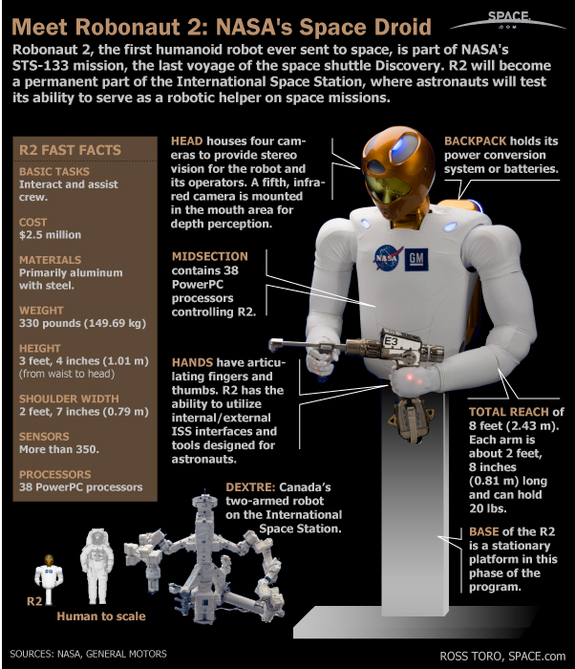
[...] Robonaut 2, which will become the first humanoid robot in space, looks a bit like a boxer's training aid.

The $2.5 million space bot consists of a head and torso, along with a pair of dexterous arms that pack down into a puncher's pose. R2 stands 3 feet, 4 inches (1.01 meter) tall and weighs about 330 pounds (150 kilograms).

R2 is a joint project of NASA and carmaker General Motors. It's the product of a cooperative agreement to develop a robotic assistant that can work alongside humans, whether they're astronauts in space or workers at GM plants here on Earth, NASA officials have said.

The bot is made primarily of aluminum and steel. Its head houses five cameras — including one infrared camera in the mouth — to provide stereo vision and depth perception. The torso contains 38 PowerPC processors, and R2 carries a backpack that can be filled with batteries or a power conversion system.

Each of R2's arms can carry about 20 pounds (9.1 kg), and its hands have articulating fingers and thumbs. The robot, which builds on NASA's work with its first Robonaut project, should be able to use the same tools astronauts on the space station use, agency officials said.

The robot's job

Astronauts will install Robonaut 2 inside the station's U.S. Destiny laboratory and put it through some test paces. The goal is to see just what the robot helper can do — how it can work side-by-side with astronauts to make station operations run more smoothly.

"We're going to use Robonaut on orbit to learn more about how robots can take over astronaut tasks — some mundane things and then potentially some of the more dangerous tasks," said Scott Higginbotham, payload manager for Discovery's STS-133 mission.

Robonaut 2 was designed to use both internal and external interfaces, so future bots could eventually be installed on the station's exterior to aid in spacewalks and other difficult or dangerous tasks. However, R2 itself will likely stay inside, officials said, since the bot lacks protection against the extreme cold of space. [...]

It really sounds more like an experiment, than a "Butler". I'm sure we will be hearing more about it as the experiment progresses.


Also see:NASA Robot Will Help Kick Off Super Bowl Sunday


Get a detailed look at Robonaut 2, NASA's first humanoid robot to fly to space, in this infographic.

Source SPACE.com: All about our solar system, outer space and exploration

Who knows what applications may be found for the robot in the future:

Project M
     

Monday, March 08, 2010

The real ISS "Room with a View" is installed

A while back I did a post about the new viewing window that was being installed onthe International Space Station. I posted a picture at the top of that post, of an artist's rendition of what it was supposed to look like.

Now it's installed. Here is what it actually looks like:


Not quite as bright and glamorous as the artist's rendition, is it? But close enough; it's practical and gets the job done. It allows the astronauts to see much of the Space Station's exterior without having to rely totally on cameras.

The view in this photo is, I think, the Sahara desert. But the view changes constantly, as the station orbits the earth about 16 times a day.
     

Wednesday, February 10, 2010

Space shuttle delivers viewing window to ISS


Endeavour to Deliver a Room With a View
The International Space Station has been moving steadily closer to completion for the past several years. But what house is complete without a utility room, a gym and a picture window?

During the STS-130 mission, space shuttle Endeavour will deliver the Tranquility node and its cupola, a dome-shaped extension from Tranquility made up of seven windows. They will be the last major U.S. modules to be added to the space station, and together they’ll help clear out premium workspace in other areas of the station – as well as offer a window on the world.

At 15 feet wide and 23 feet long, the Tranquility node will provide a centralized home for the station’s environmental control equipment – one of the systems that remove carbon dioxide from the station’s air, one of the station’s bathrooms and the equipment that converts urine into drinkable water, all of which is currently taking up space in the Destiny laboratory. And there’s enough room left over to house the station’s new treadmill and its microgravity equivalent of a weight machine, moving it out of the Unity node where it’s in the way whenever spacewalk preparations are going on inside the adjacent Quest airlock.

“It gives us a much needed addition to the house, so to speak,” said Bob Dempsey, lead space station flight director for the mission. “We’re getting to the point where we’re really cramped for space. You might be surprised at that, considering we’re essentially the volume of a 747 and we’ve been adding modules for the last couple of years. You might think we’d be sitting around in a big empty house. But no – every inch is really getting packed up there.”

STS-130 Commander George Zamka put it another way.

“It’s like exercising in the office,” he said. “This will be a more logical organization, more focused.”


Though the node has an intensely practical function, there are still fanciful aspects to Tranquility. For one, its name, which was chosen with the help of a naming contest on NASA.gov.

“It harkens back to the Sea of Tranquility, where humans made their very first tentative landing on the moon,” Zamka said. “They were only there for a few hours, and it was at the very limits of what human beings could do. From that beginning, we’re now putting up a node that will house the majority of the life support equipment for the station, where we’re going to have a permanent presence in space.”

But everyone agrees that the real scope for the imagination will be provided by Tranquility’s 6.5-by-5-foot annex: the cupola. Its true purpose will be to provide a true view of robotics operations on the station’s exterior – such as those that will be required when the next module, the Russian Rassvet, is added during STS-132 – and in that it will be invaluable.

“Out the window is the truth,” Zamka said. “The video views that we use now, you’re trying to stick together and have a mental image of where things are. When you look out the window, you don’t have to imagine. It’s all right there for you.”

But there’s no question that many people – including Zamka – are looking forward to looking out of it for other views.

“Just the idea of providing this great view of the station and the world beneath us is going to be pretty great,” he said. “That’s not what it’s for, but it will be spectacular.” [...]

A pretty neat combination of form and function, it's both practical and fanciful. Follow the link for more pics and information.


Tuesday, March 31, 2009

ISS with new solar panels & full power capacity

Thanks to the crew of the recent Space Shuttle Discovery Mission, STS-119:


Space Shuttle Mission: STS-119
Space shuttle Discovery and its crew of seven safely touched down on runway 15 at NASA's Kennedy Space Center in Florida at 3:14 p.m. EDT on Saturday, March 28. The weather cooperated enough to allow the spacecraft to land on the second opportunity.

Mission Specialist Sandra Magnus also returned to Earth with the STS-119 crew. Magnus spent 129 days aboard the International Space Station as flight engineer for Expedition 18. Japanese astronaut Koichi Wakata took her place on the orbiting laboratory and will return to Earth with the STS-127 crew.

The 13-day mission included three spacewalks, about 6-hours a piece, to install the S6 truss and enormous starboard-side solar arrays. They also unfurled the arrays and performed other get-ahead tasks.

Mission STS-119's crew of seven completed a successful mission aboard the International Space Station -- increasing the orbiting laboratory's power capacity and giving it the ability to accommodate additional crew members in the future.

Up till now, the ISS could only accommodate three permanent crew members. Two of those members have a full time job running the station, leaving only one to conduct experiments. Now they will be able to have six full-time crew members, and be able to really start using those space labs for research.

Follow this link to see the photo gallery for mission STS-119.
     

Friday, December 19, 2008

Majel Barrett Roddenberry, 76, dies of Leukemia


Majel B. Roddenberry, wife of 'Star Trek' creator, dies
Majel Barrett Roddenberry, the widow of "Star Trek" creator Gene Roddenberry and an actress whose longtime association with the "Star Trek" franchise included playing Nurse Christine Chapel in the original series, died early Thursday morning. She was 76.

Roddenberry died at her home in Bel-Air after a battle with leukemia, said family spokesman Sean Rossall.

"She was a valiant lady," Leonard Nimoy, who played Mr. Spock on "Star Trek," told The Times. "She worked hard, she was straightforward, she was dedicated to 'Star Trek' and Gene, and a lot of people thought very highly of her."

[...]

Roddenberry, whose pre-"Star Trek" acting career included guest appearances on series such as "The Untouchables" and "The Lucy Show," had no idea she was establishing a career path in science fiction when she took her first "Star Trek" role.

"Not at all," she said in a 2002 interview with the Tulsa World. "I certainly didn't have any idea that I'd be doing it this long, for so many different shows and films -- especially as a product of a series that was a flop. The original was only on for three years. It wasn't considered a success by anyone's standards."

The show took off as a pop-culture phenomenon after it went into syndication, however, and Roddenberry, who was married to Gene Roddenberry from 1969 until his death in 1991, attended her first "Star Trek" convention in 1972.

"You know, when the conventions started out, I'd attend four or five a month," she said in the 2002 interview. "But after a while, it got where there was no time for anything else. You'd just travel from city to city, making the same speech, answering the same questions."

Rossall said both Gene and Majel Roddenberry maintained warm relationships with "Star Trek" fans. And as late as August, he said, Majel Roddenberry attended a "Star Trek" convention in Las Vegas.

As she told the Buffalo City News in 1998, "It's been a hell of a ride." [...]

I didn't even know she was ill. I think she enjoyed her life, she had a lot of fans.


Star Trek Universe Loses Majel Barrett Roddenberry
[...] Majel Barrett Roddenberry reprised Nurse Chapel for brief appearances in 1979's Star Trek: The Motion Picture and 1986's Star Trek IV: The Voyage Home. She played the recurring role of Counselor Deanna Troi's mother on Star Trek: The Next Generation.

Gene Roddenberry died in 1991 at the age of 70.

After his passing, Majel Barrett Roddenberry helped bring alive one of his pet projects in the form of the 1997-2002 series Earth: Final Conflict but said she had nothing to do with running the at-times-flailing Trek ship.

"Gene sold out all of his rights to Star Trek way back 15, almost 20 years ago," she told SciFiDimensions.com in 2000. "So, they ask nothing. I volunteer nothing. They invite me to a few of their shindigs. I'll bet you I haven't been on that lot in two years."

Still, Roddenberry welcomed the recent digital remastering of the original series and Abrams' theatrical take, seeing them as validations of her husband's legacy.

"What's nice is you know a Star Trek movie is still one that everybody wants," she told The Hollywood Reporter in 2006.

In a statement today on Roddenberry.com, her son, Eugene Roddenberry Jr., said his mother appreciated the role fans played in keeping the Trek franchise running for 40-plus years.

"It was her love for the fans, and their love in return," he said, "that kept her going for so long after my father passed away."


You can read her biography at The internet movie data base.


Majel Barrett-Roddenberry - RIP


Friday, December 12, 2008

Will Obama cancel NASA's Moon Mission?

Let's hope not. I've written before about NASA's Constellation Program, which aims to replace the space shuttle with Ares rockets and the Orion spacecraft, which can also be used to bring us to the moon again. Will the financial crisis affect this program? What will an Obama administration do?

Mock-up of Orion spacecraft with Lunar Lander

The space program has always been a target for budget cutters. Many people view it as an extraneous waste of money. Many Democrats in particular, think the budget for the space program would be better spent on social programs.

It's quite natural that we should wonder what Obama's plans are for NASA and the Constellation Program in particular. It seems there has been a lot of tension between NASA's current administrator, and Obama's transition team:

NASA has become a transition problem for Obama
CAPE CANAVERAL – NASA administrator Mike Griffin is not cooperating with President-elect Barack Obama’s transition team, is obstructing its efforts to get information and has told its leader that she is “not qualified” to judge his rocket program, the Orlando Sentinel has learned.

In a heated 40-minute conversation last week with Lori Garver, a former NASA associate administrator who heads the space transition team, a red-faced Griffin demanded to speak directly to Obama, according to witnesses.

In addition, Griffin is scripting NASA employees and civilian contractors on what they can tell the transition team and has warned aerospace executives not to criticize the agency’s moon program, sources said.

Griffin’s resistance is part of a no-holds-barred effort to preserve the Constellation program, the delayed and over-budget moon rocket that is his signature project.

[...]

The tensions are due to the fact that NASA’s human space flight program is facing its biggest crossroads since the end of the Apollo era in the 1970s. The space shuttle is scheduled to be retired in 2010, and the next-generation Constellation rockets won’t fly before 2015.

Nearly four years ago, President Bush brought in Griffin to implement a plan to return astronauts to the moon by 2020 as a prelude to going to Mars. Griffin and his team selected Constellation, with its NASA-designed Ares I rocket and Orion capsule, as cheaper and safer than existing rockets. Constellation – especially Ares 1 -- is the center of what Griffin sees as his legacy to return humans to the frontiers of space.

Griffin has made no secret that he would like to stay on but only, as he recently told Kennedy Space Center workers, "under the right circumstances," including being able to finish Constellation.

But budget problems and technical issues have created growing doubts about the project. Griffin has dismissed these as normal rocket development issues, but they’ve clearly got the transition team’s attention.

When team members arrived three weeks ago, they asked the agency, among other things, to quantify how much could be saved by canceling Ares I. Though they also asked what it would take to accelerate the program, the fact that the team could even consider scrapping the program was enough to spur Griffin and his supporters into action

According to industry officials, Griffin started calling heads of companies working for NASA, demanding that they either tell the Obama team that they support Constellation or refrain from talking about alternatives. [...]

I would like to see the Constellation program stay on track. The Orion spacecraft is needed to replace the aging shuttle fleet, and will be more economical in the long run. It's needed to service the ISS too, so I suspect it may continue on schedule. But the return to the moon, I don't know. It would be nice if Obama were to look on it the way JFK did.

Back to the moon by 2020. Will we make it?

A great deal of time and resources have already been expended on the current plan; altering it significantly could throw a lot of that investment away. Also, NASA is providing jobs in the high tech industry, even in the private sector, and creating spin-off technologies that help us in so many ways. There is so much going right with it presently, I'm hoping that an Obama administration will choose to build on that rather than subtract from it.

I know Obama's team has to ask questions and make assessments. As to what he will do, I'm hoping he's going to be a JFK kinda guy in this regard.


Ares I rocket propelling Orion space capsule

The Constellation program will ultimately be not only less expensive, but safer for our astronauts too. It can service the ISS, AND get us to the Moon again, as well as assist us to getting to Mars eventually. Hopefully Obama can make it part of his plan and his presidential legacy, too.
     

Monday, November 17, 2008

New "bedrooms" and a 2nd bathroom for the ISS


I keep reading news reports about the "home makeover" for the International Space Station, talking about adding two new bedrooms and a 2nd bathroom, as if it were a house. The reality is quite different from any house you might experience here on earth.

For instance, would you call this a "bedroom"? Not by earthly standards:


It's basically a padded closet. On the right wall, you can see a thin sleeping bag stuck to the wall. That is the "bed" the astronaut uses. He/She zips themselves inside so they don't go floating around bouncing off the walls every time they move in their sleep!

As for the 2nd toilet, I think it looks kinda scary:


The Russian-made zero gravity toilet is no doubt very practical. I'm pretty sure there are sources on line that explain exactly how it works... for those who really want to know!

I got these photos from here:

Space.com: Shuttle Astronauts to Move In Aboard Space Station

Follow the link for more details and more photos of the other things they are installing, like the water recycling unit that will recycle urine into clean drinking water.

Just like home, right? But don't laugh - every home may have one, someday. Yikes.
     

Sunday, November 16, 2008

Space Shuttle Endeavour to dock with ISS today

In fact, it's happening right now:


This mission is about expanding the International Space Station's capacity to hold a larger full time crew. Here is a photo of the Endeavour crew, and a summary of their mission:

Image above: These seven astronauts take a break from training to pose for the STS-126 crew portrait. Astronaut Christopher J. Ferguson, commander, is at center; and astronaut Eric A. Boe, pilot, is third from the right. Remaining crew members, pictured from left to right, are astronauts Sandra H. Magnus, Stephen G. Bowen, Donald R. Pettit, Robert S. (Shane) Kimbrough and Heidemarie M. Stefanyshyn-Piper, all mission specialists. Image credit: NASA

Veteran space flier Navy Capt. Christopher J. Ferguson will command the STS-126 mission aboard Endeavour to deliver equipment to the International Space Station that will enable larger crews to reside aboard the complex. Air Force Lt. Col. Eric A. Boe will serve as the pilot. The mission specialists are Navy Capt. Stephen G. Bowen, Army Lt. Col. Robert S. Kimbrough, Navy Capt. Heidemarie M. Stefanyshyn-Piper and NASA astronauts Donald R. Pettit and Sandra H. Magnus.

Magnus will remain on the station, replacing Expedition 17/18 Flight Engineer Gregory E. Chamitoff, who returns to Earth with the STS-126 crew. Magnus will serve as a flight engineer and NASA science officer for Expedition 18. Magnus will return to Earth on shuttle mission STS-119.

Endeavour will carry a reusable logistics module that will hold supplies and equipment, including additional crew quarters, additional exercise equipment, equipment for the regenerative life support system and spare hardware.

STS-126 is the 27th shuttle mission to the International Space Station.

You can read more about the mission's specific tasks here:

Station Prepares for Expanding Crew
Expanding kitchen facilities, adding more bedrooms and an extra bathroom all sound like home improvements that many homeowners have tackled. But when the “house” is the International Space Station orbiting 220 miles above Earth, things are a little more complicated than visiting the local home improvement store for materials. Just in time for its 10th anniversary, the space station will get a delivery via space shuttle Endeavour that might win a prize for out-of-this-world home makeover.

When Endeavour and crew lift off on the STS-126 mission for the 27th shuttle flight to the station, it will be packed with supplies like food and clothing for the station crew members. However, Endeavour’s major payload consists of equipment for enlarging the space station’s capacity to accommodate a six-member crew. The high-tech home improvement materials are stowed inside the Multi-Purpose Logistics Module Leonardo, which will be tucked inside the shuttle’s cargo bay.

Some of the additions aboard will be: [...]

You can read the rest for the details, with photos too.

UPDATE: They have arrived!


Image above: The STS-126 crew is welcomed aboard the International Space Station by the Expedition 18 crew. Credit: NASA TV


Related Links:

Astronaut Donald Pettit
Our own Astronaut from Oregon. This is his official biography on the NASA website.

Astronaut Greg Chamitoff's Journal
A fascinating look at what the astronaut's life is like on the ISS.
     

Tuesday, October 14, 2008

ISS Crew Changeover and a Space Tourist

Space Tourist Richard Garriott paid 30 million
dollars for his 10-day space journey

A Russian Soyuz capsule carrying space tourist Richard Garriott, and Russian cosmonaut Yury Lonchakov and US astronaut Michael Fincke, has docked at the International space station. From The Associated Press:

Russian spacecraft docks with orbital station
KOROLYOV, Russia - An American computer game designer boarded the international space station Tuesday, floating onto the orbital outpost 35 years after his astronaut father circled the Earth on Skylab.

Richard Garriott was greeted by another man who has turned space flight into a family tradition: Russian cosmonaut Sergei Volkov, whose father is a decorated veteran of the Soviet space program.

[...]

Garriott, 47, paid a reported US$30 million to fulfill his childhood dream of space travel. Growing up steeped in space flight, his determination was only strengthened when he was told his poor eyesight would prevent him from becoming a NASA astronaut like his father.

[...]

Long rivals in the Cold War space race, Washington and Moscow often point to the space program as an example of cooperation in their otherwise difficult relationship, which reached a low point in August when Russia defeated Georgia, a U.S. ally, in a brief war.

During their stint, Fincke and Lonchakov will work to expand the capacity of the station to host a crew of six — up from three — with additional sleep spaces, a second toilet and an exercise machine. Their crewmate Greg Chamioff will be replaced by another U.S. astronaut, Sandra Magnus, who is scheduled to arrive on a space shuttle in November along with equipment for the expansion.

Sounds like it's business as usual, despite international tensions over the Russia/Georgia conflict. Can the Russia/America cooperation continue, without letting politics interfere? It seems they are determined to do just that.

From DailyTech.com:

Russia Space Director Talks Russia-U.S. Business Deal
Even though political tensions between the United States and Russia remain strained and global economic problems are causing credit crunches, space exploration will take place as scheduled, the head of Russia's space agency said over the weekend.

Roscosmos head Anatoly Perminov understands that in two short years the Soyuz space capsule will be the only transportation for astronauts to reach the International Space Station (ISS) until 2014 or 2015. Russia will need to assist the U.S. to get both astronauts and supplies to the ISS, and the ISS crew could be expanded from three people to six, which would add pressure to Russia.

"Cooperation is first and foremost international and it cannot be said that space has any boundaries," Perminov said during the press conference. [...]

The US Congress has made it legal for NASA to purchase seats aboard future Soyuz launches, despite political obstacles. Read the whole thing for more details.

I wonder if they can stay on course with this. The Orion project, our new spacecraft to replace our aging shuttle fleet, could be delayed beyond it's 2015 target date. The multi-billion dollar bailout for banks could affect NASA funding. For now it looks like plans have not changed. Russia needs the money as much as we need them to supply us with Soyuz spacecraft. We shall see as time goes along, if the arrangement, and our space budget, will hold up.


Related Links:

NASA, Russia, and The Space Travel Dilemma

Discovery Returns, Mission Accomplished

NASA goes Back to the Future
     

Saturday, August 16, 2008

NASA, Russia, and The Space Travel Dilemma

America's Orion Spacecraft; to launch in 2013 2014?

When the space shuttle fleet is retired in 2010, the Russian Soyuz spacecraft is supposed to be used instead, until the new American Orion ships are ready. But now that plan seems in jeopardy due to political concerns. Do we face having to expand our space program further... or even cutting it back?

Russia-Georgia conflict could affect NASA funding
WASHINGTON — Russia's military campaign in Georgia could have repercussions far beyond its borders, jeopardizing the U.S.-Russian partnership for manning the international space station over the next decade.

Lawmakers, including several from Texas, warned Friday that Moscow's air and tank attacks on its neighbor will likely prompt Congress to re-evaluate legislation allowing NASA to pay hundreds of millions of dollars for Russia to taxi astronauts to the space station.

The Soyuz spaceflights would span the five years between the shuttle's 2010 retirement and the launch of the new Orion spacecraft.

While some members predicted that Congress would eventually give NASA the go-ahead this year or next to work with Moscow's space program, others said they would rather see the retirement of the aging shuttle fleet put off a few years rather than rely on the Russians. [...]

Some people in Congress want to see our shuttle program extended, so we can avoid having to rely on the Russians for transport until our Orion spacecraft is ready (If it's completed on time, the latest estimate is September 2014. It's already been delayed one year).

The problem with extending the shuttle program would be that it's very costly, and would take money away from the building of the Orion spacecraft, causing even further delays. NASA would also like to stop using the shuttle, because of safety concerns inherent in it's design, and the age of the fleet. The Russian Soyuz spacecraft is known to be reliable, and seemed the ideal answer to the gap between the shuttle and the new Orion spacecraft. Too bad the Russian government isn't as reliable as the Soyuz.

Read the whole article for the details of the political debate. Some in congress are worried that opponents of the space program would use this as an excuse to de-fund it. Others are pushing for expanding NASA's budget to extend shuttle service AND keep the Orion spacecraft launch on schedule. I think that could be a tough sell in these budget-minded times. Yet at least the money spent wouldn't leave the country, but would be providing American's with jobs. And if the surge of the American dollar continues, that could also help economic concerns.

I think a lot is going to depend on the unfolding situation between Russia and Georgia in the coming weeks. But I don't doubt it's put a strain on NASA and their relationship with the Russian Space Agency. It's definitely dampened the enthusiasm of congress.


Orion spacecraft (right) docking at the ISS.


Related Links:

Surge for the dollar as global fears rise

Congress delays Orion Spacecraft launch date
     

Wednesday, August 13, 2008

Congress delays Orion Spacecraft launch date


The Orion Spacecraft, which is scheduled to replace the Space Shuttle as America's premier manned spaceflight transport vessel, was due to be launched in 2013. The date has now been moved to 2014.

NASA abandons plan to fly new spaceships by 2013
CAPE CANAVERAL, Fla (Reuters) - NASA has abandoned plans to get its replacement for the retiring U.S. space shuttles into service by 2013 because of a lack of additional funds and technical issues, officials said on Monday.

[...]

"The window of opportunity for us to accelerate Orion has closed," program manager Jeff Hanley at NASA's Johnson Space Centre in Houston told reporters during a conference call.

The United States will be without a means to transport people to and from space after the shuttle fleet is retired in 2010 until the new ships are ready to fly. It intends to rely on Russia to ferry crews to the space station and on private companies to deliver cargo during the gap.

NASA had hoped to minimize the gap, but additional funding to do so has not been approved by the U.S. Congress. [...]

(bold emphasis mine) Our wonderful congress at work. I suspect many of them would like to scrap the manned space program, and use the money for pork programs to buy votes. But to be fair, there were also concerns about safety, that have lead to some people at NASA seeing the later launch date as a good thing. So hopefully the Orion will be ready to fly to the ISS by 2014, and on to the moon by 2020, if congress will stop obstructing and get with the program... the Constellation Program.


Related Links:

Asteroid mission concept unveiled
A Nasa scientist has proposed using the replacement to the space shuttle to visit a near-Earth asteroid.

The Crew Exploration Vehicle (CEV) is due to make its maiden flight in 2014, with the eventual aim of ferrying astronauts to and from the Moon.

Dr Paul Abell said such a mission could help efforts to protect against an asteroid on course to hit Earth.

Currently, the project is envisaged to include two or three crew members and last a total of 90-180 days.

Dr Abell presented an outline of his mission concept here at the Lunar and Planetary Science conference in Houston, Texas.

The plan would be to visit an asteroid in the sub-kilometre size range, perhaps about the size of asteroid Itokawa (535m) which was visited by Japan's Hayabusa spacecraft. [...]

Wow. This also sounds like it would be a good practice step towards a Mars Mission. Read the rest of this fascinating article for more details.

Below are two links to prior posts about the Orion spacecraft:

NASA goes Back to the Future

Re-entry Dilemmas; the Orion Capsule and SS2


Sunday, June 15, 2008

Discovery Returns, Mission Accomplished


So what did they get done, besides the usual goofy zero gravity pics?


Plenty! They installed the main components of the Kibo science lab, the largest module on the station. Below is the interior of the lab:


Here is the exterior, with the storage unit placed on top:


Astronaut Nyberg looks out the shuttle window at the station as the shuttle departs:


Here is a closeup of the installed modules, taken from the shuttle after it departed:


Same photo, bigger view:


You can see more photos from the mission here:STS-124 Mission Photos


You can read more about the mission's conclusion here:
NASA, Astronauts Celebrate Successful Mission
Seven astronauts flew space shuttle Discovery back to NASA's Kennedy Space Center on Saturday to end the latest construction mission to the International Space Station.

Commander Mark Kelly and Pilot Ken Ham were at the controls of Discovery as it glided through Florida skies to touch down on time at 11:15 a.m. EDT.

Kelly, Ham and Mission Specialists Karen Nyberg, Ron Garan, Mike Fossum and Japan's Akihiko Hoshide spent 14 days in orbit installing the Japanese Pressurized Module to the space station. The module is the largest section of the Japanese laboratory called "Kibo," or hope. Garrett Reisman also returned onboard Discovery. He spent three months living on the space station.

Talking to the news media a few hours after landing, the crew of STS-124 beamed about the flight.

"I think I have the best space shuttle crew of all-time," Kelly said.

Although there are more pieces to add on future flights, Fossum said the addition of Kibo made the station look nearly complete.

"It was a great feeling of accomplishment as we backed away (from the station)," he said.

Hoshide, one of the astronauts of the Japan Aerospace Exploration Agency, spent time on Earth monitoring Kibo's preparation for space. Saying goodbye to it in orbit was not easy.

"When we went to close the hatch, that was a tender moment, it was kind of sad," he said.

NASA and Japanese officials hailed the flight just after landing.

"I can't think of a mission really that's been better than this one," said Bill Gerstenmaier, NASA's associate administrator of Space Operations. "We're starting to break that tie to planet Earth and get out and do what exploration is."

Discovery returned to its base in good shape, said Michael Leinbach, shuttle launch director.

"It's just a terrific day here at the Kennedy Space Center." [...]


Wednesday, June 04, 2008

Kibo Lab attached, to be activated today

Yesterday, the Discovery crew unloaded the pressurized Kibo space lab from Discovery's cargo bay, and attached it to the station.


The spacewalk crew unbolted it, and two astronauts inside the station attached it to the station using a robot arm, while the spacewalk crew got on with other repairs outside the station.


Here is an illustration that shows where the Kibo lab has been attached on the station:


Today the astronauts will complete all the internal hookups, and open the lab up. Here is some information from NASA's mission summary .PDF file:

NASA Mission Summary, SPACE SHUTTLE DISCOVERY (STS-124)
FACTS & FIGURES

• STS-124 is the 123rd space shuttle flight, the 26th flight to the station, the 35th flight for Discovery and the third flight in 2008.

• The Kibo laboratory—which means “hope” in Japanese—is the country’s major contribution to the station and will enhance the research capabilities of the space station.

• The JPM will be the largest habitable module on the space station and is equipped with its own airlock and robotic arm for external experiments.

• The final components of Kibo will be assembled in space on shuttle mission STS-127.

• The RMS main arm can handle up to 14,000 pounds of hardware. The small fine arm, when attached to the main arm, handles more delicate operations. Each arm has six joints that mimic the movements of a human arm.

• The JPM is 36.7 feet long and 14.4 feet in diameter, about the size of a large tour bus.

• The main arm measures 32.5 feet long, and the small fine arm measures 6.2 feet.

• Kibo experiments and systems are operated from the Japan Aerospace Exploration Agency's control center called the Space Station Integration and Promotion Center, just north of Tokyo.

• Experiments in Kibo focus on space medicine, biology, Earth observations, material production, biotechnology and communications research.

• To help prevent the glove cuts seen in recent missions from recurring, both spacewalkers will wear gloves with special patches on the thumb and index finger for the first time. The patches are made of the same protective vectran material already used in the palm of the gloves, but in a much tighter weave. In this form, the fabric is called TurtleSkin. It is up to four times more resistant to damage.

When all the components are in place, the Kibo lab unit should be configured like this:


The porch-like attachment is for performing experiments outside the station, using robotic arms. I believe the porch-platform is scheduled to brought up and added on in a future mission.

More about todays activities:

Crews to Enter Japanese Lab Today
The shuttle and station crews will open the newly installed Japanese laboratory Kibo for business today. Hatch opening is planned for 4:52 p.m. EDT. The experiment module was installed on the Harmony Node’s port side Tuesday.

After a leak check, mission specialists Karen Nyberg and Akihiko Hoshide will prepare Kibo for activation before opening the hatches. Shortly after entering Kibo with Hoshide, Expedition 17 Commander Sergei Volkov will sample the air and test for contamination. They will wear protective goggles and masks until they are sure the Japanese lab’s air is clean.

Mission Specialists Mike Fossum and Ron Garan will review procedures for their second spacewalk and sleep in the U.S. Quest airlock tonight to purge the nitrogen from their bodies. During Thursday’s spacewalk, the second of the mission, the spacewalkers will outfit the new lab and prepare the Japanese logistics module for relocation.

You can check the link for progress updates. They have already fixed the malfunctioning Zero-Gravity Space Toilet. That should make life in space a bit easier.
     

Tuesday, June 03, 2008

A busy day at the International Space Station

The Shuttle Discovery docked yesterday, and today their work begins:

STS-124 Commander Mark Kelly works inside the Quest airlock with Expedition 17 Commander Sergei Volkov. Photo credit: NASA TV

STS-124 to Conduct First Spacewalk, Install JPM
Mission specialists Mike Fossum and Ron Garan are scheduled to kick off STS-124’s first spacewalk at 11:32 a.m. EDT. During the 6-½ hour excursion, the pair will retrieve a shuttle inspection tool, service and inspect components of a solar alpha rotary joint and prepare the largest component of the Japan Aerospace Exploration Agency’s Kibo laboratory for installation on the International Space Station.

The spacewalkers’ first task is to transfer the Orbiter Boom Sensor System (OBSS) from the station’s truss to space shuttle Discovery. The OBSS, which attaches to the shuttle’s robotic arm for detailed inspection of the shuttle’s heat shield, was left at the station for STS-124 during the previous shuttle mission to provide room for the giant Kibo module in Discovery’s payload bay.

Next, the spacewalkers will prepare Kibo’s Japanese Pressurized Module (JPM) for installation. After inspecting the common berthing mechanism on the Harmony Node’s left side and opening a window cover, Fossum and Garan will work together in the shuttle’s cargo bay to remove contamination covers from the JPM’s docking surfaces. Fossum will also disconnect heater cables and remove locking bolts from the shutters of the JPM’s forward window.

For their final tasks, Garan and Fossum will move to the station’s starboard solar alpha rotary joint, which began experiencing increased vibration and power usage in the fall of 2007. Garan will install a replacement of one of the joint’s 12 trundle bearing assemblies. Meanwhile, Fossum will inspect a potentially damaged area on the joint and try out several techniques for cleaning debris from the surface of the joint’s race ring.

While Fossum and Garan work outside the orbital outpost, mission specialists Karen Nyberg and Akihiko Hoshide will use the station’s robotic arm to remove the JPM from the shuttle’s payload bay and install it on Harmony.

An Astronauts work is never done. You can visit the page for more links and info about the mission.
     

Sunday, June 01, 2008

Discovery Shuttle Launch a Success: both the Shuttle and the ISS are easily seen from Earth


'Huge Day' for NASA, Japan
May 31
6:45 p.m. EDT

Commander Mark Kelly promised "the greatest show on Earth," and space shuttle Discovery delivered with a thundering, fiery arc stretching over Florida's East Coast on Saturday. The launch began a 14-day mission for Kelly and his crew of seven astronauts as they install a new Japanese-built laboratory module on the International Space Station.

As the astronauts got used to their new surroundings in space, NASA officials on Earth basked in the satisfaction of a flawless countdown and liftoff from NASA's Kennedy Space Center in Florida.

"(It was) obviously a huge day," said NASA Administrator Mike Griffin. "A huge day for the space station partnership, for the Japanese Space Agency, for NASA and, really, for the people who hoped to see the space station do what it was designed to do, to be a place in orbit where we can learn to live and work in space."

[...]

Next up for the STS-124 mission is a two-day chase across space to link up with the International Space Station. It will take the crew several hours of robotic arm maneuvers and spacewalks to connect the Pressurized Module of Japan's Kibo laboratory to the station. The 36-foot-long module is the largest habitable section to be launched to the orbiting research post.

Both the International Space Station and the Discovery shuttle are visible to the naked eye. The ISS travels a fast orbit over the earth, and sees as many as 14 sunrises and sunsets in one day! When it passes over where you live, you may have several opportunities to see it in one night. I had published the following link previously, as a way to find out when the ISS is flying over where you live:

Find out when the ISS passes over your city

If you go to the page and type in your country and the city you live in, it will give you a schedule of when the ISS will be visible to you, weather permitting. Well it now also offers you the schedule of the Discovery Shuttle too. And as the two get closer together over the next few days, you might even see them flying together right up until they dock.

When they attach the Kibo lab, I expect the station and docked shuttle will appear larger and brighter than ever. I'll be watching for it.
     

Friday, May 30, 2008

Space Shuttle Discovery to Launch Saturday

On the agenda for this trip will be high tech toilet repairs, and the addition of the main component of the Japanese built Kibo space lab:

Image above: A technician loads replacement parts onto space shuttle Discovery for the International Space Station's toilet. The crews of Discovery and the station will install the new components during STS-124. Photo credit: NASA/Dimitri Gerondidakis

Space Shuttle Discovery Mission STS-124
[...] May 29
New parts to fix an intermittent problem with the Russian toilet on the International Space Station arrived in the United States last night and were packed inside space shuttle Discovery well before dawn at NASA's Kennedy Space Center in Florida.

The crew of Discovery and the residents of the International Space Station will install the new parts, including a pump, during the STS-124 mission that is scheduled to launch Saturday at 5:02 p.m. EDT. The three station residents already in orbit currently are using alternatives to the toilet.

The main toilet on the station works for solid waste disposal but requires additional steps for liquid waste. It also takes two crew members and 10 minutes of maintenance after three flushes, said Kirk Shireman, deputy International Space Station program manager.

"It is very inconvenient at this time because it requires a lot of manual intervention," Shireman said.

The good news for the station is that there are no trouble signs for Discovery as it nears launch day.

[...]

Discovery's 14-day flight will carry the largest payload so far to the station and includes three spacewalks. It is the second of three missions that will launch components to complete the Japan Aerospace Exploration Agency's Kibo laboratory. The crew will install Kibo's large Japanese Pressurized Module and Kibo's robotic arm system. Discovery also will deliver new station crew member Greg Chamitoff and bring back Flight Engineer Garrett Reisman, who will end a three-month stay aboard the outpost.

You can follow the link for updates. Here is a photo of the Discovery Crew:


You can read more about the Astronauts here. The page includes links to individual biographies and interviews for each astronaut.
     

Monday, April 21, 2008

All three astronauts appear at news conference

Even after a grueling re-entry and rough landing, they all appear to be well:

Russian flight engineer Yuri Malenchenko, left, American astronaut Peggy Whitson, centre and South Korea's first astronaut Yi So-yeon pose after news conference in Star City, outside Moscow, Monday, April 21, 2008. (AP Photo/Misha Japaridze)

Yi describes frightening return to Earth
STAR CITY, Russia (AP) — South Korea's first astronaut said Monday she was "really scared" when the Russian space capsule she was in made an unexpectedly steep descent to Earth over the weekend.

"During descent I saw some kind of fire outside as we were going through the atmosphere," said Yi So-yeon, a 29-year-old bioengineer. "At first I was really scared because it looked really, really hot and I thought we could burn."

But then she said she noticed it was not even warm inside the Soyuz capsule. "I looked at the others and I pretended to be OK," Yi said.

The steeper-than-usual descent from the international space station subjected Yi, American astronaut Peggy Whitson and Russian flight engineer Yuri Malenchenko to severe gravitational forces during the re-entry Saturday.

The technical glitch also sent the TMA-11 craft off-course and it landed about 260 miles from its target on Kazakhstan's barren steppe.

All three members of the crew walked slowly and were unsteady on their feet Monday when arriving for the news conference at Russia's Star City cosmonaut training center outside Moscow.

Malenchenko said it was not yet clear what caused the unusual descent.

"There was no action of the crew that led to this," he said. "Time will tell what went wrong."
[...]

(bold emphasis mine) Interesting. Previously, a spokesman at the Russian Mission control said that the Soyuz crew failed to notify them of a change in flight path and trajectory. Now the pilot, Malenchenko, says the crew had nothing to do with it. Whatever the problem was, thank goodness it didn't kill or injure them.

You can read more details about the re-entry here:

Soyuz spacecraft has rough landing on Earth