Showing posts with label space exploration. Show all posts

Saturday, May 07, 2016

What a real spaceship would look like

Or could look like, based on technology we already have or have within our grasp:


The video is from 2011, so no doubt there have been many revisions since. A similar, but more advanced looking ship was used in the movie The Martian. No doubt based on this design.


So when are we going to see this ship for real? Not in my lifetime, I expect. In a world where industrialized, technologically advanced nations are over budget, bordering on bankruptcy and/or currency collapse, I don't realistically see funding for projects like this for a long, long time. If ever. It may remain just a dream, only fulfilled in movies. CGI special effects are so much cheaper than reality.

For more photos from the movie, and commentary of the science, follow this link: SCIENCING THE MARTIAN
     

Friday, February 13, 2015

The mental/emotional effects of isolation

An article by Felicity Aston, the first woman to ski cross-country across the Antarctic continent, completely alone. She talks about her experience of isolation, and how her experience might compare to what future astronauts might face:

How will space explorers cope with isolation?
[...] It was the alone-ness itself that was frightening and my subsequent 59-day ski across the continent was dominated by my battle to deal with the shock of it.

I imagine that the first humans to visit Mars might experience a similar state of shock at their disconnection from human society. It is intriguing to wonder whether there might be parallels between the psychology involved in exploring Mars and exploring Antarctica.

Could potential astronauts preparing for long space missions across the solar system learn anything useful from experiences like mine in Antarctica?

As I began my loneliest of expeditions I had the benefit of more than a decade of previous polar journeys to draw from. In addition I had carefully prepared for the psychological stress of isolation, consulting a specialist sport psychologist.

Yet, I was taken aback by the range of ways in which the alone-ness affected me. I became increasingly emotional. With no one to witness my behaviour, I allowed inner feelings to flow into outward expression without check. If I felt angry, I shouted. If I felt upset, I cried.

Self-discipline became much harder. Surrounded by others, taking risky short-cuts isn't a possibility, largely because of the embarrassment of being discovered. But alone, with no-one to observe your laziness, the voice of temptation was always present. I found that ignoring the voice of temptation was an extra drain on mental energy that simply hadn't existed on team expeditions.

My brain, starved of any input by the lack of colour, shape or form in my largely blizzard-obscured world began to fill in the gaps by creating hallucinations.

I was surprised to find that we can hallucinate not just with our visual sense but with all our senses. I hallucinated strange forms in the gloom of regular whiteouts that took the shape of floating hands and small bald men on dinosaurs, but I also hallucinated smells, tastes and sounds that all seemed very real.

As I skied, I began to direct my internal monologue at the sun (when it was visible through the bad weather) and was slightly perturbed when eventually the sun began to talk back to me in my mind. It took on a very distinct character and even though I knew on some level that it wasn't real, the sun played an important part in my coping strategies.

Routine became increasingly important to me in overcoming these damaging responses to alone-ness. When everything else in my landscape and daily experience was so surreal, routine became the rhythm that I clung to. I performed every task in exactly the same way, every time it had to be done. I repeated chores in the same order again and again until I reached the point that I barely had to think about them. Reducing the thought required seemed to simultaneously reduce the emotion.

This was despite the fact that I did have some connection to the outside world during my expedition. I carried a satellite phone which was capable of calling anyone in the world at any time from my tent -- and yet, largely, I decided not to.

I was scared of the emotional high that speaking to loved ones might bring, knowing that it would inevitably be followed by a crushing emotional low as I was forced to end the call. [...]
To read it is to almost be there in her shoes. Fascinating. See the links for pics and more.
     

Saturday, August 09, 2014

A real "Warp Drive" for Space Travel

I had posted about this previously. Here is a video, talking about a possible prototype, if experiments on earth justify further research:


Saturday, August 02, 2014

A propulsion drive without fuel?

Yes, and it may take us to Mars:

EmDrive Is an Engine That Breaks the Laws of Physics and Could Take Us to Mars
An experimental engine is gaining acceptance among scientists, and could introduce a new era of space travel — it only had to break a law of physics to do so.

The picture, below, is of the EmDrive. It uses electricity to generate microwaves, which then bounce around in a closed space and generate thrust. The drive does not need propellant, an important part of current space-travel mechanics.


The force generated by the drive is not particularly strong, but the implications are big. Multiple independent experiments have now replicated the drive's ability to generate thrust, albeit with varying success. Using panels to convert solar energy into electricity and then into thrust, opens the door to perpetual space travel fueled by the stars.

Scientists were slow to warm up to the EmDrive since it violates the law of the conservation of momentum. In addition to not being sure why it works — current theories rely on quantum mechanics — scientists also have some pretty good ideas why it shouldn't work. [...]
Follow the link for pics, video and embedded links.
     

Wednesday, December 11, 2013

The Moonbase That Almost Was

Moonbase Apollo (1968)
[...] Not widely known is that in 1968, as it prepared its first piloted Apollo flight – Apollo 7, which flew in September 1968 – and its Fiscal Year 1970 submission to the Bureau of the Budget, NASA briefly considered an alternate approach to Apollo. Had it been pursued, it might have laid the technological foundation for a permanent moon base in 1980. After perhaps three Apollo exploration missions to different landing sites, NASA would have dispatched a series of Apollo missions to a single site.

In addition to intensively exploring the selected site, the astronauts would have performed engineering and life sciences experiments, assessed the lunar environment for radio and optical astronomy, and experimented with resource exploitation. The single site revisit missions would have played the role for a permanent lunar base that Gemini played for Apollo; that is, it would have enabled NASA to acquire operational skills needed for its next step forward in space.

The single site revisit concept – sometimes called the “lunar station” concept – got its start some time before 30 April 1968, when the NASA-appointed Lunar Exploration Working Group (LEWG) presented it to the Apollo Planning Steering Group. Lee Scherer, director of the Apollo Lunar Exploration Office at NASA Headquarters, asked mission planner Rodney Johnson on 7 May to chair a 10-man Single Site Working Sub-Group of the LEWG. He directed Johnson to present a progress report at the LEWG meeting scheduled for the third week of May. The Sub-Group held a two-day meeting on 12-13 May and presented results of its brief study at the 22 May LEWG meeting. It issued a revised final report on 4 June 1968.

The Sub-Group’s report began by declaring that a 12-man “International Lunar Scientific Observatory” in 1980 could become a new “Major Agency Goal” for NASA. The single site revisit missions, it continued, would pave the way by demonstrating the value of a permanent lunar base. The Sub-Group then examined four options for carrying out its single site revisit program, which it labeled 0, A, B, and C. All would employ spacecraft and standard Saturn V launch vehicles the space agency had already ordered for Apollo. [...]
The rest of the article is about the plans, with some neat diagrams of next-stage Lunar exploration vehicles similar to the originals, but more advanced. But alas, it was not to be. We got the Space Shuttle instead, which was interesting, but in many ways a divergent distraction from real space exploration. If Apollo had kept going... well, we'll never know, because it didn't.

And won't likely start again any time soon. Not by us, anyway. The Chinese like to think they will, but I wouldn't hold my breath waiting.
     

Saturday, July 06, 2013

Can a Warp Drive really "fly"?

Some people say definitely "yes":


Why Warp Drives Aren't Just Science Fiction
[...] According to Einstein's theory of special relativity, an object with mass cannot go as fast or faster than the speed of light. However, some scientists believe that a loophole in this theory will someday allow humans to travel light-years in a matter of days.

In current FTL theories, it's not the ship that's moving — space itself moves. It's established that space is flexible; in fact, space has been steadily expanding since the Big Bang.

By distorting the space around the ship instead of accelerating the ship itself, these theoretical warp drives would never break Einstein's special relativity rules. The ship itself is never going faster than light with respect to the space immediately around it.

Davis's paper examines the two principle theories for how to achieve faster-than-light travel: warp drives and wormholes.

The difference between the two is the way in which space is manipulated. With a warp drive, space in front of the vessel is contracted while space behind it is expanded, creating a sort of wave that brings the vessel to its destination.

With a wormhole, the ship (or perhaps an exterior mechanism) would create a tunnel through spacetime, with a targeted entrance and exit. The ship would enter the wormhole at sublight speeds and reappear in a different location many light-years away.

In his paper, Davis describes a wormhole entrance as "a sphere that contained the mirror image of a whole other universe or remote region within our universe, incredibly shrunken and distorted." [...]
It goes on to describe a theoretical device called a "Ford-Svaiter mirror", and how it would work to create this "wave". Fascinating stuff.


Wednesday, May 15, 2013

Sunday, March 17, 2013

Sci-Fi Rockets of the '50s become a reality

SXSW: Elon Musk discusses hovering rocket, Mars and that NYT review
AUSTIN -- Elon Musk says if mankind doesn't make it to Mars by the time he dies, it'll be the biggest disappointment of his life.

Speaking to a packed crowd of several thousand attendees at South by Southwest on Saturday, the founder of Tesla and SpaceX said he might even consider making the journey himself.

"I'd like to die on Mars, just not on impact," he said.

For now, he's been focusing his attention on something a bit closer to home. Musk revealed to the crowd that SpaceX is one step closer to developing a reusable rocket, saying the company recently launched a 10-story rocket that burst into the sky, rose 262.8 feet, hovered and landed safely on the pad 34 seconds later using thrust vector and throttle control. To cushion its fall back to the launch pad, the Grasshopper has steel landing legs with hydraulic dampers, plus a steel support structure.

Video of the test, which took place at SpaceX’s rocket development facility in McGregor, Texas, was shown to an enraptured South by Southwest crowd. Musk said it was the first time anyone aside from the video editor and himself had seen the footage, which you can check out below.

"It can land on Earth with the accuracy of a helicopter," he said. [...]
I saw the video in the article, it was pretty cool. I used to laugh at those old sci-fi movies of the '50's, showing people landing and taking off in rockets. In my time, rockets have always been disposable. The idea of landing and taking off again in the same rocket seemed unrealistic. But now it seems, it might really have been a vision of the future after all.

Once more, everything old is new again.

Hopefully we will be seeing many more wonderful things from SpaceX.
     

Tuesday, August 28, 2012

Song will Premiere Broadcast from Mars

NASA, will.i.am to Premiere Song Live From Mars
Black Eyed Peas co-founder William Adams, a.k.a. will.i.am, is working with NASA on an interplanetary stunt with chart-disrupting implications—the musical artist's new single "Reach for the Stars" will premiere live from the surface of Mars via the space agency's Curiosity rover.

"Reach for the Stars" will be broadcast by Curiosity at 4 p.m. on Tuesday, NASA said in a statement. Curiosity, the largest automated mobile lab NASA has sent to the Red Planet, touched down on Mars on Aug. 5 after more than eight months in space.

The premiere of the song will coincide with an event at NASA's Jet Propulsion Laboratory (JPL) in Pasadena, Calif., mission control for the Curiosity expedition. Fans will be able to tune into the premiere of "Reach for the Stars" online via NASA TV, which will stream the broadcast live.

Will.i.am, through his i.am.angel Foundation, is also working with NASA and Discovery Education, a developer of digital educational resources, to push a new science, technology, engineering, arts, and mathematics initiative leveraging Curiosity and other NASA probes, the agency said.

The singer has taken a keen interest in science and technology in recent years. Named "director of creative innovation" by Intel in early 2011, will.i.am has participated in the FIRST Robotics Competition for high school students and has discussed starting a car company.

In one interview on the red carpet, (video below) he said: "The world doesn't need another musician. They need another Bill Gates." [...]
Kewl!    

Monday, August 27, 2012

Neil Armstrong, on Space Exploration


Neil Armstrong: modest man, large footprint in time and space
[...] After commanding the Apollo 11 mission, Armstrong took a desk job at the National Aeronautics and Space Administration, then taught engineering at the University of Cincinnati, served on several corporate boards, and worked out of his farm in southwest Ohio. He said he regretted not spending the time he wanted to with his family.

"I am, and ever will be, a white socks, pocket protector, nerdy engineer," he said in a rare public appearance in February 2000, cited by The Associated Press. "And I take a substantial amount of pride in the accomplishments of my profession."

He also regretted that the US space program did not make more progress than it did. "I fully expected that by the end of the century we would have achieved substantially more than we did," he told "60 Minutes." The end of the cold war also marked the end of the drive for space dominance, he said. "When we lost the competition, we lost the public will to continue."

In 2010, he came out of retirement to make a case before the US Congress to restore funding and a vision for the US space program and a workforce he described as "confused and disconsolate" by the termination of the 30-year space shuttle program, layoffs of thousands of aerospace workers, and the absence of a new US space strategy.

Public policy must be guided by the recognition that we live in a technologically driven world, he told a House panel. "Our choices are to lead, try to keep up, or get out of the way" he said. "A lead once lost is very difficult to regain."

"Neil Armstrong understood that we should reach beyond the stars," said Sen. Bill Nelson (D) of Florida, a former NASA shuttle astronaut, in a statement. "His 'one giant leap for mankind' was taken by a giant of a man." [...]


Also see:

R.I.P. Neil Armstrong
     

Tuesday, August 14, 2012

How SpaceX is Saving America Money

By being more efficient than NASA:


Why SpaceX is setting the pace in the commercial space race
[...] Dec. 7, 2012, will mark the 40th anniversary of the flight of Apollo 17. That was the last time the United States ever launched an astronaut beyond Earth orbit. The reason why the operational era of human exploration beyond Earth orbit lasted a mere three and a half years, from July 1969 to December 1972, is that early in the Space Age, and continuing with the space shuttle, the nation tied itself to an infrastructure and a way of doing business that was too expensive to sustain.

NASA acknowledged this reality in 2006, even as it was pursuing its plan to send astronauts back to the moon — known as Project Constellation or “Apollo on Steroids” — by establishing the Commercial Orbital Transportation Services program. The purpose of the COTS program was to see if there was a better, more sustainable model for achieving access to space by forgoing the traditional approach of top-down, sole-source , cost-plus contracting — and instead harnessing the innovation and drive of private industry while still maintaining a close partnership with NASA.

After plowing nearly $8 billion into the Ares 1 booster program, Project Constellation did in fact prove too expensive to sustain. Instead, it was the COTS approach for cargo delivery to the space station that became the basis for NASA’s commercial crew program.

Success for SpaceX
SpaceX’s first demonstration cargo flight to the space station was accomplished in May as part of the COTS program. That flight took longer than expected, but the results were well worth NASA’s time and money. Thanks to its investment of $396 million, plus a great deal of advice, NASA has made it possible for SpaceX to produce not just a new launch vehicle but something much more profound: a new space transportation system consisting of the Falcon 9 launch vehicle, the recoverable and reusable Dragon spacecraft, and the infrastructure to support those spacecraft.

For comparison’s sake, the cost to NASA for doing this was less than what the space agency spent on one suborbital test launch of the Ares 1-X booster in 2009. It was less than NASA has spent on the development of its deep-space Orion crew capsule in the first half of this year alone.

Now SpaceX has a contract to launch 12 cargo flights to the space station at a cost to the American taxpayer of about $133 million per flight — putting America back in the orbital transport business. The SpaceX Falcon-Dragon transportation system arguably represents the best investment NASA has ever made. In light of that success, a failure to include the company in the top two for NASA’s commercial crew program would signal an almost unfathomable retreat, unworthy of the best of American ingenuity.

The stunningly low-cost and expansive nature of the Falcon-Dragon system represents much more than a rare bargain for taxpayers, in an era when most such stories have a very different ending. It offers indisputable proof that a new approach to space transportation can work far more effectively than the old ways. It’s absolutely vital to keep the company and the space transport system which has pioneered this path in the vanguard. [...]

I did a post about SpaceX last year. It's a truly amazing company.

NASA was necessary to get manned space exploration started. It's done that. But now it's role is changing; it gets to hold the door open for others to follow.
     

Wednesday, June 01, 2011

NASA's Space Shuttle Program Winds Down; What is likely to replace our space fleet?

Next-to-last space shuttle flight lands on Earth
[...] Launch managers marveled Wednesday over how good Endeavour still looks.

"It looks like it's ready to go do another mission," Kelly noted. He said he'd fly the space shuttle every couple months if he could — heck, every week if possible. "But it's 30 years old ... and we've got to grow and adapt and build new things."

Atlantis will remain at Kennedy Space Center as a tourist stop, following one last supply run to the space station. Liftoff is set for July 8.

Discovery, the fleet leader, returned from its final voyage in March. Its next stop is a Smithsonian Institution hangar outside Washington.

Moving Atlantis to the launch pad as Endeavour landed helped temper the sadness so many are feeling with one mission remaining, officials said. Thousands of more layoffs loom once the shuttle program ends.

"It's been a heck of a month in the last four hours," observed launch manager Mike Moses, "and I think we've used up our overtime budget for the entire month."

NASA is leaving the Earth-to-orbit business behind to focus on expeditions to asteroids and Mars. Private companies hope to pick up the slack for cargo and crew hauls to the space station. But it will be a while following Atlantis' upcoming flight — at least three years by one business' estimate, five to seven years by Kelly's — before astronauts ride on American rockets again.

Until then, Americans will continue hitching rides aboard Russian Soyuz capsules at the cost of tens of millions of dollars a seat.

"We're in the process of transition now, and it's going to be awkward," Atlantis astronaut Rex Walheim said. "But we'll get to the other side and we'll have new vehicles.

"I really do have to say, though, it's going to be really hard to beat a vehicle that is so beautiful and majestic as that one is," he said as Atlantis rolled to the pad behind him. "I mean, how can you beat that? An airplane sitting on the side of a rocket. It's absolutely stunning."

I read elsewhere, that Endeavor was designed to fly a total of 100 missions. Retiring it at 25 seems premature, and in many ways, a waste of money. So why are they retiring it?

1. Safety issues. Since the Challenger and Columbia deaths, there have been a lot of safety concerns about continuing to use the shuttles. Dangers inherent in the design, that are not easily managed.

2. The cost of launching, and maintenance. The vehicle's themselves may be paid for, but their continued maintenance, and the cost of launching them safely, is quite expensive.

NASA was working on a new transport vehicle, the Orion Spacecraft, but that got scrapped by Obama when he scrubbed the Constellation Program.

Recently there has been talk of restoring the part of the Constellation Program that would finish building the Orion, so the US would at least have a spacecraft. There is some sense in that, since billions have already been spent on it. But it will be years before it's ready.

Obama has suggested that the private sector should step in to fill the transport gap. I suspect he says that because he's not that interested in the space program, and wants their budget money for entitlement spending.

Money spend on NASA's budget was only a fraction of what's spent on entitlements; see this graph. Entitlement spending, and even the interest on our debt, is way, WAY more than NASA's budget. And at least the NASA spending created jobs, and spin-off technologies that could be used in the private sector. We at least got something back for our money.

Still, I agree with the President that the private sector should be more involved in space transportation, and some good may come out of Obama's decision. Some private companies are already striving to fill the gap, and my favorite, Spacex, has already come quite far in doing so. Competition in the free market often creates better, and more cost-effective, alternatives. So perhaps it will ultimately benefit The Future of American Manned Space Flight.

We shall see.


The "Dragon" spacecraft, by Spacex


Sunday, April 03, 2011

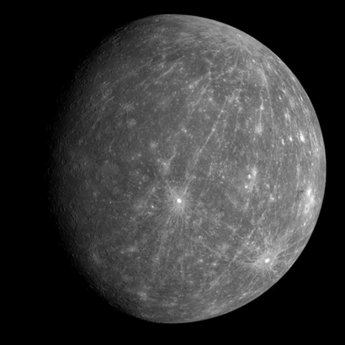
Photos of Mercury from the Messenger Probe

Apparently it took years to arrive there, because it had to follow a convoluted path to avoid being destroyed by the sun's gravitational pull.


First photos of Mercury from orbit

There are 19 pics. Some in color, but not a lot of color to see. Some purple, blue and beige tinges. Mostly grey, looks a lot like the moon at first, but there are significant differences. The photo quality is MUCH better than the old photos from the Mariner mission. And it has a lot more than just cameras, measuring all kinds of new data. Did you know Mercury has an atmosphere?


It's a planet with plenty of mysteries yet to be revealed.

Secrets of Mercury
The closest planet to our sun, and the smallest in the solar system, is also one of the least understood. Compared to more glamorous planets like Mars, Jupiter and Saturn, Mercury has received much less attention from scientific study missions. But NASA's Messenger probe is set to reveal the secrets behind the odd planet. The probe has flown by Mercury three times and will enter orbit around the planet in March — the first spacecraft ever to do so.

Here's a look at some of Mercury's most enduring mysteries. In the words of Messenger science team member Robert Strom, "The best is yet to come. What you're seeing here is just the tip of the iceberg." [...]

I find it all fascinating, and will continue to follow it with great interest.
     

Saturday, January 01, 2011

2011. Here we go...

Shall we start the year with some interesting pictures from space? Why not...


11 MORE Strange Things About Outer Space

If you follow the link, the pics and facts are kinda interesting and/or weird.
     

Monday, June 14, 2010

Asteroid Sample Brought Back to Earth

At least, that's what they think:

Space probe returns to Earth from trip to asteroid
ADELAIDE, Australia -- A team of eager scientists flew into the Australian Outback on Monday to recover a Japanese space capsule they hope contains the first-ever asteroid samples that could provide clues into the evolution of the solar system.

The Hayabusa explorer returned to Earth overnight after a seven-year, 4-billion mile (6-billion kilometer) journey, burning apart on re-entry in a spectacular fireball just after jettisoning the capsule. It was the first time a spacecraft successfully landed on an asteroid and returned to Earth.

Seiichi Sakamoto of the Japan Aerospace Exploration Agency, which launched the explorer in 2003, said they were "delighted" to recover the capsule, particularly after a number of technical problems delayed Hayabusa's arrival for three years.

"It was an extremely difficult technological challenge, and we did everything to overcome the troubles one by one," he said. "This is an achievement we could make simply because we never gave up hope."

On Monday, two helicopters took scientists to the capsule's landing site in the Woomera Prohibited Area, a remote military zone 300 miles (485 kilometers) northwest of the South Australian state capital of Adelaide.

It could take many hours to retrieve the capsule and collect samples, which will be taken to Japan for study after a series of measures to protect the capsule and its cargo. [...]

It was supposed to come back in 2007, but was delayed by technical problems, and missed it's window of opportunity to maneuver into the Earth's orbit until this year. I found all the details interesting. Quite an accomplishment, if the samples made it back.


Wednesday, April 14, 2010

Obama's "Devastating" Plans for NASA

President to Outline His Vision for NASA
President Obama will seek to promote his vision for the nation’s human space flight program on Thursday, just two days after three storied Apollo astronauts — including Neil Armstrong, the first human to walk on the Moon — called the new plans “devastating.”

In an announcement to be made at the Kennedy Space Center in Florida, the president will personally talk for the first time about the sweeping upheaval of the National Aeronautics and Space Administration’s human spaceflight program outlined in his 2011 budget request: canceling the current program that is to send astronauts back to the Moon, investing in commercial companies to provide transportation to orbit and developing new space technologies.

[...]

Mr. Obama’s budget request called for the cancellation of Orion crew capsule, which was to be used to carry astronauts to the International Space Station and then to the Moon, as well as other components of the current program known as Constellation.

The president will propose that a simpler version of the Orion be used as a lifeboat for the space station. Russian Soyuz capsules currently provide that function. Because the Orion lifeboat would not carry astronauts to the space station, it could be launched on existing rockets.

[...]

“There has not been a well-articulated plan and vision,” said Edward F. Crawley, an engineering professor at the Massachusetts Institute of Technology who served on the blue-ribbon panel that reviewed NASA’s human spaceflight program last year.

Others find the essentials of the plan flawed, not just the presentation. In a letter to Mr. Obama, reported Tuesday by NBC News, Mr. Armstrong, the commander of Apollo 11, along with James A. Lovell Jr., the commander of Apollo 13, and Eugene A. Cernan, the commander of Apollo 17, wrote, “For the United States, the leading space-faring nation for nearly half a century, to be without carriage to low Earth orbit and with no human exploration capability to go beyond Earth orbit for an indeterminate time into the future, destines our nation to become one of second- or even third-rate stature.”

In a letter released Monday, 27 NASA veterans — including Eugene F. Kranz, the flight director who presided over the safe return of the crew aboard the crippled Apollo 13 spacecraft in 1970 — asked Mr. Obama to reconsider the “misguided proposal.”

The reception from Congress has so far been mostly chilly but mostly from representatives in states that are home to the NASA centers that would be most hurt by the changes — the Kennedy Space Center in Florida, the Johnson Space Center in Texas and the Marshall Space Flight Center in Alabama. [...]


A great deal of money has already been spent on developing the Orion spacecraft and the Constellation program. Cancel that now, and all that money is wasted.

The Orion spacecraft is supposed to be our replacement for the space shuttle. Canceling it leaves us with no spacecraft. We will be 100 % dependent on the Russians for transporting astronauts, and we will have to pay them a fortune to do that for us.

What kind of behind-closed-doors deal has Obama struck with the Russians? This seems to benefit them the most.

I'm all for more private enterprise in our space program, but this is so wrong in so many ways. Wasteful, and the shenanigans with the budget, well, read the whole thing.

Killing our space program. More Change You Can Believe In.


Also See:

NASA's Planned Return to the Moon - Canceled?

NASA's Constellation Program
     

Monday, February 01, 2010

NASA's Planned Return to the Moon - Cancelled?

There's been talk about this since Obama won the election, and now it looks like it's about to happen:

Orion Spacecraft; to launch in 2013 2014? Or... Never?


Obama budget would cut NASA moon plan
Companies to take over space taxi flights
NASA to focus on future technologies for Mars, beyond
CAPE CANAVERAL, Fla. Feb 1 (Reuters) - President Barack Obama's proposed budget gives NASA a $6 billion 5-year boost but aborts early attempts to return to the moon and turns over space transportation to commercial companies.

The space agency's budget would grow to $19 billion in 2011 under the proposed budget released on Monday, with an emphasis on science and less spent on space exploration.

It "adds $6 billion to NASA's budget over five years and draws upon American ingenuity to enable us to embark on an ambitious 21st Century program of human space exploration," the budget proposal reads.

But the plan ends the Constellation program "which was planning to use an approach similar to the Apollo program to return astronauts back to the Moon 50 years after that program's triumphs."

The budget notes that an independent panel found the moon program was years behind schedule.

"Instead, we are launching a bold new effort that invests in American ingenuity for developing more capable and innovative technologies for future space exploration," it reads.

The new budget, which is subject to change by Congress, also extends operations at the International Space Station past its planned retirement date of 2016, suggesting such potential additions as inflatable space habitats.

Obama's proposal hands over more space operations to the commercial sector, saying it will create thousands of new jobs and hold costs down.

NASA already has spent $9 billion on Constellation and likely would owe millions more to cancel existing contracts. Prime contractors on the Ares rocket program include ATK Launch Systems, Pratt & Whitney Rocketdyne and Boeing Co. [...]

The Constellation program fell behind, because George Bush failed to deliver the funding that he promised for it.

I actually like the idea that they are talking about involving the private sector more in the space program, to create more jobs. They should have done it long ago. But talking about skipping the moon and going on to Mars in nonsense.

Any astronauts sent to Mars would best be trained on lunar missions first, where they would gain experience. Also, the moon is much closer, useful, and doable; Mars is very far away, and I believe manned missions to Mars are even farther away still. Pie in the Sky, at this point. And if we can't even make it back to the moon, then we have no business even trying to go to Mars. The moon is the stepping stone to the rest of the solar system. It would be foolish to skip it.

Besides, if the Constellation program is canceled now, the billions that have already been spent will be wasted. Why not revise the program to include more private sector involvement and investment?

I know some people think manned space exploration is wasteful, yet look at how small NASA's budget is, compared to other government spending:


Unlike entitlement spending, the space program creates jobs, and new technologies that can be adapted to other uses to improve our lives here on Earth.

Opening up our space program to more private sector involvement IS change I could believe in. I just want to see the Constellation program continue, under those changes. Let the seed money the government has already spent on it be invested, not wasted. Let it be used instead to jump start a new partnership with NASA and private sector companies, to streamline the Constellation program and keep it on track, on time, and within it's budget.


Also see:

Will Obama cancel NASA's Moon Mission?


Friday, October 09, 2009

Lunar crashes: No plume, just ... data.

Moon crash: Public yawns, scientists celebrate
WASHINGTON — NASA's great lunar fireworks finale fizzled. After gearing up for the space agency's much-hyped mission to hurl two spacecraft into the moon, the public turned away from the sky Friday anything but dazzled. Photos and video of the impact showed little more than a fuzzy white flash.

In social media and live television coverage, many people were disappointed at the lack of spectacle. One person even joked that someone hit the pause button in mission control.

Yet scientists involved in the project were downright gleeful. Sure, there were no immediate pictures of spewing plumes of lunar dust that could contain water, but, they say, there was something more important: chemical signatures in light waves. That's the real bonanza, not pictures of geyser-like eruptions of debris, the scientists said.

The mission was executed for "a scientific purpose, not to put on a fireworks display for the public," said space consultant Alan Stern, a former NASA associate administrator for science.

Scientists said the public expected too much. The public groused as if NASA delivered too little.

The divide was as big as a crater.

[...]

The key is not in photographs but in squiggly lines that show those complicated light waves, Colaprete said. Once they are analyzed — a task that may take weeks — the light waves will show whether water was present at the crash site.

"It wasn't a dud. We got a gold mine of data,"
said Kaku, a professor at the City College of New York and host of "Sci Q Sundays" on the Science Channel. If those squiggly lines show there is ice just under the surface of the moon, it would make the lack of pictures worth it, he said.

"Ice is more valuable than gold on the moon," Kaku said.

For about a decade, scientists have speculated about buried ice below the moon's poles. Then surprising new research last month indicated that there seem to be tiny amounts of water mixed into the lunar soil all over the moon, making the moon once again a more interesting target for scientists.

But a discovery of ice later this month would not be quite the same as seeing promised flashes through a telescope. [...]

NASA should not have hyped it up so much. Data that may only be weeks or months away is boring to the public.

I hope they do find water. If they don't, then our back-to-the-moon program could be scrapped.


Thursday, October 08, 2009

Two Intentional Lunar Crashes on Friday

An artist's rendering shows the LCROSS spacecraft, left, separating from its Centaur rocket.

NASA set to crash on the moon -- twice
(CNN) -- Two U.S. spacecraft are set to crash on the moon Friday. On purpose. And we're all invited to watch.

NASA's Lunar Crater Observation and Sensing Satellite is scheduled to drop its Centaur upper-stage rocket on the lunar surface at 7:31 a.m. ET.

NASA hopes the impact will kick up enough dust to help the LCROSS probe find the presence of water in the moon's soil. Four minutes later, the LCROSS will follow through the debris plume, collecting and relaying data back to Earth before crashing into the Cabeus crater near the moon's south pole.

The LCROSS is carrying spectrometers, near-infrared cameras, a visible camera and a visible radiometer. These instruments will help NASA scientists analyze the plume of dust -- more than 250 metric tons' worth -- for water vapor. [...]

The dust plumes will be visible with midsize or larger backyard telescopes. Read the whole thing for more details.

I expect the results of this mission's findings will have a major impact on whether or not NASA will continue to plan for a manned mission to the moon. If the moon can be proved to contain water (ice crystals) then a return to the moon, to set up a permanent base, would be more viable, if we didn't have to bring all the water necessary to establish a moon base. Lunar ice would save us money, a factor that NASA is having to consider more and more, as some politicians clamor for it's budget to be cut and used for "social" programs instead.


Also see:

Is a Big Shake Up going to happen at NASA?

NASA's Mission to the Moon may be Scrapped
     

Wednesday, September 09, 2009

After the Repairs: The New Hubble Photographs


Superb vistas from reborn Hubble
Astronomers are celebrating the release of remarkable new images from the Hubble Space Telescope (HST).

They prove the mission carried out by astronauts in May to service the observatory was an outstanding success.

The latest pictures include trademark Hubble visions - from colliding galaxies to dying stars.

Nasa says the orbiting telescope, regarded as one of the most important scientific tools ever built, should keep working until at least 2014.

The Atlantis shuttle mission in May was the fifth and final Hubble makeover.

The US space agency and its international partners plan now to concentrate their efforts on preparing a bigger and more capable observatory known as the James Webb Space Telescope (JWST).

Wednesday's release of pictures was the usual tour de force that astronomers have come to expect following a Hubble servicing. [...]

To see more photos, follow the above link, and then click on the link below the Butterfly Nebula to see a larger image of that. From there you will be able to view a selection of recent photos.