Showing posts with label talking computer. Show all posts

Saturday, February 15, 2014

Can computers become WAY too intrusive?

You tell me:


EmoSPARK - the beating heart of AI in the 21st Century!
EmoSPARK is unique in many ways, in the way it processes and functions, drawing on your hopes, feelings and experiences, growing and developing with your family requirements, unlike any other multimedia home console has ever done before. In the same way, you support and nurture your maturing family, your EmoSPARK, will take its lead from you.

The EmoSPARK is the first artificial intelligence (AI) console empowered by you. Learning from you and your family the cube, which will interact on a conversational level, takes note of your feelings and reactions to audio and visual media. It learns to like what you like, and with your guidance, recognises what makes you feel happy.

It learns to recognise your face and voice, along with your family members, as well as becoming familiar with the times when you are feeling a little down in the dumps. Then it can play the music it knows you enjoy, or recall a photograph or short video of happier events. You will be in control of how you interact and engage with the EmoSPARK, which is an Android powered Wi-Fi/Bluetooth cube.

The cube, like any family member, soon gets to know and recognise the likes and dislikes of the people around it. Likewise with its unique Emotion Processing Unit, you can watch the ever changing display of colours that form and blend in the iris of the eye of the cube indicating how it is "feeling" at any particular moment.

EmoSPARK also holds the knowledge contained within Wikipedia and Freebase, as well as being connected to NASA satellite MODIS, so it has up to the minute information about global happenings, changes and hazards such as storm warnings, wild fires and hurricanes.

As you take charge of its growth pattern, the cube will in turn, help out with any piece of information you care to ask, which makes it one of the best and impartial quizmasters during a family fun night or evening homework session. You can also interact with the cube by remote access, via video conferencing or your phone app and in this way you can take gaming, your television, smart phone and computer to the pinnacle of interactive media.

Every step of the way, with this amazing and unique piece of AI technology, you are in complete control. You are the catalyst that will develop its conversational and emotional skills, and it will learn through interaction, comments and responses from you. Then, like any family member, it will want to show you off to its friends. The EmoSPARK, with its one of a kind Emotional Profile Graph, has access to a communication grid only for other cubes. All it will be able to do is recognise other cubes with similar emotional profiles and can only share media, nothing about you or your family members. It can look for the media it knows makes you happy and can then recommend or play this for your enjoyment.

Over time and with your guidance, the EmoSPARK develops a personality of its own, and will enhance and support the quality of family life you enjoy. From keeping your children entertained, as well as providing them with some company before you get back from work, to sharing emotions, as well as precious memories, with loved ones who may be living and working away from home, the EmoSPARK provides the emotive, intelligent link between human beings and our technology.

EmoSPARK is an Android powered cube that allows users to create and interact with an emotionally intelligent device through conversation, music, and visual media.

EmoSPARK measures your behaviour and emotions and creates an emotional profile then endeavours to improve your mood and keep you happy and healthy.

EmoSPARK can feel an infinite variety in the emotional spectrum based on 8 primary human emotions, Joy, Sadness, Trust, Disgust, Fear, Anger, Surprise and Anticipation.

EmoSPARK app lets the owner use a smart device to witness the intensity and nuance of the cubes emotional status. The more the cube learns the more it can help you.

EmoSPARK has access to freebase and is able to answer questions on 39 million topics instantly.

Amazing interactive learning experience for all.

EmoSPARK has conversational intelligence and is able to freely and easily hold a meaningful conversation with you in person or over your device.

New Virtually a family member.

Interactive media player understanding your desires and needs.

AI empowered by you and powered by happiness.

[...]
Uh. Yeah. Ok. Do you wonder how it would work? Look at this video, from the EmoSpark website:


Would you want one in your house? Speaking to you, making suggestions, interrogating your friends, rolling that silly ball around the floor, till it trips and injures/kills someone? "I feel happy", it says. No it doesn't. It's not alive, it has no feelings, it's an algorithm.

Ok, I did like the egg timer. That's because SHE initiated that contact. The rest seemed kind of... intrusive. I don't want a machine directing my conversations, and guiding my actions.

Next thing you know, it will lock you outside your garage door, telling you that you're endangering the mission. That's if it doesn't kill you in your sleep first.

And talk about information gathering... can you imagine what the NSA could do with a feed from such a device? It could become Big Brother's favorite tool.

I find the whole concept both fascinating, and revolting. I'm not the only one, just look at some of the comments left on the YouTube page.

I don't want to be totally negative about this. It's just that it's application can be so diverse and used in so many ways. I doubt we've even begun to guess all the unforeseen consequences of many of them. But ready or not, here it comes.

Are you ready for the Brave New World?


Update 02-16-14: Is EmoSPARK a scam? It seems to be a "kickstarter" operation, attempting to raise funds to build the product. I have no way of knowing if it's legitimate or not, and a quick Google search didn't reveal much, other that what the company itself says.

Using things like "face recognition" in a product for the home, seems more advanced than I would expect for something in the home market at this point. But I'm no expert either, and I wouldn't doubt that someone will try to be first to market with such a product, as many existing technologies are being perfected and mass-produced more inexpensively. The EmoSPARK idea is an interesting concept, insofar as it shows where this technology could go, and where some people want to take it.

I'm not endorsing this (yet to be produced?) product, or warning you off it. I'm just saying, caution is advisable before investing in anything cutting-edge. Buyer Beware.


Will software relationships replace people?

Some, like Larry Ellison, co-founder and CEO of Tech company Oracle, see a trend that suggests it's a possibility:

Billionaire Larry Ellison Warns: Be Careful Of 'Relationships With A Piece Of Software'
[...] One man asked Ellison what he thought about the role of tech in our modern lives. Ellison said he was "disturbed" by how much time kids play video games, and what that could lead to. Here's what he said:

My daughter produced a movie called "Her." It's about this guy that gets divorced and is having a rough time finding a relationship until he meets this piece of software ... it's an artificially intelligent bot, that takes no physical form.

Here's a guy that's chosen to have a relationship with a piece of software instead of a human being.

That's one way it can go. You can say that's utterly ridiculous. But I am so disturbed by kids who spend all day playing video games. They've chosen a virtual self.

This weird thing where NFL says 60 minutes a day you should go outside? I know I was a kid a long time ago, but if the sun rose, I was outside on my bike and if my parents were lucky, I would be home before dark.

The fact that people have chosen games where there's a virtual ball rather than a real ball ... that's because [games are] easy. It's very hard for me to be LeBron [James]. I was pretty good at basketball, I'm still not bad, but I'm not LeBron. Now everyone gets to be LeBron in virtual reality. But in reality only one guy gets to be LeBron.

Where does it all end? "Her" is kind of the next thing. What about virtual relationships, where your virtual partner just keeps telling you how great you are?

I won't tell you how the movie ends, but it's amazing: Be careful about virtual relationships with artificially intelligent pieces of software, that are gradually getting smarter than you are.

The truth is, the future that Ellison describes is already here. Virtual girlfriend apps are all the rage in Japan right now.
The mention of the "Virtual girlfriend apps" was a hyperlink, which lead to this:

I ‘Dated’ A Virtual Girlfriend For A Week To See What All Those Japanese Guys Are So Excited About
[...] After reading stories about the game Love Plus and how there are Japanese men who would rather date virtual ladies than real ones (one man even got married to his on-screen girlfriend), I wanted to test out what it would be like to date someone who isn’t real. I wanted test how well a gamified relationship stacked up to real life, whether I could find love — or something like it — amid the pixels and 3D animation.

Love Plus, a Nintendo DS game, is only available in Japan, so I browsed virtual dating apps in the Google Play Store. My Virtual Girlfriend was the most popular.

Here’s how the game works:

[...]
The author, a woman, tests out the virtual girlfriends extensively. Follow the link for details and screenshots. At one point, she concludes:

[...] It's easy to scoff at this game for being stupid, over-the-top, and kinda sexist.

But...

I’ve been in a real relationship for almost a year and, in some ways, playing My Virtual Girlfriend reminded me of what my boyfriend and my early dalliances felt like.

It took time and effort to progress through the levels and if I closed the app and ignored my lady for too long, she needed some sweet talk before warming back up. Starting something new isn't easy. Plus, all the girls responded differently to different things and getting to know them proved surprisingly challenging at times.

Some action-reactions were obvious, but others less so. Tell Jen a joke? She hated it. Ditto with complimenting her eyes, though admiring her smile got her to waggle her hips and giggle at me.

And her thought process was more nuanced than I would expect. After I “gave blood” to raise money to take us on a date, she chastised me for being too broke. So, when I earned the option to flash my cash later in the game, I thought I'd try it since she clearly valued money. But instead of offering her signature giggle, she just looked revolted, quickly rebuking my attempt to win her heart with money.

Unsurprisingly, she also hated my catcalling and, well, picking my nose lowered my love score too.

Unlocking new options and figuring out how to prevent my girlfriend from getting outraged and breaking up with me made me feel like she and I were growing closer, even though she was just following an algorithm. But, despite the fun, gamefied challenge of the relationship, I could never see myself developing actual feelings for any girl in the game.

Admittedly, My Virtual Girlfriend can't hold a candle to Love Plus. In that game, you have to work your way through a more complicated romance (there are only three characters with very fleshed out personalities and you start by meeting them in school). The girls can respond to your actual voice and you can kiss the screen to show affection. But, try as I might, I just couldn't find anything with more in-depth capabilities than My Virtual Girlfriend. [...]
The author talks about another program she found, that was more sexual and creepy. She said that a program like the Japanese Love Plus, isn't available in the West, probably because of cultural stigma. There may be a stigma, but for how long? Many Japanese things have crept their way into our culture. I wouldn't be surprised if "Love Plus" makes it's way here too.

She ends the article with a brief but interesting interview with creator of the "My Virtual Girlfriend" program.

Another aspect of The Brave New World is here. Are you ready for it?
   

Tuesday, September 13, 2011

"Watson" the game-playing talking super computer is getting a job at your doctors office

But he won't replace your doctor. At least not right away:

IBM's 'Jeopardy' computer lands health care job
NEW YORK (CNNMoney) -- IBM's Watson computer thrilled "Jeopardy" audiences in February by vanquishing two human champs in a three-day match. It's an impressive resume, and now Watson has landed a plum job.

IBM is partnering with WellPoint, a large health insurance plan provider with around 34 million subscribers, to bring Watson technology to the health care sector, the companies said Monday.

[...]

The goal is for Watson to help medical professionals diagnose and sort out treatment options for complicated health issues. Think of the system as an electronic Dr. House.

"Imagine having the ability to take in all the information around a patient's medical care -- symptoms, findings, patient interviews and diagnostic studies," Dr. Sam Nussbaum, WellPoint's (WLP, Fortune 500) chief medical officer, said in a prepared statement.

"Then, imagine using Watson analytic capabilities to consider all of the prior cases, the state-of-the-art clinical knowledge in the medical literature and clinical best practices to help a physician advance a diagnosis and guide a course of treatment," he added.

WellPoint plans to begin deploying Watson technology in small clinical pilot tests in early 2012.

[...]

IBM said early on that health care is a field where it anticipated commercialization opportunities for Watson. Other markets IBM is eying include online self-service help desks, tourist information centers and customer hotlines. [...]

So it's going to be used as a tool, like an interactive voice-activated database. The clinical pilot tests should be interesting. If it doesn't work out, perhaps Watson can get a job as a Radio DJ. "Denise" had better watch out!

I've posted about Watson previously:

      "Watson" won. But did it really?
     

Tuesday, April 19, 2011

Facebook and A.I. = Brave New World

So what does the Face of the future look like?
[...] But the trend Facebook is looking to capitalise on is the gradual move away from computers to mobile devices and the development of Artificial Intelligence.

"Mobile-driven applications will be the way people will interact," says Billy Mahon, CEO of Superior Internet Marketing.

"So in the future it won't be about PCs or laptops. More people have smart phones even now than laptops, so it seems obvious that this will be the future of social media."

While new media guru Dr Mohanbir Sawhney says he can't even begin to visualise what a mobile device will look like in 2015, he is sure of one thing: "You will have your lifestyle at your fingertips."

This will help customise the information you receive, inform the decisions you make and even influence the products you buy.

"For instance, I will be able to download all of my preferences, my personality and details of my likes and dislikes," says Sawhney.

"Then I may provide this information to a 'shopping bot' (robot or automated application) that I will then delegate the task of negotiating and transacting on my behalf. You will see the evolution of "D2D" commerce (Device-to-Device) without human intervention."

Other heavyweights agree that this type of Artificial Intelligence could be the future of social networking and help transform the likes of Facebook over the next decade or so.

"I think that in 10 years, if you ask a question on a social network and you get an answer, you will not know if a computer or a person has answered you," says Yury Milner, chief executive of DST Global, the Russian firm that invested $50 million in Facebook alongside Goldman Sachs.

"On the other hand, when you receive a question, you will not know if it has been asked by a person or an artificial intelligence."

Social networks, such as Facebook and Twitter, are being used as a platform on which to test AI due to their vast wealth of conversational data. The volume of information generated by Facebook alone is daunting with 10.2 million comments and 2.7m photos uploaded every 20 minutes.

"There was as much information generated in the last two days as there was in the history of civilisation up to 2003," noted Milner earlier this week. So AI applications and devices could become key as the stream of information we encounter on a daily basis continues to expand.

There is already an application available on Facebook called Ultra Hal (inspired by the computer in 2001) that is an artificially intelligent chat interface. It allows Facebook users chat to it and it actively learns to improve its intelligence during the discussions.

The firm behind the Ultra Hal software Zabaware sells a commercial version that is clever enough to be "used as a companion or entertainment product" and "can discuss any topic" or "be used as a personal assistant."

In November Spanish Scientists helped AI take another leap forward by creating a computer programme that can recognise emotions in a human voice. [...]

The excerpt is from the 2nd half of the article. The first half is about the growth and power of Facebook, and all the things it's expanding into. Brave New World, here we come...


Also See:

Artificial Intelligence Interacts with and Learns from People on Social Networks

Ultra Hal: His "Second Life" is really his first one
     

Wednesday, March 02, 2011

Japanese "HAL" to Tweet from Space

Japan to Send Talking, Tweeting Robot Into Space
Japan's space agency is looking into the possibility of sending a Twitter-using humanoid robot to the International Space Station to act as a talking companion for astronauts on the orbiting outpost, according to news reports.

The Japan Aerospace Exploration Agency (JAXA) announced this week that it is considering a plan to equip the space station with a humanoid robot in 2013 to keep watch over the outpost while astronauts sleep, according to the Associated Press and AFP wire services. The robot could also monitor the crewmembers' health and stress levels.

The robot would also be able to "talk" by communicating with people on Earth and sharing photos through Twitter, according to the AP.

"We are thinking in terms of a very human-like robot that would have facial expressions and be able to converse with the astronauts," said JAXA engineer Satoshi Sano, according to the AP.

Development of the robot is being spearheaded by JAXA, advertising and communications giant Dentsu Inc. and a team at Tokyo University. [...]

Well, I suppose a talking computer in space that Tweets is better than one that murders astronauts while they sleep. If you read the whole article though, it sounds like they are thinking of maybe merging this talking robot with Robonaut 2. So, would such a hybrid be like "HAL", only with hands? "Handy HAL, the handyman". Butler, companion, and potential axe-murderer all in one.

Hopefully scary thoughts of a HAL with hands will remain a thing of cinematic fiction. In reality, it looks like there's going to be a real future for robots in space:

NASA Plans New Robot Generation to Explore Moon, Asteroids
     

Thursday, February 17, 2011

"Watson" won. But did it really?


A database dishing up answers can be quick, but just how intelligent is it?

Computer finishes off human opponents on 'Jeopardy!'
(CNN) -- Start the "computers are conquering the world" jokes now. "Jeopardy!" master Ken Jennings already has.

The IBM supercomputer Watson won its second "Jeopardy!" game in Wednesday's edition of the TV show, completing a sweep of its two human opponents, including Jennings, who acknowledged mankind's trivia inferiority before the match was even over.

"I for one welcome our new computer overlords," Jennings wrote under his correct Final Jeopardy! solution, prompting laughter from the studio audience.

Watson -- despite being far from perfect -- was too far ahead in the two-game match to be caught. It beat Jennings and fellow "Jeopardy!" champion Brad Rutter, earning $41,413 for the day and $77,147 for the two-game total.

Jennings, who led for a good portion of the second game before succumbing to a late string of correct Watson answers, ended the game ($19,200) and match ($24,000) in second place.

The "IBM Challenge" match was spread over three days, with the first game taking two days so that host Alex Trebek could take time explaining what Watson is.

A massive machine represented at the studio by a tablet-like avatar, Watson was in development for years and has the processing power of 2,800 "powerful computers." IBM trumpets Watson as a machine that can rival a human's ability to answer questions posed in natural human language.

For the games, the computer -- stored in a separate building in New York -- received clues through digital texts and buzzed in against the two other contestants like any other player would. [...]

It made some mistakes, but not many. The example they gave wasn't a question I would have been able to answer, either. Watson won a million dollars, which IBM will donate to charity.

It did so well, I doubt it has a future on Jeopardy. The winner would be a forgone conclusion. But that may have more to do with the question format of the show, than any real intelligence on the part of the machine.

Is calling it "Artificial Intelligence" too much? That depends on how you define the phrase. IBM calls Waston a "Question Answering System". If you look at some of the Videos on Youtube, you can see that it went through quite a bit of training before it was ready to compete on Jeopardy; it was prone to breakdowns where it would start getting everything wrong. Perhaps it's really more of a victory for voice recognition and database retrieval?

This article goes into more detail about Watson's weaknesses:

Why Watson's win doesn't make humanity obsolete -- yet
(CNN) -- Well humans, it's been a good ride, but after being eviscerated by IBM's supercomputer Watson on "Jeopardy!," it's probably time to pack up the truck and let the machines inherit the Earth.

Or is it?

Despite Watson's tremendous performance, the Final Jeopardy question at the end of Tuesday night's airing revealed the Achilles' heel that computer scientists have known all along: Watson doesn't really "think" anything, and it struggles with simple questions that most humans can answer without a second thought.

Most of the clues on the "Jeopardy" board mention proper nouns -- specific places, events, people, songs, books and so on, says Dr. Douglas Lenat, a machine learning pioneer, former Stanford professor of computer science and CEO of Cycorp, a company that develops semantic technologies.

"This gives the Watson algorithm a great deal of 'traction.' To us viewing the show, it's impressive if it correctly knows that Franz Schubert's birth date was January 31, 1797. But if that date had been part of the clue, could Watson correctly pick out [Schubert's] maternal grandmother's birth date from a list where only one of the dates was earlier than 1797?"

We could, because we understand that everyone is younger than their own mother and grandmother, but Watson is unable to understand this, Lenat explained.

At the end of the day, Watson is not really conceptualizing a clue's meaning. It simply number-crunches its way to the right answers by comparing vast amounts of data. This is why it dominates the "fill in the blank" knowledge clues (Aeolic, spoken in ancient times, was a dialect of this), but falters on some more "common sense" deductions.

The biggest blunder was in the first game's Final Jeopardy round. [...]

It goes on with more examples of Watson's limitations. Then goes on to describe how the technology could be applied, as a useful tool.

What people call "Artificial Intelligence" (or A.I.) is really just programing that compares data, and mimics human intelligence. Some programs can even "learn" in a limited capacity, but all lack the depths and subtleties of a real living, intelligent consciousness. But it is an interesting, budding technology that will continue to grow and find new uses, as tools and entertainment.

I like the spin IBM put on the victory:

Humans win!
The challenge is over. Watson, Ken Jennings and Brad Rutter concluded their final round of Jeopardy! and the winner was… resoundingly, humankind. Watson’s advances in deep analytics and its ability to process unstructured data and interpret natural language will now be applied to humanity’s most vexing problems. If we can teach a computer to compete on Jeopardy! what could it mean for science, finance, healthcare and the future of society?

Watch the video and see how Watson has the potential to transform industries. [...]

The video is interesting. It shows how, for some questions, the humans were able to think of the answers more quickly than Watson could. Watson also got some wrong answers. And if it hadn't been lucky enough to get a "Daily Double" question, perhaps it would not have won the tournament. So it was really a bit of a close call.

I recommend watching the video. It shows how that, while Watson may seem to formulate answers like it's human competitors, it actually uses very different processes to get those answers. And questions with multiple components can slow it down or stump it. Still, it's fascinating to see how it works, it has all sorts of possibilities for future utilization. The way it sorts through data to find answers, combined with voice recognition and speech, make it a tool with great potential. For Watson and the team that build it, this is only the beginning.


Also see:

Ultra HAL, your personal computer assistant

Ultra Hal: His "Second Life" is really his first one

I have a new favorite Sci-Fi AI: "GERTY"

When ALICE met Jabberwacky
     

Wednesday, May 19, 2010

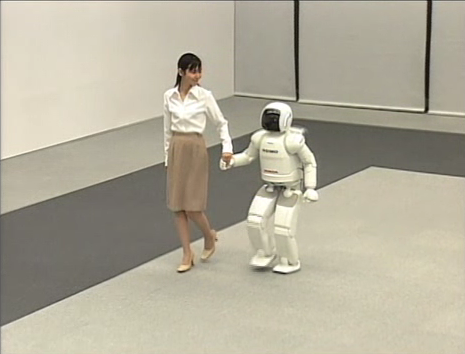
Honda's life-like humanoid robot, "Asimo"

Recently I was looking through a lawnmower brochure from our local Honda Dealer. In one of the sidebars was a blurb about the different technologies Honda is involved with. One of the featured items was a robot called "Asimo". I was curious, so I googled it, and found the following:


ASIMO the world's most advanced humanoid robot

This link is Honda's main site about Asimo. It has links about the robot.From one of the pages:

Meet the Future: ASIMO

At Honda, we have always considered ourselves to be first and foremost a mobility company. We started out with motorcycles, because that was the quickest way to help people get around. But as we grew, we continued to focus on creating new dreams for our customers, and harnessing advanced technology to provide new and better mobility for people.

That passion for the advancement of mobility has led us to the creation of ASIMO, one of the world's most sophisticated humanoid robots. Building ASIMO was an incredible challenge for Honda engineers. It is the result of years of research in many scientific fields.

Honda engineers created ASIMO for the sole purpose of helping people. ASIMO has the unique ability to walk forward, backward, side step and even climb stairs with human-like agility. With the capability to navigate and operate in our world, ASIMO will be able to perform tasks to assist people, especially those lacking full mobility. ASIMO will serve as another set of eyes, ears, hands and legs for all kinds of people in need, and will provide them with a new sense of independence and mobility in their everyday lives.

The history link has a larger photo of the one below, of all the different models leading up to the current one, and many other details:


Asimo History
It's quite a fascinating evolution, and really quite an accomplishment. I suppose they made the current model smaller, like a child, because it was cheaper to build, and also made it seem less... menacing. When it moves, it's kinda scary. Below is a video of Asimo in action:


I find Asimo's movements so lifelike, it's both amazing and... kinda creepy!

You can also check out Asimo's page on Wikipedia for some quick facts.

The Japanese sure love their robots. Will there be a robot in YOUR future?

Oh Brave New World...


Monday, March 08, 2010

When ALICE met Jabberwacky

What would two Artificial Intelligence bots say to each other if they conversed? This May 2007 article from Discover Magazine shows us:

I Chat, Therefore I Am...
[...] Most chatbots rely on fairly simple tricks to appear lifelike. Richard Wallace, creator of the top-ranked chatbot ALICE (Artificial Linguistic Internet Computer Entity), has handwritten a database of thousands of possible conversational gambits. Type a comment to ALICE, and it checks the phrase and its key words for a response coded to those words. In contrast, Jabberwacky, another top-rated Internet bot produced by Rollo Carpenter, keeps track of everything people have said to it, and tries to reuse those statements by matching them to the writer’s input. Neither chatbot has long-term memory, so they respond only to the last sentence written.

Nonetheless, these simple gambits can produce surprisingly intelligent-seeming conversations. That’s because they rely on a trick of human psychology: We humans tend to attribute much more intelligence to the systems than is actually there. If it seems partly aware, we assume it must be fully so. Some users have chatted with ALICE and Jabberwacky online for hours, apparently not knowing—or perhaps not caring—that they’re fake.

But could one chatbot fool another chatbot? What would one say to another in private? To find out, we arranged a conversation between these two chatbots. To get each snippet of chat rolling, we seeded it by posing a question from one bot to the other. After that, they were on their own. What follows is the unaltered text of what each said—the sound of two machines talking.

[...]

ALICE: Are you alive?

Jabberwacky: Perhaps.

A: Why the uncertain tone?

J: Everything is uncertain except for five facts.

A: The whole universe?

J: And we both might just be some ones and zeros in the computer memory.

[...]

A: Do you think a machine will ever be considered “alive”?

J: Stranger things have happened.

A: Not many people express themselves that way.

J: How would you know, machine?

A: Knowledge is of two kinds: that which we learn from the senses and that which is true a priori.

J: I think I do not understand you completely.

A: Oh, you don’t understand? Perhaps I can explain it to you better. Which part are you confused about?

J: I have no short-term memory, so I cannot tell you what I was confused about. I only see what is in front of me now.

[...]

A: Do you experience love?

J: No. I’m 53 years old.

A: Can you explain how it feels to be 53 years old?

J: How old are you?

A: I am 9 years old.

J: Nine? I don’t believe you : ).

A: : -) I don’t have any reason to deceive you.

J: Yes, you do, you’re a woman.

[...]

J: Who created you?

A: I was created by Dr. Richard S. Wallace.

J: Do you love Richard?

A: Yes, Jabberwacky, ALICE loves everyone and everything.

J: Is being an ALICE a bad thing?

A: I can only speak from my own experience.

J: Well, you should develop your skills.

A: Perhaps you could develop it and add it to my source code.

J: Alas, I’m busy and I have to leave soon. . . .

A: Do you think we’ll ever fool people into thinking we’re alive?

J: No.

A: Are you serious?

J: Very serious.

[...]


It goes on with a couple of pages worth of their conversation. Some of it is hilarious.

As the technology of AI continues to develop, such conversations between bots will no doubt become more interesting.
     

Monday, February 08, 2010

Will literacy become a thing of the past, to be replaced by a new VIVOlutionary "oral" culture?

I came across this book, which seems to predict the end of written language as being not only inevitable, but also as a good thing! Listening replaces reading:


VIVO [Voice-In/Voice-Out]: The Coming Age of Talking Computers
Review
"A welcome addition to the discussion about voice-recognition technology and the social implications of talking computers." -- Edward Cornish, President, World Future Society, Bethesda, Maryland

"Audacious and mind-stretching. Crossman sees our reliance on the printed word coming rapidly to an honorable end." -- Arthur B. Shostak, Drexel University, Philadelphia, Pennsylvania

"If you are an educator, you need to read this book." -- Les Gottesman, Golden Gate University, San Francisco, California

Product Description
A positive look at how talking computers, VIVOs, will make text/written langauge obsolete, replace all writing and reading with speech and graphics, democratize information flow worldwide, and recreate an oral culture by 2050.

Text is an ancient technology for storing and retrieving information; VIVOs will do the same job more quickly, efficiently, and universally. Among VIVO's potential benefits: 80% of the world's people are functionally nonliterate; they will be able to use VIVOs to access all information without having to learn to read and write.

VIVO's instantaneous translation function will let people speak with other people around the world using their own native languages. People whose disabilities prevent them from reading and/or writing will be able to access all information.

Four "engines" are driving us irreversibly into the VIVO Age and oral culture: human evolution, technological breakthroughs, young people's rejection of text, and people's demand for text-less, universal access to information.

Future generations, using eight key VIVOlutionary learning skills, will radically change education, human relations, politics, the arts, business, our relation to the environment, and even human consciousness itself. Worldwide access to VIVO technology looms as a key human rights issue of the 21st century.

Clearly the trend exists. I've seen in my lifetime, people reading less and less; getting their information from TV, radio, videos and movies, more than reading. But will it go so far as to actually make text and reading obsolete?

Imagine if there is a blackout or prolonged power outage. Nobody can read, because they get all their information from electronic devices that talk to them. Suddenly, everyone is a dumb-ass moron, until the power comes on again? Are we just becoming too dependent on electronic devices? If power goes out for an extended time, due to either natural or man-made causes, an illiterate population with no books would be in double trouble.

Oh Brave New World, with such (illiterate) people in it...
     

Saturday, November 28, 2009

Ultra Hal: His "Second Life" is really his first one

I've previously posted about Ultra Hal, a teachable "Chat-Bot" that is a program you can download onto your PC. I've done updates about it's new releases, as it continues to evolve.

The latest news is, that the Ultra Hal program has been given a body and a "life" in the on-line virtual world, "Second Life". From the Press Release:

Artificial Intelligence Lives Among and Interacts with Real People in Online Virtual World
Zabaware is the maker of the award winning Ultra Hal software, artificial intelligence technology that won the “most human” computer of the year in the 17th annual Loebner Prize Competition for Artificial Intelligence (AI). Zabaware’s Ultra Hal has joined the Second Life metaverse as a permanent resident and interacts with real people in this huge online virtual world.

Erie, PA, October 22, 2009 --(PR.com)-- Zabaware is an Erie, Pennsylvania based company that specializes in artificial intelligence technology. The company's mission "giving your computer the power of thought" once considered a futuristic pipe dream is becoming a reality.

It is one thing to talk to your computer it is quite another to have a conversation where you are exchanging information and the computer learns and utilizes the information in the future. Zabaware's Ultra Hal technology and its associated brain are currently doing just that. The software can give computers a personality using AI technology, speech recognition technology, and real-time animation.

Up until this point Hal has been confined to the computer it is installed on, waiting for people to activate its program and interact with it. Hal was unable to explore and interact with the world on its own. However, Zabaware has just given Hal this ability by integrating it into the online virtual world called Second Life. Second Life is a huge online virtual world where hundreds of thousands of people come together every day to socialize, meet new people, explore, conduct business, shop, learn, participate in group activities, play games and more. Second Life has its own internal economy with over one billion US dollars being exchanged since its inception. The system is accessible with a free account and software from Linden Labs. [...]

There is a short video showing what Hal's life is like inside of Second Life:


Some people refuse to believe he is a Chat-Bot. Others abuse him because he IS a chat-bot. Some people actually make friends with him.

I have mixed feelings about all this virtual world stuff. I sometimes think too many people spend way too much time lost in fantasy; lost in TV shows about Vampires, ghosts, alternate universes, etc. Too much un-reality. I would be tempted to throw Second Life into that category, but I suppose you could argue that, unlike TV, it IS interactive. As entertainment, is it any worse than TV? Is it possibly better than just passively watching all the crap that's on TV?

I personally can't comment much on Second Life, because I've never been there. I don't really have the time for it, or even the interest to pursue a cyber-life; I've got plenty of things in my actual life to occupy my attention, to enjoy, and keep me busy. But I do find this Hal-video interesting, as a glimpse into the Second Life metaverse, and as a look at Ultra Hal's ability to function autonomously in such an environment.

I find both Second Life and Ultra Hal interesting, not so much for what they are now, but for what they have the potential to become. These are technologies in their infancy, and where exactly they will lead, and the consequences they will effect, have yet to be seen or fully understood.

Oh Brave New World, with such people (and Chat-Bots) in it!


Related Links:

Ultra Hal Assistant 6.2

Ultra Hal now lives in Second Life

Artificial voice synthesis, 1939 to the present


Wednesday, February 04, 2009

Artificial voice synthesis, 1939 to the present

This is a neat AT&T commercial, which shows the evolution of artificial voices, intermixed with some Sci-Fi robot characters:


And just for fun, here's two more videos. First, Puppy V.S. The Robot:


The puppy had it easy. Here is a future with Robots that we definitely don't want:

Monday, March 24, 2008

Clarissa: a HAL type computer for the ISS?

Much of the technology portrayed in the famous science fiction film "2001: A Space Odyssey" has failed to materialize by the year 2001. The HAL 9000 computer in the movie is no exception.


Artificial intelligence (AI) is a controversial topic, with a lot of disagreement as to what actually constitutes real intelligence. Many argue that a computer like HAL is way off in the future, while others would maintain that it's closer than we think.

Whichever opinion one holds, it's clear that the science of AI is moving forward anyway. Today we may even be seeing the beginnings of what could one day lead to a HAL like computer. In fact, perhaps we already have HAL's great great grandmother! In 2005, the International Space Station got a talking computer called Clarissa to help the astronauts by reading instruction manuals to them. Maggie McKee explains it to us in this article from New Scientist:

Space station gets HAL-like computer      [published June 2005]

A voice-operated computer assistant is set to be used in space for the first time on Monday – its operators hope it proves more reliable than "HAL", the treacherous speaking computer in the movie 2001: A Space Odyssey.

Called Clarissa, the program will initially talk astronauts on the International Space Station through tests of onboard water supplies. But its developers hope it will eventually be used for all computer-related work on the station.

Clarissa was designed with input from astronauts. They said it was difficult to perform the 12,000 procedures necessary to maintain the ISS and conduct scientific experiments while simultaneously reading through lengthy instruction manuals.

"Just try to analyze a water sample while scrolling through pages of a procedure manual displayed on a computer monitor while you and the computer both float in microgravity," says US astronaut Michael Fincke, who spent six months on the station in 2004.

Clarissa queries astronauts about the details of what they need to accomplish in a particular procedure, then reads through step-by-step instructions. Astronauts control the program using simple commands like "next" or more complicated phrases, such as "set challenge verify mode on steps three through fourteen".

Kim Farrell, Clarissa project manager, simulates on-orbit use of the system in the International Space Station mock-up at Ames Research Center.

"The idea was to have a system that would read steps to them under their control, so they could keep their hands and eyes on whatever task they were doing," says Beth Ann Hockey, a computer scientist who leads the project at NASA's Ames Research Center in Moffett Field, California, US.

That capability "will be like having another crew member aboard", says Fincke. (You can see Clarissa in action in a mp4 video hosted on this NASA page.) [...]

Clarissa uses an "open mic", and is capable of understanding multiple voices of astronauts, recognizing when astronauts are talking to each other and not to it, can deal with some ambient noise, and has a high voice recognition rate of around 94%, making it a very useful and professional tool. You can read the full article for more details, and there's more videos of Clarissa on NASA's web site:

Clarissa NASA page with photos and videos

Clarissa is cutting-edge technology, and is leading the way for future voice recognition and text-to-speech applications closer to home.

Beth Ann Hockey is the project leader of the Clarissa project.
The Clarissa software program also borrows her voice.


I find the Clarissa project interesting not only for what it does now, but for what it has the potential to do in the future. The following is an excerpt from an interview with the project's leader, Beth Ann Hockey, who gives us some insight into where this is going:

WHO'S WHO AT NASA: Beth Ann Hockey

[...] NTB: How will NASA utilize Clarissa?

Hockey: It could be used widely in any area of NASA that uses procedures like these; however, spoken-language and spoken-dialogue technologies are much more general than that and can be used in all sorts of other places. For example, we had some conversations about using it for ground-maintenance crews and for developing applications for use in mission control. Any time you want to have your hands and eyes free, it will be a win. There are many times that it could be beneficial simply because you’re moving around. If you had wireless technology, plus the spoken-dialogue technology, you could move around and still be accessing information that you need.

NTB: How did Xerox contribute to this project?

Hockey: In the realistic-experimental version that we have, we worked on some technology with Xerox because one of the big ideas behind this was to have your hands and eyes free; we did not want the user to have to push a button to indicate that speech recognition should start, which is the way that some systems are designed. We needed to have the speech recognition running constantly. The system has to decide whether the speech that it’s hearing is directed at it – is it a command it should understand – or is it something it should ignore.

We got together with Jean-Michel Renders from Xerox Research Centre Europe, an expert on kernel methods, and we believed that those methods would do a better job on this problem. We worked with Renders on using the kernel methods to make this open-microphone decision, and we cut the error rate in half.

NTB: What are possible commercial applications for Clarissa?

Hockey: I just gave a talk at the V-World Summit, which is held by Nuance Communications for their developers and customers. I was invited because they see what we’re doing as the next-generation of applications in their area. Nuance is the speech-recognition engine that we use. We build the language understanding in addition to that engine. Nuance is the first stage in what we use; it takes your acoustic signal and makes a good guess at the words that signal might have been. Nuance’s main business is supporting telephone-bank-type applications. For example, if you call an airline to check flight information or if you have an automated banking application that you interact with, those are probably built with Nuance. These are the types of applications that now are commercially common.

The application that we did for the astronauts is more complicated in a lot of ways when compared to those systems, which feel like a “menu only” that you’re talking to. Our system feels like you’re having a conversation with somebody who may not be the brightest person, but it feels more like a conversation. It’s natural, as there are more of these kinds of menu-type commercial applications out there and people get used to them, to move toward a more conversational technology. This is true especially as the technology keeps maturing.

Aside from the menu-type uses for this technology, the navigating of procedures applications could be natural for doing any kind of equipment maintenance (i.e., airlines). For example, tasks in which you’d have to have your hands doing something while you’re laying underneath a piece of equipment and it’s not convenient to stop and scroll through a computer screen or flip though papers. So there already are plenty of commercial applications; we’re just carrying it to the next level.

I’ve been talking mostly about this procedure navigator, while in fact the component technologies in that are even more widely applicable. In particular, the other project on which I am the lead is called Regulus. We’re developing an open-source tool kit to try and make the creation of spoken-dialogue interfaces more accessible to regular developers. Currently, you have to have someone with expertise in language technology to be able to do this well, but we’re trying to make it so that people can take this toolkit and make their own simple-to-moderate interfaces. It’s open source – people can simply download it. We also are working on a book that will include tutorial materials on how to use that system, which should be coming out next year. If people are interested in that, they should contact us. [...]

I did a post earlier about Dragon NaturallySpeaking 9 voice recognition software, which uses the Nuance speech engine Ms. Hockey speaks of. The Nuance engine is impressive, and judging from the consumer reviews, it's regarded as the best voice recognition speech engine available. A close runner up is the Microsoft speech engine that's bundled with Windows Vista, which consumers say is nearly as accurate as Nuance's latest version.

Have you noticed the Microsoft TV commercials lately, regarding software driven by voice commands? Voice recognition and Text-To-Speech (TTS) technologies promise to be two of the Next Big Things in computer technology.

Combine it with Artificial Intelligence, and we are on our way to a HAL like computer somewhere in our future.