Showing posts with label Pacific rim. Show all posts

Friday, May 01, 2015

Underwater volcano active off Oregon coast

A volcano may be erupting off the Oregon coast, scientists say

Three hundred miles off the Pacific Northwest coast, the seafloor has been rumbling.

Over the past five months, there were hundreds of small earthquakes on most days at Axial Seamount.

Then on April 24, there was a spike: nearly 8,000 earthquakes. The seafloor level dropped more than two meters. Temperatures rose.

Scientists believe an underwater volcano is erupting.

An eruption is not a threat to coastal residents, researchers say, because the earthquakes are small, mostly magnitude 1 or 2, and the seafloor movements are relatively gradual, so they won't cause a tsunami.

The volcanic activity has no relationship to the Cascadia Subduction Zone, which scientists watch closely for signs of a much larger and more destructive earthquake.

To Bill Chadwick, an Oregon State University geologist, the eruption at Axial Seamount was not a surprise.

He had predicted it would happen this year. He predicted the previous eruption, in 2011, too.

Chadwick hopes the lessons he and his collaborator, Scott Nooner at the University of North Carolina Wilmington, learn from Axial Seamount can eventually be applied to volcanoes on land.

Land volcanoes have thicker crusts and are influenced by large earthquakes and other nearby volcanoes, among other things, so predictions are more difficult, Chadwick said.

"Axial Seamount is a pure example, if you will," he said. "It has relatively simple plumbing."

Chadwick and other scientists watch the signals at Axial Seamount in real-time via a cable laid out on the seafloor. The cable is part of the Ocean Observatories Initiative funded by the National Science Foundation. [...]
I doubt that it has nothing to do with the Cascadia Subduction Zone, since it is practically right on top of it. I presume they mean to say, that the volcano isn't signaling an imminent earthquake. As far as they can tell.

Read the whole thing for embedded links, photos and more.


Tuesday, May 07, 2013

Japanese Tsunami Debris on Oregon Coast

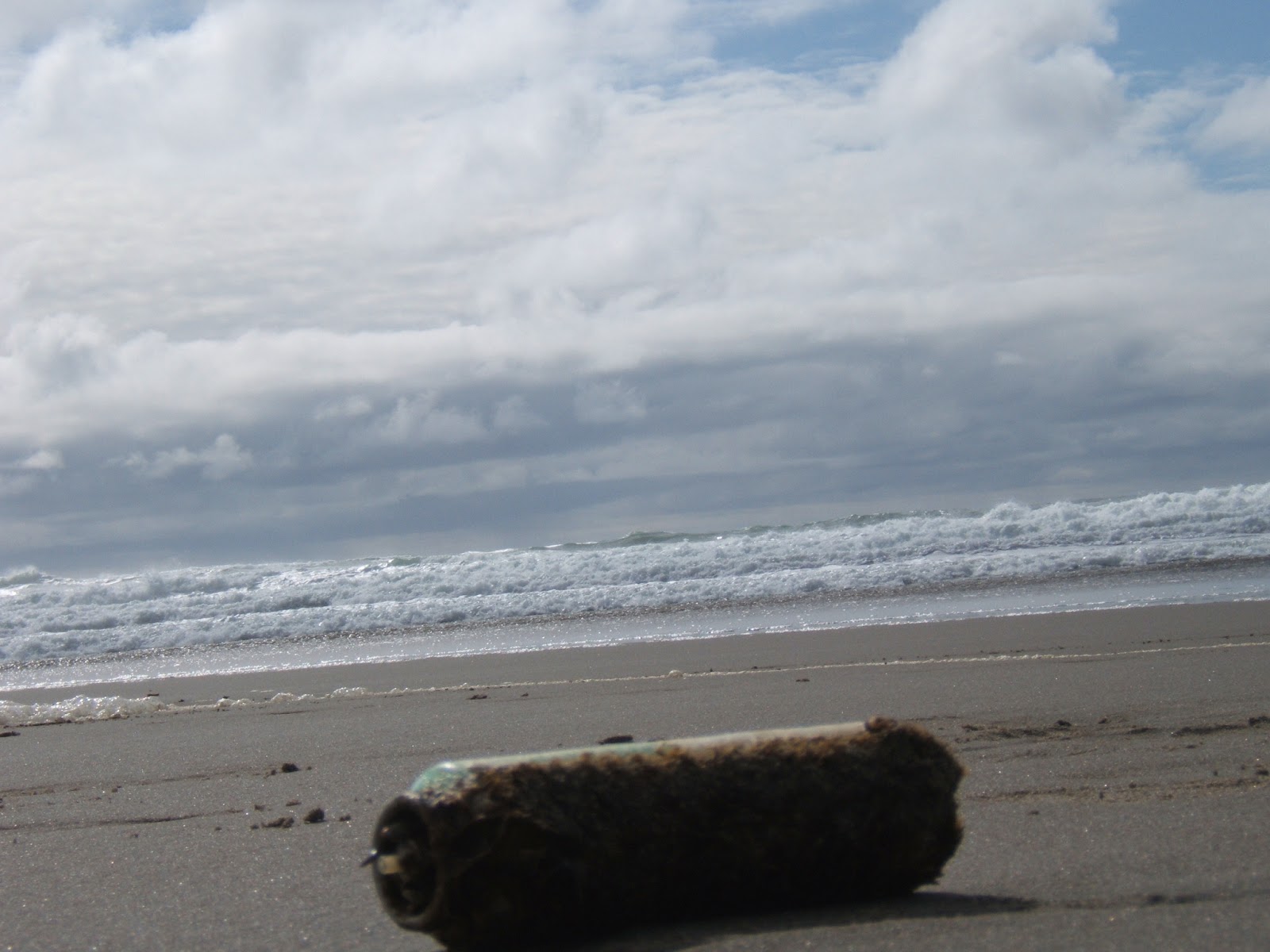
It's starting to arrive in greater quantities. A few Sunday's ago, I encountered my first piece. We were having a nice walk on a local beach:


It was another day in paradise. Just beautiful. Then I saw it:


A first I thought it was just an ordinary piece of rubbish. But then I saw the Japanese writing on it. It was a bottle of hairspray. It had floated in the ocean for a long time, so long that it had seaweed growing on it.

I could only wonder; had it been sitting on a shelf in a hair salon? Or on a ladies dressing table, or in someone's bathroom cabinet? Was it swept out to sea from someone's house - WITH the house? With people still in the house? All questions that can never be answered.


I left it there, bearing witness to a disaster far away, years ago. I continued my walk, and told myself I would pick it up on my way back down the beach. But on the way back, it was gone. Either someone else picked it up, or it went back to sea for a while, to remind someone else on another day.

Meanwhile, an article in the Vancouver Sun tells us that a Tsunami here would not be as bad as the earthquake that would cause it:

Monster earthquake would devastate Pacific Northwest, leaving thousands dead
But tsunami would be secondary issue for Lower Mainland, because Vancouver Island would take brunt of big wave: expert
A monster earthquake and tsunami would wreak havoc on B.C.’s west coast, but the effects would be far worse in Washington and Oregon states.

“I suspect there’d be a significant number of deaths in the Lower Mainland as a result of the shaking,” said Ronald Clowes, a crustal seismologist and professor emeritus at the University of B.C. “But the tsunami would be a secondary concern.”

Clowes spoke on Friday after researchers told Oregon legislators Thursday that more than 10,000 people could die when — not if — a monster earthquake and tsunami occur off the Pacific Northwest coast.

Coastal towns would be inundated; schools, buildings and bridges would collapse; and economic damage could hit $32 billion, the researchers said.

These findings were published in a chilling new report by the Oregon Seismic Safety Policy Advisory Commission, a group of more than 150 volunteer experts.

[...]

According to the Oregon report, the 2011 Japan quake and tsunami were a wake-up call for the Pacific Northwest. Governments have been taking a closer look at whether the region is prepared for something similar, and discovering it is not.

Oregon legislators requested the study so they could better inform themselves about what needs to be done to prepare and recover from such a giant natural disaster.

The report says that geologically, Oregon and Japan are mirror images. Despite the devastation in Japan, that country was more prepared than Oregon because it had spent billions on technology to reduce the damage, the report said.

Meanwhile, a third minor earthquake has struck off the north B.C. coast, the latest in a series that has rattled the area since last fall. [...]
I don't deny that there is a seismic hazard here. But I don't know how they can say "Oregon and Japan are mirror images". Japan has a long history of active earthquakes, which is why they are better prepared. Earthquakes in Oregon are few and far between, which is why we are not better prepared. I don't see how that makes us a "mirror image". Though I suppose if a large earthquake and resulting tsunami happen, it won't much matter what we call it.
   

Sunday, March 20, 2011

The Oregon Tsunami BUZZ is getting louder

It was buzzing before, but with recent events, the talk about tsunami preparation is getting even more attention now:

Japan quake brings a warning to Oregon
Senate President Peter Courtney likes to emphasize the dramatic. But he's not over-exaggerating when he talks about Oregon's potential for killer earthquakes and tsunamis.

The science is what scares him: The region's last great earthquake occurred Jan. 26, 1700. Geology shows that a cataclysmic quake occurs here every 241 years, on average. Basic math shows we're overdue for The Big One, a quake that will rival or exceed Japan's devastating 9.0 earthquake.

Bear in mind that thousands of people have died, and more are missing, even though Japan's earthquake preparations are far greater than Oregon's.

"We can build buildings and highways that will withstand this, but I don't know how much time we'll have," Courtney told the Statesman Journal Editorial Board last week. "It's very hard to get people to understand that this thing is going to be of a magnitude that is unimaginable." [...]

Of course, much of the rest of the article is all about how we don't have the money to build new earthquake/tsunami resistant bridges and structures, and how we have to go ahead and do it anyway.

If they hadn't already spent decades wasting our tax money on CRAP, spending way over budget, and raising taxes to the point that they've driven many revenue payers out of the state, we would have the money, or at least the ability to finance it.

They're concerned about a physical tsunami. Too bad they aren't equally concerned about the fiscal tsunami that our over-extended state government has helped to create. But that's another story. On with this one:

Oregon coast escaped loss of life in tsunami, but next time it could be different
[...] In wake of the tsunami, which caused millions of dollars in damage in Brookings Harbor, two main themes emerged in debriefings this week: the need for more education of the population and better communication with the public.

Emergency managers, coastal authorities and officials with the Oregon Department of Geology and Mineral Industries have spent a decade educating the public about tsunamis. DOGAMI has drawn initial inundation maps, outlining the danger zones, and many evacuation routes are in place. Most coastal counties have reverse 9-1-1 systems and sirens dot the coast.

Periodically, emergency officials hold conference room drills, running through tsunami procedures. All that snapped into play on Friday morning, as command posts were set up, calls went out and officials knocked on doors and scoured campsites as emergency managers fielded an calls from officials, the media and residents.

But in the wealth of information, with advisories, watches and warnings flowing from tsunami experts at the National Oceanic and Atmospheric Administration's center in Alaska, one simple message got lost: Tsunami waves arrive and then surge again and again and again over perhaps 24 hours.


"You don't get just one wave," said Ian Madin, chief scientist at DOGAMI. "You get a series of waves. It's like dropping a pebble into glass of water. With a tsunami, the second or third wave could be the largest."

[...]

Tsunamis are so infrequent in Oregon that people forget about the dangers -- and in this instance the state had hours to prepare.

When a powerful earthquake hits off the coastline along the Cascadia fault, people will have 20 minutes to flee.

"If you are knocked to the ground and it lasts two to three minutes, don't wait for somebody to tell you it's the big one, McCraw said. "You need to get to 50 feet elevation."

DOGAMI has a full-time staffer working on outreach along with county emergency managers, but Oregon's education effort is focused on the coast.

That misses the rest of the population who flock to the beach throughout the year, especially in summer.

"We are a nice tourist spot," McCraw said. "What would have happened if this had been the middle of July when we would have doubled our population in the county and had school kids on the beach?"

Burns said the state needs to push hotel, motel and rental owners to tack up warning signs that include show evacuation routes.

DOGAMI has drawn about 40 evacuation maps but most are based on pre-2006 data and some rely on information from 1995. Only Cannon Beach and the area from Bandon to Brookings have up-to-date maps. The department plans to finish its mapping of the coast by 2013 when a four-year $2.8 million grant from NOAA ends. At the same time, the public needs to prepare, officials say. [...]

On one of our ham radio nets, I heard someone speculate that we've seen earthquakes moving clockwise around the Pacific rim: Chile, New Zealand, Japan. "Maybe we're next" they said. Well if it's really traveling clockwise, I would guess Alaska might be next. But who knows?

I don't doubt the possibility of a tsunami threat; but it's impossible to predict. I also have to wonder which one is most imminent; the physical or the fiscal one? And many of the preparations of the former are also applicable in dealing with the aftermath of the latter. I suppose that's convenient.

Either way, I guess the Boy Scout motto applies.


Also see:

Oregon Coast must prepare for repeat of the Great Cascadia Earthquake of 1700 (links)