You know how you can hear something a hundred times in a hundred different ways before it finally gets through to you? The ten truths listed below fall firmly into that category – life lessons that many of us likely learned years ago, and have been reminded of ever since, but for whatever reason, haven’t fully grasped.Follow the link to read the other eight. With lots of embedded links. It's good stuff to remember, not just for the beginning of a new year, but for your whole life through.
This, my friends, is my attempt at helping all of us, myself included, “get it” and “remember it” once and for all…
1. THE AVERAGE HUMAN LIFE IS RELATIVELY SHORT
We know deep down that life is short, and that death will happen to all of us eventually, and yet we are infinitely surprised when it happens to someone we know. It’s like walking up a flight of stairs with a distracted mind, and misjudging the final step. You expected there to be one more stair than there is, and so you find yourself off balance for a moment, before your mind shifts back to the present moment and how the world really is.
LIVE your life TODAY! Don’t ignore death, but don’t be afraid of it either. Be afraid of a life you never lived because you were too afraid to take action. Death is not the greatest loss in life. The greatest loss is what dies inside you while you’re still alive. Be bold. Be courageous. Be scared to death, and then take the next step anyway.
2. YOU LIVE THE LIFE YOU CREATE FOR YOURSELF
Your life is yours alone. Others can try to persuade you, but they can’t decide for you. They can walk with you, but not in your shoes. So make sure the path you decide to walk aligns with your own intuition and desires, and don’t be scared to switch paths or pave a new one when it makes sense.
Remember, it’s always better to be at the bottom of the ladder you want to climb than the top of the one you don’t. Be productive and patient. And realize that patience is not about waiting, but the ability to keep a good attitude while working hard for what you believe in. This is your life, and it is made up entirely of your choices. May your actions speak louder than your words. May your life preach louder than your lips. May your success be your noise in the end.
And if life only teaches you one thing, let it be that taking a passionate leap is always worth it. Even if you have no idea where you’re going to land, be brave enough to step up to the edge of the unknown, and listen to your heart.
[...]
Showing posts with label philosophy. Show all posts
Showing posts with label philosophy. Show all posts
Thursday, December 31, 2015
Advice For Your Life
10 PAINFULLY OBVIOUS TRUTHS EVERYONE FORGETS TOO SOON

Tuesday, August 12, 2014
"Blondie", Satanism, and Christian Contemplativism
Two more interesting posts on the Philosophy for Life blog:
Crowley’s Children
Gary Lachman apparently saw through the Crowley philosophy, and wrote a book about him, showing what a flawed man he was. Thank goodness.
Just for the heck of it, here is a video from 1979 of the band Blondie performing the song "Heart of Glass":
I had come across that video recently, and so when I saw Blondie mentioned at the beginning of that blogpost, it drew me in.
And on that same blog, I also enjoyed reading this article, which is an interview with the Bishop of London:
The Bishop of London on Christian contemplation
Crowley’s Children
A couple of weeks ago, I wrote a blog-post analysing the video for Blondie’s Rapture, and pointing out the voodoo, occult and mystic symbolism in it. I wondered if Blondie were into that sort of thing, or perhaps I was seeing things. It turned out they were, and one of them – the bassist Gary Lachman – had even become a historian of the occult.Read the whole thing for embedded links, pics and videos. It was a fascinating read. Crowley's ideas pervade our society through pop culture. And when you see how Crowley ended up, it's not hard to see why many of his rock and roll followers crashed and burned. I love what the author, Jules Evans, says about the conscious and subconscious mind, and how Crowley used it, and the way Jules concludes the article. Good lessons for us all.
I met up with Gary in the British Library, to ask him about the influence of occult ideas on rock and roll – and particularly the ideas of Aleister Crowley. I’m interested in this because I’m interested in ecstatic states and how we reach them in modernity. Sex, drugs, rock n’ roll, and magic are part of that story. It’s not always a very nice story.
[...]
Crowley was a poster-boy for liberationist philosophy. It makes perfect sense that he would be picked up by rock and roll and later forms of pop music, because in many ways it’s tailor-made to the adolescent sensibility. Think of Jim Morrison’s ‘we want the world and we want it now’, or Iggy Pop: ‘I need more than I’ve ever done before.’ When you’re young you want to throw away all constraints on you. Crowley did that his whole life. His whole thing was excess in all directions.’
Liberationists want to liberate themselves from any social hang-ups, which means liberating themselves from traditional morality and even from reason itself. ‘Turn off your mind and float downstream’, as Timothy Leary said and John Lennon later quoted. Leary and other key figures in the 60s saw in Crowley a genius explorer of altered states of consciousness accessed through drugs, music, poetry and sex – just as they were trying to do. His Rite of Eleusis was a blueprint for the acid tests of the 1960s, and the raves of today – which also aim to bypass rational thought and get the audience into trances. [...]
Gary Lachman apparently saw through the Crowley philosophy, and wrote a book about him, showing what a flawed man he was. Thank goodness.
Just for the heck of it, here is a video from 1979 of the band Blondie performing the song "Heart of Glass":
I had come across that video recently, and so when I saw Blondie mentioned at the beginning of that blogpost, it drew me in.
And on that same blog, I also enjoyed reading this article, which is an interview with the Bishop of London:
The Bishop of London on Christian contemplation
[...] I have a simple map of spiritual reality. We spend most of our time at the mental ego level, on the surface, with the self negotiating the world around – a self which we have largely manufactured and confected. It is very difficult to get modern people to understand prayer is not just a form of thinking at that level. That’s one of the fundamental errors and difficulties people encounter at the beginning of learning to pray.The bold emphasis is mine. I found it interesting that, even though this is a different subject from the Crowley article, there are some parallel ideas expressed, about where people go wrong in looking for happiness. Not everyone finds happiness in the same way, but among the ways they do, there are often core ideas, realizations and truths, even inside of seemingly different philosophies. The perennial philosophy in philosophy, which is one of my favorite areas of interest.
At that mental ego level, there are often things of darkness which are unacknowledged. At the end of The Tempest, Prospero says of Caliban, ‘this thing of darkness I acknowledge mine’, but often those dark things are left unacknowledged within us. And much religion is really dangerous and I would say lethal, because it is in effect the surreptitious re-ascent of the bruised ego.
We project parts of ourselves – our anger, all kinds of personal psychic material – into the middle distance, deifying it and conducting a solipsist conversation. God is very often a projection of some of this unacknowledged material.
You can see it very clearly: the God which causes people to smite and slay. Sane religious cultures which have lasted for a very long time have discerned that the real fruits of the spirit are love, joy, peace and various other things. They certainly aren’t homicidal impulses.
So you have the mental ego level – and the adventure of prayer is to go beyond and beneath that – into the psychic zone, in which very often there are gifts of the spirit, charismatic gifts of various kinds – glossolalia, gifts of prophecy, and ecstatic utterance.
There is a great danger in falling in love with yourself once again as a spiritual person, in becoming too intrigued by these things, and to think ‘because I have these things I am a really serious Christian’. There has to be a continued Copernican revolution, and that revolution always turns us outwards in generosity to our fellows and in adoration to God. St Anthony the Great says we must see the Spirit in our neighbour, and love them.
But instead, what can happen when you have notable charismatic gifts, is once again a turning inwards, an admiration of the self. Lucifer the light-bringer fell, because he fell so in love with his own reflection.
And then after the psychic zone, there is what is called the heart, which for the Hebrews was not the blood pump, the heart for the Hebrews was the vitals, where the spiritual centre was actually located. And once you were quiet enough and had been educated by silence and stillness, and had gone through this journey, from time to time, you tasted from the eternal well-spring that there is at the heart of every life and all life, where the spirit is already there and praying in ways we can’t understand. [...]
Sunday, August 10, 2014
Distraction as a form of Therapy
These are from a philosophy blog I posted about last week:
Distraction therapy, or ‘shut up and deal’
Following a similar theme, another blog post is advice to a teenager, who decided after smoking Marijuana, that life was pointless, resulting in deep depression:
What’s the point in life?
Distraction therapy, or ‘shut up and deal’
[...] Sometimes, in the darkness, we need to give our minds a rest, and find a distraction. Games are good for that. It reminds me of Billy Wilder’s film, The Apartment. Shirley Maclaine’s character has tried to kill herself with an overdose. Jack Lemmon’s character finds her, resuscitates her, and then tries to keep her awake and busy by playing cards with her. When she asks him what’s the point in life, he replies: ‘shut up and deal’ – a line she repeats to him at the end of the film, when she has recovered and they’re in love.Read the whole thing. It actually starts with a letter from a reader, who talks about how his relentless search for meaning of the mysteries of life, lead to great and deep depression. And how he eventually got himself out of it, through distraction therapy, while still remaining a "seeker". The article then goes on to talk about how many of the great minds of history knew this, and how even modern medicine is recognizing it today.
One of the few philosophers who understood our need for distractions amid the existential confusion was Blaise Pascal, the 17th century French philosopher and mathematician. He’s a fascinating figure – he was one of the leading mathematicians of his age, he almost died in a riding accident, and then had a sort of near-death experience (known as his ‘nuit de feu’ or ‘night of fire’), after which he became a religious philosopher. But he’s fascinating even if you’re not theist - he’s really the first existentialist philosopher, in that he has an acute sense of the mystery of existence and the absurdity of human endeavour.
His Pensees, or ‘thoughts’, are a collection of brief meditations on existence. Here’s one of them: [...]

Following a similar theme, another blog post is advice to a teenager, who decided after smoking Marijuana, that life was pointless, resulting in deep depression:
What’s the point in life?
[...] This is exactly what I felt like when I was in late adolescence and early adulthood. And I think it’s a classic psychological journey. It’s the Fall of Genesis. It’s also what happened to the Buddha – happy teenager, then a sudden shock to his world-view, then a period of depression and searching. A lot of us go through the Fall when we’re in our late teens or early 20s. It’s a nasty surprise, not something our parents or teachers told us about, although it’s described in many books.There's a lot more, with embedded links too. Pretty good stuff!
The Fall is really an awakening. It’s our consciousness realizing that some of the things we believed in are actually a bit of a charade.
When I was 17 or so, I went through one of these awakenings – suddenly, the world seemed a rather sordid and selfish place. Everyone else seemed a bit of an egotistical phony, chasing after their shallow and pointless goals. Getting a career, getting a nice house with a nice lawn and a nice wife, getting a thousand followers on Twitter…what’s the point!
People are like greyhounds chasing after a mechanical rabbit, desperately trying to out-run each other, and if one of the greyhounds stops, scratches his arse and says ‘it’s just a mechanical rabbit’, they call him crazy.
And what lies beneath all the ego, all the desire, all the shadow puppetry? Nothing. The abyss. Human life is a game of charades played over a trapdoor of nothingness, and every now and then the trapdoor opens, one of the actors disappears below, and everyone goes on like nothing happened!
[...]
I didn’t exactly choose to awaken to the emptiness of constructed reality. It was an accidental awakening – maybe through drugs, which can alter our consciousness and make us see things differently. Some people go through similar accidental awakenings through, say, meditation – suddenly everything seems a bit empty and pointless. Or it might happen to them when they first lose someone they love. They notice the trapdoor beneath their feet and think: ‘what’s the point!’
This kind of awakening to the emptiness of our constructs has been called the Dark Night of the Soul. In truth, it happens occasionally through life. It comes with being human, unfortunately, and with being blessed / cursed with consciousness.
So how do we get out of it? How do we discover a sense of purpose or meaning?
People get out of the darkness two ways. Firstly, some people just fall asleep again. Life changes, and they stop thinking such deep thoughts, and get caught up in the game once more. Actually, this happens to everyone. You fall in love, you get a great job, you go on holiday, and things are fun again, and you shelve your inner Hamlet and enjoy the festivities.
There is nothing wrong with this at all. Sometimes the game of charades is a really fun game, and it’s fun to get involved, though unfortunately we often forget it’s just a game and end up totally believing in it and taking it very seriously.
Secondly, some people get out of the darkness by discovering a philosophy or an attitude that helps them through it and gives them a sense of meaning. Their old philosophy – ‘be happy-go-lucky’ - doesn’t quite work anymore, but they discover a new philosophy which works better.
I’ve turned to different philosophies to help me when I’m lost: Buddhism, Stoicism, Sufism, Taoism, Christianity. These are all quite different philosophies, but I think they have a core message to them.
Which is this: We’re here to know ourselves, to discover our nature, and to help other people do the same.
The journey to know ourselves is not an easy one. It involves a lot of wrong turns, a lot of dark forests, steep mountains and sinking swamps. And we meet bad people along the way, fools, liars, egotists, and people who wish us harm. What makes the journey particularly difficult is, when we ask passers-by how to get to our destination, they all give us different directions, and they all seem immensely confident that they’re right.
On this journey, I don’t think you can go backwards. You can’t go back to the Happy Valley of childhood. Frodo and Sam can’t go back to how things were, they’ve got to go forward. You have to go forward. Your consciousness grows – sometimes accidentally, sometimes through education and experience – and then it’s like you don’t fit into the old clothes any more, they feel cramped and ridiculous. That means it’s time to go forward. [...]
Saturday, August 02, 2014
Who was Epicurus? And more.
This blog page is probably the best thing I've read about Epicurus and Epicurians, it's answered most of my questions:
EPICUREANS
Who was Epicurus?
But the interesting thing is, the author of this blogpost has also written a book, Philosophy for Life and Other Dangerous Situations: Ancient Philosophy for Modern Problems, which sound quite interesting:
I find that exciting, because I've always been interested in cognitive therapy, and more recently, the philosophies of the Stoics, Epicurians and Buddhists. I've found myself wanting to learn from all of them, to get the best of each without having to embrace their weaker aspects; to in effect, benefit from their collective good, to use as a base in creating a happy, solid psychological foundation for dealing with life. Jules Evan's book sounds like it may be trying to do exactly that, so I'm adding it to my wish list!
Here is an excerpt from the book.
EPICUREANS
Who was Epicurus?
[...] How can we pursue pleasure as rationally as possible?Read the whole thing, it's good, and there's embedded links too. But as interesting as Epicurian philosophy is, I don't think I would embrace it completely. Like much of ancient philosophy, I find much of it useful, but don't find the whole of it completely embraceable.
Like the other philosophies of the Socratic tradition, Epicureans believed that what causes humans suffering is our false beliefs. In particular, we have many false beliefs about what is necessary for our happiness. We put a great value on some external goods such as status and luxury, because we think they will make us happy. In fact, Epicurus says, many of these external goods are not good for us at all, and the pursuit of them only makes us more miserable.
Epicurus said that, for each belief or action, we should consider the pleasure it will lead to, and the pain, and then ‘measure the one against the other’. Some activities lead to a short-term spike in pleasure, such as heavy drinking, but ultimately lead to pain, in the form of hangovers, sick bodies and damaged relationships. We should restrict our desires to what is necessary and easy to attain, Epicurus says. So actually, contrary to the popular image of Epicureans as libertines, Epicurus and his followers lived quite austere lives, following a simple diet and not having many possessions.
Where’s the fun in that?
The simpler and less complicated your needs, the freer and less anxious your life. If you come to depend on luxuries, you’ll then have to work hard to support your lifestyle – and slaving away in a boring or stressful job is no fun. By restricting one’s desires to what is necessary and easy to attain, you free up more time for the good things in life: friendship and philosophy. It’s a sort of intelligent slacker philosophy that has quite a lot in common with the Idler philosophy of Tom Hodgkinson, who we meet at the beginning of the chapter. There are even some ‘life-coaches’ today, such as Stefan Streitferdt, who teach Epicurean philosophy as a way to prioritise your life and avoid unnecessary stress.
[...]
Don’t the Stoics use a similar cognitive technique?
Yes, the technique was also taken up by Stoic writers like Seneca and Marcus Aurelius. They agreed with the Epicureans that it’s only in the present moment that we have any control. We don’t control the past – it’s already happened. And we don’t control the future. So the more we focus on the past and the future, the more we are disempowering ourselves. If we bring our attention back to the present, we are re-empowering ourselves, and being more efficient in our use of attention and energy.
We see a similar idea in Buddhism, of course, which developed a whole arsenal of techniques for bringing the attention back to the present moment. And this idea of focusing on the present moment, and our beliefs in the present, has been taken up in the last few years by Cognitive Behavioural Therapy (CBT) and by Acceptance and Commitment Therapy (ACT) . Both CBT and ACT insist that the way to get over emotional disorders is not by diving into the past and ruminating over all your conflicts with your parents, as psychoanalysis might get you to do. It’s wiser and more effective to bring your attention back to the present, to your beliefs in the here-and-now. As Seneca puts it: ‘What’s the use of dragging up sufferings that are past, of being miserable now, because you were miserable then?’
There’s also something mystical in the technique of focusing on the present moment. It’s telling us that everything we need in life is right here, right now, in our consciousness of the eternal moment. The more we bring our attention back to the present moment, the more we can savour it, appreciate it, and enjoy the strange wonder of being alive and conscious in the universe. We see some of this sense of the mystery and wonder of the present moment in the work of Eckhart Tolle. Here’s a video of Tolle talking about Marcus Aurelius’ use of the technique.
OK, but what if the present moment is actually pretty challenging. What if we’re suffering from a serious or painful illness, for example?
[...]
But the interesting thing is, the author of this blogpost has also written a book, Philosophy for Life and Other Dangerous Situations: Ancient Philosophy for Modern Problems, which sound quite interesting:
When philosophy rescued him from an emotional crisis, Jules Evans became fascinated by how ideas invented over two thousand years ago can help us today. He interviewed soldiers, psychologists, gangsters, astronauts, and anarchists and discovered the ways that people are using philosophy now to build better lives. Ancient philosophy has inspired modern communities — Socratic cafés, Stoic armies, Epicurean communes — and even whole nations in the quest for the good life.I enjoyed the reviews by readers, many of whom say that the author talks about many of the teachings of the philosophies of the ancients, along with modern cognitive therapy concepts, giving the old teachings new relevance for our modern lives.
This book is an invitation to a dream school with a rowdy faculty that includes twelve of the greatest philosophers from the ancient world, sharing their lessons on happiness, resilience, and much more. Lively and inspiring, this is philosophy for the street, for the workplace, for the battlefield, for love, for life.
I find that exciting, because I've always been interested in cognitive therapy, and more recently, the philosophies of the Stoics, Epicurians and Buddhists. I've found myself wanting to learn from all of them, to get the best of each without having to embrace their weaker aspects; to in effect, benefit from their collective good, to use as a base in creating a happy, solid psychological foundation for dealing with life. Jules Evan's book sounds like it may be trying to do exactly that, so I'm adding it to my wish list!
Here is an excerpt from the book.
A final blog post
Not from me, but from the Being Human blog, which I had been reading because of the interesting links to philosophy. His last entry talks about his terminal illness, and the final things he had to say. It's quite sobering:
Is it finally time to say goodbye?
Thank you, Jaakko Wallenius. R.I.P.
Is it finally time to say goodbye?
The Being Human -blog that you are reading just now is at the moment a collection of 434 smaller and larger essays. Their subjects range from the nature of our universe to things like the reasons why masturbation is seen as a sin in Christianity. I started this blog in December of 2007, and this blog has since had over 860 000 visitors from all over the world.There is much more. He talks quite a bit about the things that were important in his life, and that helped him. I had linked to some of his posts in the past, and am very grateful for his contribution to my education, about things I've wanted to learn about.
During all these years, I have told very little of myself. My aim has been to air my ideas and not promote myself. This blog is not weblog, but a collection of little essays. Not a single posting has been tied to a particular daily event or happening. They try always to be reflections on ideas on a bit wider perspective. How I have succeeded in this, remains for my readers to judge, of course.
Things are about to change. Just now I see a need to record some of my personal history also here in this blog that has always been the favorite child among my blogs. The basic reason for this is that was diagnosed with inoperable cancer in November of 2011. Cancer was by then already deeply embedded in my liver and lungs. It simply cannot be removed from liver without destroying the liver also, anymore.
I am still here thanks to chemotherapy that has given me an additional year and a half, but the therapies were terminated a week ago because their ability to fight my cancer has waned off. I am on my own now, but nobody knows how soon the end will come. However, it is quite certain that I will not see my 56th birthday in January of 2014. [...]
Thank you, Jaakko Wallenius. R.I.P.
Sunday, June 29, 2014
The perennial philosophy in philosophy
Aldous Huxley wrote about The Perennial Philosophy that runs through all theologies. It's made me think recently, about the commonalities that run through many philosophies.
Recently, I've posted about Buddhism as a philosophy. More recently still, I've been reading about Epicureans and Stoics, and have been struck by the similarities they share with each other, and with Buddhist philosophy.
I'm not the only one who has noticed:
Buddhism, Epicureanism, and Stoicism
While reading about the Stoics, I came across this informative timeline on the Stoics' wikipedia page:

Since I don't have a lot of leisure time to study philosophy, I decided to cut to the chase and read Marcus Aurelius, who seems to be the culmination of the stoic philosophers. I had read a little bit of his writing in the past, and was favorably impressed, so I've ordered a book of his meditations.
Even though Marcus was a Stoic, he had studied Epicurus. I wondered if one could mix Marcus Aurelius and Epicurianism as practical wisdom for a good life? It seems I am not the first one to ask that question:
Can one mix Epicurus and Marcus Aurelius to create a great recipe for a good life?
I think we are blessed to have so many great minds from the past that we can still learn from. Wisdom we can build on. I'm very much enjoying all this!
Also see:
"Never let the future disturb you" or Marcus Aurelius and Epicurus on foundations for a good life
Recently, I've posted about Buddhism as a philosophy. More recently still, I've been reading about Epicureans and Stoics, and have been struck by the similarities they share with each other, and with Buddhist philosophy.
I'm not the only one who has noticed:
Buddhism, Epicureanism, and Stoicism
[...] Stoics aimed not at getting rid of emotions (despite the popular caricature of Stoics as Spock-like figures), but rather to channel them in a more productive direction. This was achieved through a combination of logic, concentration and reflection, and eventually evolved into various contemporary forms of cognitive behavioral therapy. (In this sense, both Buddhism — with its various meditative techniques — and Stoicism have entered the realm of modern practices, which can be pursued essentially independently of the philosophies that gave origin to them.) The ultimate goal of the Stoic was apatheia, or peace of mind, which I think is akin to both the Epicurean ideal of ataraxia and the Buddhist goal of nirvana (again, with due consideration given to the significant differences in the background conditions and specific articulation of the three philosophies). And of course Stoics too had a ready-made recipe for their philosophy, in the form of a short list of virtues to practice (nothing compared to the above mentioned panoply of Buddhist lists though!). These were: courage, justice, temperance and wisdom.Read the whole thing, for a thoughtful comparison of the three philosophies. And for the embedded links, and some interesting comments afterward.
I am sure one could continue with this conceptual cross-mapping for a while, and of course scholars within each of the three traditions would object to or modify my suggestions. What I am interested in here, however, is pursuing the further questions of what the common limitations of the philosophies of Buddhism, Epicureanism and Stoicism are, as well as what positive contributions they have made to humanity's thinking about (and dealing with!) the universe.
I am inclined to reject both Buddhism’s and Stoicism’s metaphysics, being significantly more happy with the Epicurean view of the world. I don’t think there is any reason to think that concepts like logos or karma have any philosophical substance, nor do they do any work in actually explaining why things are the way they are. The Epicurean embracing of a materialist metaphysics, instead, is in synch with the development of natural philosophy and eventually of modern science. [...]
While reading about the Stoics, I came across this informative timeline on the Stoics' wikipedia page:

Since I don't have a lot of leisure time to study philosophy, I decided to cut to the chase and read Marcus Aurelius, who seems to be the culmination of the stoic philosophers. I had read a little bit of his writing in the past, and was favorably impressed, so I've ordered a book of his meditations.
Even though Marcus was a Stoic, he had studied Epicurus. I wondered if one could mix Marcus Aurelius and Epicurianism as practical wisdom for a good life? It seems I am not the first one to ask that question:
Can one mix Epicurus and Marcus Aurelius to create a great recipe for a good life?
It is time to present two of my all-time favorites among humanistic thinkers of the past. Number one on my list is early Greek philosopher Epicurus. He did create a comprehensive and wholly rational recipe on how to attain a maximal state of peace of mind.
My second choice is the Roman emperor-philosopher Marcus Aurelius. He did teach how to use self-restraint for achieving tranquility of mind.
These two great men had much in common. Marcus Aurelius was well aware of the teachings of the much earlier Epicurus, even if he belonged to a competing school of philosophy. Marcus Aurelius was a Stoic and Stoicism did compete for followers with Epicureanism in the time of Marcus Aurelius.
Stoics did, in fact, at times pour scorn over Epicurus. However, the fact remains that their philosophy contains very many elements that were taken quite straight out of Epicureanism. Many ideas that were presented by Marcus Aurelius could have as well been uttered by Epicurus or his followers as well. [...]
 |
| Marcus Aurelius |
I think we are blessed to have so many great minds from the past that we can still learn from. Wisdom we can build on. I'm very much enjoying all this!
Also see:
"Never let the future disturb you" or Marcus Aurelius and Epicurus on foundations for a good life
Friday, June 20, 2014
Buddhism: a philosophy for the 21st century?
NOT a religion, but a philosophy. I've recently finished reading this book:

Awakening the Buddha Within: Tibetan Wisdom for the Western World
There was much I simply could not agree with. In fact, it very much reminded me of why I never pursued Buddhism, even though I like a lot of the things the Buddha is said to have taught. Every time I've tried to learn more about Buddhism, there would be something irrational that would put me off.
I felt that many times while reading this book, but it was a mixture of things, it wasn't all off-putting. I persevered with it, and by the end I was glad I did. I bought the book in the first place because I was hoping that it would:
A.) Teach me about Tibetan Buddhism.
B.) Be an interesting story of the life Surya Das (formerly known as Jeffrey Miller from Long Island) chose for himself, becoming a Tibetan Buddhist Lama.
C.) Teach me some things I could integrate into my own life.
In the end, I have to say it did all of those things. Surya Das has lead a life I would not have liked to have had, but thankfully he did it and I got to read about it and get the benefit of his insights from that, without having to do it myself. Sometimes you can learn a lot from a book, even if you don't agree with much of what it says. It challenges your ideas and makes you think. This was one of those books.
While reading the book, I found myself looking up a lot of things he was referring to on the internet. It was on-line that I found this essay by Sam Harris. I found myself agreeing with much of it:
Killing the Buddha
Read the whole essay for embedded links and more. Harris expounds further on some of the ideas mentioned in the above excerpts, as he makes his case, and it's a good read. But back to the "Awakening the Buddha Within" book:
At the end of that book, even Jeffrey - oops, excuse me, "Surya Das" - said there were many types of Buddhism, and that one didn't have to embrace or believe in many of the beliefs held by Buddhists, or even believe in God. In the end, he said you could take from it what you wanted or needed.
I appreciated the lack of insistence on following dogma, but also found it a little ironic that he seemed to be indirectly supporting at least a portion of Sam Harris's essay; that Buddhist teachings don't have to be mixed up with religion.
I would not go so far as to say the two authors agree, but they seem close to agreement on some points. I think perhaps that Das is saying the teachings don't have to be mixed with religion, whereas Harris is more forcefully arguing that they should not be. That's not agreement, but pretty darn close.
Also see:
On criticizing fellow Buddhists
The tyranny of "Consensus Buddhism"!
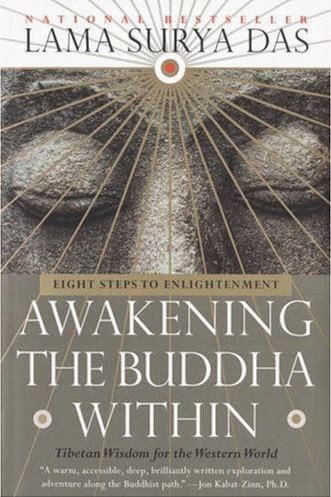
Awakening the Buddha Within: Tibetan Wisdom for the Western World
Lama Surya Das, the most highly trained American lama in the Tibetan tradition, presents the definitive book on Western Buddhism for the modern-day spiritual seeker.I actually struggled with this book quite a bit. There were several times, where I almost quit reading it.
The radical and compelling message of Buddhism tells us that each of us has the wisdom, awareness, love, and power of the Buddha within; yet most of us are too often like sleeping Buddhas. In Awakening the Buddha Within, Surya Das shows how we can awaken to who we really are in order to lead a more compassionate, enlightened, and balanced life. It illuminates the guidelines and key principles embodied in the noble Eight-Fold Path and the traditional Three Enlightenment Trainings common to all schools of Buddhism:
Wisdom Training: Developing clear vision, insight, and inner understanding -- seeing reality and ourselves as we really are.
Ethics Training: Cultivating virtue, self-discipline, and compassion in what we say and do.
Meditation Training: Practicing mindfulness, concentration, and awareness of the present moment.
With lively stories, meditations, and spiritual practices, Awakening the Buddha Within is an invaluable text for the novice and experienced student of Buddhism alike.
There was much I simply could not agree with. In fact, it very much reminded me of why I never pursued Buddhism, even though I like a lot of the things the Buddha is said to have taught. Every time I've tried to learn more about Buddhism, there would be something irrational that would put me off.
I felt that many times while reading this book, but it was a mixture of things, it wasn't all off-putting. I persevered with it, and by the end I was glad I did. I bought the book in the first place because I was hoping that it would:
A.) Teach me about Tibetan Buddhism.
B.) Be an interesting story of the life Surya Das (formerly known as Jeffrey Miller from Long Island) chose for himself, becoming a Tibetan Buddhist Lama.
C.) Teach me some things I could integrate into my own life.
In the end, I have to say it did all of those things. Surya Das has lead a life I would not have liked to have had, but thankfully he did it and I got to read about it and get the benefit of his insights from that, without having to do it myself. Sometimes you can learn a lot from a book, even if you don't agree with much of what it says. It challenges your ideas and makes you think. This was one of those books.
While reading the book, I found myself looking up a lot of things he was referring to on the internet. It was on-line that I found this essay by Sam Harris. I found myself agreeing with much of it:
Killing the Buddha
“Kill the Buddha,” says the old koan. “Kill Buddhism,” says Sam Harris, author of The End of Faith, who argues that Buddhism’s philosophy, insight, and practices would benefit more people if they were not presented as a religion.
The ninth-century Buddhist master Lin Chi is supposed to have said, “If you meet the Buddha on the road, kill him.” Like much of Zen teaching, this seems too cute by half, but it makes a valuable point: to turn the Buddha into a religious fetish is to miss the essence of what he taught. In considering what Buddhism can offer the world in the twenty-first century, I propose that we take Lin Chi’s admonishment rather seriously. As students of the Buddha, we should dispense with Buddhism.
[...]
For the fact is that a person can embrace the Buddha’s teaching, and even become a genuine Buddhist contemplative (and, one must presume, a buddha) without believing anything on insufficient evidence. The same cannot be said of the teachings for faith-based religion. In many respects, Buddhism is very much like science. One starts with the hypothesis that using attention in the prescribed way (meditation), and engaging in or avoiding certain behaviors (ethics), will bear the promised result (wisdom and psychological well-being). This spirit of empiricism animates Buddhism to a unique degree. For this reason, the methodology of Buddhism, if shorn of its religious encumbrances, could be one of our greatest resources as we struggle to develop our scientific understanding of human subjectivity.
[...]
Religion is also the only area of our discourse in which people are systematically protected from the demand to give evidence in defense of their strongly held beliefs. And yet, these beliefs often determine what they live for, what they will die for, and—all too often—what they will kill for. This is a problem, because when the stakes are high, human beings have a simple choice between conversation and violence. At the level of societies, the choice is between conversation and war. There is nothing apart from a fundamental willingness to be reasonable—to have one’s beliefs about the world revised by new evidence and new arguments—that can guarantee we will keep talking to one another. Certainty without evidence is necessarily divisive and dehumanizing.
Therefore, one of the greatest challenges facing civilization in the twenty-first century is for human beings to learn to speak about their deepest personal concerns—about ethics, spiritual experience, and the inevitability of human suffering—in ways that are not flagrantly irrational. Nothing stands in the way of this project more than the respect we accord religious faith. While there is no guarantee that rational people will always agree, the irrational are certain to be divided by their dogmas.
[...]
What the world most needs at this moment is a means of convincing human beings to embrace the whole of the species as their moral community. For this we need to develop an utterly nonsectarian way of talking about the full spectrum of human experience and human aspiration. We need a discourse on ethics and spirituality that is every bit as unconstrained by dogma and cultural prejudice as the discourse of science is. What we need, in fact, is a contemplative science, a modern approach to exploring the furthest reaches of psychological well-being. It should go without saying that we will not develop such a science by attempting to spread “American Buddhism,” or “Western Buddhism,” or “Engaged Buddhism.”
If the methodology of Buddhism (ethical precepts and meditation) uncovers genuine truths about the mind and the phenomenal world—truths like emptiness, selflessness, and impermanence—these truths are not in the least “Buddhist.” No doubt, most serious practitioners of meditation realize this, but most Buddhists do not. Consequently, even if a person is aware of the timeless and noncontingent nature of the meditative insights described in the Buddhist literature, his identity as a Buddhist will tend to confuse the matter for others.
There is a reason that we don’t talk about “Christian physics” or “Muslim algebra,” though the Christians invented physics as we know it, and the Muslims invented algebra. Today, anyone who emphasizes the Christian roots of physics or the Muslim roots of algebra would stand convicted of not understanding these disciplines at all. In the same way, once we develop a scientific account of the contemplative path, it will utterly transcend its religious associations. Once such a conceptual revolution has taken place, speaking of “Buddhist” meditation will be synonymous with a failure to assimilate the changes that have occurred in our understanding of the human mind.
It is as yet undetermined what it means to be human, because every facet of our culture—and even our biology itself—remains open to innovation and insight. We do not know what we will be a thousand years from now—or indeed that we will be, given the lethal absurdity of many of our beliefs—but whatever changes await us, one thing seems unlikely to change: as long as experience endures, the difference between happiness and suffering will remain our paramount concern. We will therefore want to understand those processes—biochemical, behavioral, ethical, political, economic, and spiritual—that account for this difference. [...]
Read the whole essay for embedded links and more. Harris expounds further on some of the ideas mentioned in the above excerpts, as he makes his case, and it's a good read. But back to the "Awakening the Buddha Within" book:
At the end of that book, even Jeffrey - oops, excuse me, "Surya Das" - said there were many types of Buddhism, and that one didn't have to embrace or believe in many of the beliefs held by Buddhists, or even believe in God. In the end, he said you could take from it what you wanted or needed.
I appreciated the lack of insistence on following dogma, but also found it a little ironic that he seemed to be indirectly supporting at least a portion of Sam Harris's essay; that Buddhist teachings don't have to be mixed up with religion.
I would not go so far as to say the two authors agree, but they seem close to agreement on some points. I think perhaps that Das is saying the teachings don't have to be mixed with religion, whereas Harris is more forcefully arguing that they should not be. That's not agreement, but pretty darn close.
Also see:
On criticizing fellow Buddhists
The tyranny of "Consensus Buddhism"!
Monday, January 13, 2014
Lifelong Learning, and Resiliency
Two topics I've been interested in, and two articles about them on one of my favorite websites:

How and Why to Become a Lifelong Learner
Building Your Resiliency: Part V – Recognizing and Utilizing Your Signature Strengths

How and Why to Become a Lifelong Learner
For the first twenty-two years or so of our lives, our main “job” is learning. The bulk of our time is spent in classrooms acquiring new knowledge. And then, once we graduate, we feel like the education phase of our lives is done and now it’s time to go out into the world. Have you ever thought about how odd that idea is? That only a quarter of our lives should be devoted to learning, and then we should simply rest on our laurels for the remaining three-quarters of it?It goes on to give examples, and more. Lots of good links, I thoroughly enjoyed it. One of the links was this:
It’s an erroneous idea – but one many have absorbed, at least subconsciously. But school need not be your exclusive provider of learning. Just because you’ve finished your formal education, doesn’t mean that your education is over!
Many, perhaps most, of history’s greatest men were autodidacts – those who devote themselves to self-education, either in addition to or as a substitute to formal schooling. [...]
Building Your Resiliency: Part V – Recognizing and Utilizing Your Signature Strengths
This is the fifth part in a series designed to help you boost your resiliency. For the previous entries, see Part I, Part II, Part III, and Part IV.Again, it's full of interesting links. And this article is part of a series, so I can look forward to reading them all.
When we first introduced the topic of resiliency, we discussed how it is both a reactive and an active quality, a skill that helps you bounce back and reach out.
Today’s discussion will center on the active aspect of resiliency and the path to gaining the confidence to take risks and embrace change.
Anchoring Your Resiliency in Your Authentic Self
When your self-esteem and sense of self-worth is tied to other people, your job, or any other external factors, your confidence is subject to every wind of change and lacks real stability. Any time these external factors change, your happiness and confidence go with it. Your emotional fortitude goes up and down like a roller coaster.
Tying your self-concept to external factors also keeps you from embracing adventure and approaching the world like a courageous explorer. If you base your self-concept on external things, any changes in those things will throw you for a loop, create anxiety, and compel you to cling as tightly as you can to the status quo. You become desperate to keep your life just the way it is and can’t handle change. You avoid traveling, moving, changing jobs, and getting into relationships because these steps alter the environment on which you’ve based your self-concept, leaving you feeling lost and out of control
The key to active resiliency is to build your self-concept not on a constructed self, but on an authentic self, not on external things, but on the inner, personal strengths that make you unique as a man. Your unique strengths are your special tools that will allow you to build a happy and fulfilling life. Understanding what tools you possess can give you the confidence that you’ll be able to face any challenge that comes your way. While we can’t predict the future, we can have confidence in our ability to deal with whatever happens. [...]
Saturday, December 28, 2013
Ever Hear of The Sterling Stone?
I hadn't, till I read this:
What E’er Thou Art, Act Well Thy Part


I'd love to have a replica of one for my office. And a HUGE one for Congress!
What E’er Thou Art, Act Well Thy Part

Over the door of a building that sits close to the Stirling Castle in southern Scotland, hangs a curious stone designed by John Allan, a 19th century architect known for his peculiar designs, as well as including inscriptions in his work.
At the top of this particular piece, Allan had carved a quote typically attributed to Shakespeare: “What e’er thou art, act well thy part.” Below the quotation sits a grid of nine squares, each bearing different symbols and shapes.

The design forms what is called a “magic square.” Each of the symbols represents a numerical value, and no matter which way you add the numbers up, they always total 18. If any of the numbers are moved or replaced with another, the tiles will no longer add up to 18, and the square will lose its “magic.” Each symbol has an irreplaceable part to play in contributing to the whole.The rest of the article elaborates on that sentiment. A nice one to carry forward into the New Year.
I have a replica of the Stirling stone sitting in my office. It reminds me that whatever part I have to play in my family, community, or work — whether it’s a big role or a seemingly minor one — it’s up to me to carry out my responsibilities the very best I can. The Stirling stone also reminds me that true happiness and fulfillment in life comes not from being recognized, but from being useful to the world around me.
For any group or culture to function as it was intended and reach its full potential, everyone must pull their own weight, from those doing the “grunt” work to those at the top of the pile. The idea that you should do your best – even in the small and obscure roles of life — isn’t a particularly sexy principle, but one much needed in our world. [...]
I'd love to have a replica of one for my office. And a HUGE one for Congress!
Saturday, December 22, 2012
A Criticism of Critics
I enjoyed reading this:
There's A Meanness Abroad in the Land
The writer here was talking about a negative review he read of the movie "The Hurt Locker". I love what he said about that. He also ended it with a quote from the composer Jean Sibelius, which made me chuckle.
There's A Meanness Abroad in the Land
[...] In many of the reviews I read daily, on a whole range of subjects besides filmmaking, I am so struck with the underlying view the critics seem to have about intelligence. Review after review bespeaks the idea of "look how intelligent I am, I can see – more than most – everything that's wrong with this." (Whatever the this may be.) I was raised with a very different view of intelligence: it valued "look how intelligent I am, I can see – more than most – all the things there are to appreciate, about this."The other day at dinner, were were talking about people we know (or have known) who are habitually critical and fault finding, and how unhappy they are as a result. This reminded me of that. I know that criticism has it's place, but you sure need to balance it, if you want to be happy.
In our day, and perhaps in other days as well, it is a far rarer soul who makes appreciation the defining motif of his or her life, than those who make criticism their defining goal. Criticism is easy; it takes no brains to say what's wrong with something. Appreciation however, is difficult; you sometimes have to fight to see things to appreciate, digging for example beneath ugly surface impressions, to see some shining beauty underneath. That's why prejudice flourishes. It takes brains to see what there is to appreciate in every man and woman who was ever born. Which should be the goal of every intelligent man or woman. Civilization never decays or vanishes because of a lack of criticism in a society; it decays or vanishes because of a lack of appreciation in that society. As a direct consequence of this, that society tends to preserve the commonplace, while it casually throws away treasures. And criticism causes more meanness to be abroad, in the land.
Every critic begins with assumptions, usually unexamined, that they use to justify their hammering the thing they are examining. [...]
The writer here was talking about a negative review he read of the movie "The Hurt Locker". I love what he said about that. He also ended it with a quote from the composer Jean Sibelius, which made me chuckle.
Thursday, September 27, 2012
Middle Age Musings and A Tender Heart
Martin Amis Contemplates Evil
"Midlife Is A Crossroads, Not A Crisis"
[...] “Your youth evaporates in your early 40s when you look in the mirror. And then it becomes a full-time job pretending you’re not going to die, and then you accept that you’ll die. Then in your 50s everything is very thin. And then suddenly you’ve got this huge new territory inside you, which is the past, which wasn’t there before. A new source of strength. Then that may not be so gratifying to you as the 60s begin [Amis is 62], but then I find that in your 60s, everything begins to look sort of slightly magical again. And it’s imbued with a kind of leave-taking resonance, that it’s not going to be around very long, this world, so it begins to look poignant and fascinating.” [...]
"Midlife Is A Crossroads, Not A Crisis"
[...] At midlife, we find ourselves experiencing a discrepancy between who we thought we were and who we actually are now.
To make matters worse, while the person we thought we were seems to be dissolving, the person we hoped we weren't begins to show up more and more.
This clash of images can leave us feeling sad, depressed, angry and very alone. We might feel a sense of profound loss that we cannot really explain to ourselves.
Midlife transformative forces can push us deeply into our fear. Then we see its real nature. Behind our fear is a sadness that is an expression of a tender heart. This tender heart is an important source of compassion and concern for others as well as of awe and wonder about the mystery of life.
When we connect with our tender heart, we no longer have to be embarrassed about who we are.
There is an art and science to making a midlife transformation. First we need to recognize that the turmoil we feel represents life working on us rather than evidence that we are sick or other than we should be.
At midlife our soul makes a grab for the steering wheel, it wants to drive. Ego's dress rehearsal is over.
Death is no longer hidden on the horizon. We need to face the task writing a script for the second half of our lives, so we can live with conviction and real intent.
As we give up our concepts of who we are and what we "should" be, we can then become sensitive to a kind of internal guidance.
Our psyche, at first, frightens us by shaking up our world entirely. It then stimulates us by pointing to some of life's most interesting possibilities. Our task is listening and attending to what our soul is telling us.
Subscribe to:
Posts (Atom)