Saturday, July 05, 2014

Palestinians can save Israel from itself.

Can the Palestinians really do that, to the benefit of everyone? This article says they have the power:

Israel doesn't have peace because peace and fear don't mix well
Israel simply cannot bring itself to use the bargaining chips it holds in exchange for the big prize. Why can’t it deliver the goods?
[...] A feeling of victimhood – as if our lengthy national childhood was one characterized by abuse – has turned us into a country that behaves like an abusive parent. This is how it works in 
nature, where violence is perpetuated from one generation to the next. The parents were fearful and beaten, so the children become thugs, yet remain fearful and lacking in self-confidence.

Where are the keys needed to break this impasse? One of them is the passage of time. Maybe there is no such thing as “Peace Now.” Maybe our temporal proximity to the trauma of the ovens does not allow us to act with cold logic, only with hot passion. Maybe we need to wait for the next generation, already born, to accomplish what two generations – ourselves and our parents – totally failed at doing.

The other key is unfair, placing responsibility for Israel’s wellbeing on the Palestinians, for their own good as well. I liken Israel to a lazy elephant, sprawled across the road. It has no motivation to budge. It enjoys seeing itself as big and powerful, heavy, reclining and satiated.

It’s not surprising that in politics it is the weak and hungry that are agents of change. In contrast to a strong agent that has no motivation to move, the weak Palestinian can effect change. How? Violence has not wrought change, since we have become inured, even addicted to it. Each blow only adds to the historical fate to which we believe we have been subjected to over time – to justifying the present situation on the backdrop of our traumatic past.

Only one thing will raise the elephant from its current pose: a nonviolent campaign of civil disobedience, a creative and determined insurrection aimed at one goal – attaining equal rights. It seems as if there has been a recent awakening among Palestinians in this direction. This is reflected in a transition from a discourse about interests, power, terror and honor to a conversation about values, rights and liberties. Many Palestinians are rightfully angry at Israel, holding it accountable for many wrongs, but they are no longer afraid of it or feel threatened by making peace with it. They have internalized the positive aspects of a political settlement, and, in terms of their political mental framework, they are well ahead of many Israelis. More and more Palestinians are acting in the political arena without fear and with an ideology of nonviolent resistance. Israel has no response to such a course of action, neither a military, political nor moral one.

In contrast, Israelis are still an anxious collective. Since peace and fears don’t mix well together, we still don’t have peace. The dread inside us has taken on a life of its own, to which we’ve become accustomed and even addicted. Fears can play a positive role, keeping us alert in the face of dangers and threats, leading us to deal with them in an appropriate manner. For too many Israelis, any kind of peace is enmeshed in an existential dread, a condition that supposedly conceals a plot to eradicate us, posing risks but no opportunities.

There will only be peace here when the masses and their political leaders internalize the fact that peace is a therapy for our fears. It is the total, completely beneficial alternative to all our historical phobias – a condition that can replace or erase them. Paradoxically, the Palestinians – who now bear the brunt of our current historic phase of fears and phobias – can save Israel from itself. A million Palestinians who relate to Israel and its corrupting occupation with peace and conciliation, rather than with terror and hostility, will do well for themselves and us. [...]
Well, civil disobedience has worked as a political strategy in other places, most recently in South Africa. But I don't know how much of a chance it would have in Israel, as long as rockets keep flying over their borders at them.

If you read the whole thing, it explains a lot about the historical/psychological dynamics at work, that need to be overcome. That's a hard sell though, while the rockets continue to fly, reinforcing the old dynamics.
   

Sunday, June 29, 2014

The perennial philosophy in philosophy

Aldous Huxley wrote about The Perennial Philosophy that runs through all theologies. It's made me think recently, about the commonalities that run through many philosophies.

Recently, I've posted about Buddhism as a philosophy. More recently still, I've been reading about Epicureans and Stoics, and have been struck by the similarities they share with each other, and with Buddhist philosophy.

I'm not the only one who has noticed:

Buddhism, Epicureanism, and Stoicism
[...] Stoics aimed not at getting rid of emotions (despite the popular caricature of Stoics as Spock-like figures), but rather to channel them in a more productive direction. This was achieved through a combination of logic, concentration and reflection, and eventually evolved into various contemporary forms of cognitive behavioral therapy. (In this sense, both Buddhism — with its various meditative techniques — and Stoicism have entered the realm of modern practices, which can be pursued essentially independently of the philosophies that gave origin to them.) The ultimate goal of the Stoic was apatheia, or peace of mind, which I think is akin to both the Epicurean ideal of ataraxia and the Buddhist goal of nirvana (again, with due consideration given to the significant differences in the background conditions and specific articulation of the three philosophies). And of course Stoics too had a ready-made recipe for their philosophy, in the form of a short list of virtues to practice (nothing compared to the above mentioned panoply of Buddhist lists though!). These were: courage, justice, temperance and wisdom.

I am sure one could continue with this conceptual cross-mapping for a while, and of course scholars within each of the three traditions would object to or modify my suggestions. What I am interested in here, however, is pursuing the further questions of what the common limitations of the philosophies of Buddhism, Epicureanism and Stoicism are, as well as what positive contributions they have made to humanity's thinking about (and dealing with!) the universe.

I am inclined to reject both Buddhism’s and Stoicism’s metaphysics, being significantly more happy with the Epicurean view of the world. I don’t think there is any reason to think that concepts like logos or karma have any philosophical substance, nor do they do any work in actually explaining why things are the way they are. The Epicurean embracing of a materialist metaphysics, instead, is in synch with the development of natural philosophy and eventually of modern science. [...]
Read the whole thing, for a thoughtful comparison of the three philosophies. And for the embedded links, and some interesting comments afterward.

While reading about the Stoics, I came across this informative timeline on the Stoics' wikipedia page:


Since I don't have a lot of leisure time to study philosophy, I decided to cut to the chase and read Marcus Aurelius, who seems to be the culmination of the stoic philosophers. I had read a little bit of his writing in the past, and was favorably impressed, so I've ordered a book of his meditations.

Even though Marcus was a Stoic, he had studied Epicurus. I wondered if one could mix Marcus Aurelius and Epicurianism as practical wisdom for a good life? It seems I am not the first one to ask that question:

Can one mix Epicurus and Marcus Aurelius to create a great recipe for a good life?
It is time to present two of my all-time favorites among humanistic thinkers of the past. Number one on my list is early Greek philosopher Epicurus. He did create a comprehensive and wholly rational recipe on how to attain a maximal state of peace of mind.
My second choice is the Roman emperor-philosopher Marcus Aurelius. He did teach how to use self-restraint for achieving tranquility of mind.

These two great men had much in common. Marcus Aurelius was well aware of the teachings of the much earlier Epicurus, even if he belonged to a competing school of philosophy. Marcus Aurelius was a Stoic and Stoicism did compete for followers with Epicureanism in the time of Marcus Aurelius.

Stoics did, in fact, at times pour scorn over Epicurus. However, the fact remains that their philosophy contains very many elements that were taken quite straight out of Epicureanism. Many ideas that were presented by Marcus Aurelius could have as well been uttered by Epicurus or his followers as well. [...]

Marcus Aurelius

I think we are blessed to have so many great minds from the past that we can still learn from. Wisdom we can build on.  I'm very much enjoying all this!


Also see:

"Never let the future disturb you" or Marcus Aurelius and Epicurus on foundations for a good life


People who say they "Don't care about money"

A recent example is the Clinton's daughter:

Chelsea Clinton: I tried to care about money but couldn't
The daughter of former President Bill Clinton and ex-secretary of state Hillary Clinton explained in a recent interview why she left lucrative professions and opted for working with her family’s philanthropic foundation. ‘I was curious if I could care about (money) on some fundamental level, and I couldn’t,’ she said.

[...]

Comparing her experience to the average millennial, the 34-year-old former first daughter defended jumping around to different careers — from consulting to a hedge fund to academia to journalism — before finding her true calling working with her parents.

“It is frustrating, because who wants to grow up and follow their parents? I’ve tried really hard to care about things that were very different from my parents … it’s a funny thing to realize I feel called to this work, both as a daughter and also as someone who believes I have contributions to make,” she continued about her reluctant status as a boomerang kid.

The Clinton name likely opened doors for the political heiress, including an eye-popping $600,000 annual salary for an irregular stint as an NBC special correspondent, but Chelsea insists her work speaks for itself.

“I will just always work harder (than anybody else) and hopefully perform better,” said Clinton, who along with former banker husband Marc Mezvinsky, purchased a $10.5-million Gramercy Park apartment in 2013. [...]
Didn't her parents spend $3,000,000 on her wedding? I wouldn't be surprised if she has a trust fund, too. I doubt she ever has to worry about becoming homeless.

Given that she has more than enough to live comfortably, perhaps what she means is, she doesn't wish to work hard trying to earn more, because she already has enough? That she doesn't care about striving for more cash?

That would be understandable. But it's not quite the same as not caring about money. It's not like she's giving it all away, and becoming a renunciant with a begging bowl or anything. In fact, I find that people in her income class usually do care, and take steps to hang on to their money. Her parents have:

Wealthy Clintons use trusts to avoid full estate tax they back
Bill and Hillary Rodham Clinton have long supported an estate tax to prevent the United States from being dominated by inherited wealth. That doesn't mean they want to pay it.

To reduce the tax pinch, the Clintons are using financial planning strategies befitting the top 1 percent of U.S. households in wealth. These moves, common among multimillionaires, will help shield some of their estate from the tax that now tops out at 40 percent of assets upon death.

The Clintons created residence trusts in 2010 and shifted ownership of their New York house into them in 2011, according to federal financial disclosures and property records.

Among the tax advantages of such trusts is that any appreciation in the house's value can happen outside their taxable estate. The move could save the Clintons hundreds of thousands of dollars in estate taxes, said David Scott Sloan, a partner at Holland & Knight L.L.P. in Boston.

"The goal is really be thoughtful and try to build up the nontaxable estate, and that's really what this is," Sloan said. "You're creating things that are going to be on the nontaxable side of the balance sheet when they die." [...]
All this posturing about not caring about money is easy when you have more than you could ever need, but IMO it rings hollow to someone whose annual income is only $11,000 a year. At that level, you HAVE TO CARE, and you know it, if you are reasonably smart and don't wish to be living in the streets.

I'm not envious of people for having wealth; who doesn't want to be better off than they are? That is perfectly natural, and I'm glad for people who manage to do it, because I want to be better off too. But it does grate when those who have so much more talk about being "broke" when they never were, like Hillary does, or not caring about money, like her daughter. Couldn't they be more honest? And shouldn't we insist that they are? Especially if they involve themselves in making laws about what is to be done with OUR money?


Friday, June 20, 2014

Buddhism: a philosophy for the 21st century?

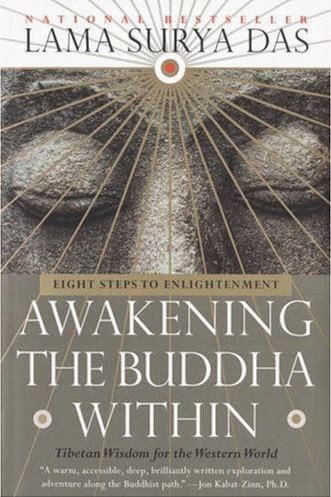
NOT a religion, but a philosophy. I've recently finished reading this book:


Awakening the Buddha Within: Tibetan Wisdom for the Western World
Lama Surya Das, the most highly trained American lama in the Tibetan tradition, presents the definitive book on Western Buddhism for the modern-day spiritual seeker.

The radical and compelling message of Buddhism tells us that each of us has the wisdom, awareness, love, and power of the Buddha within; yet most of us are too often like sleeping Buddhas. In Awakening the Buddha Within, Surya Das shows how we can awaken to who we really are in order to lead a more compassionate, enlightened, and balanced life. It illuminates the guidelines and key principles embodied in the noble Eight-Fold Path and the traditional Three Enlightenment Trainings common to all schools of Buddhism:

Wisdom Training: Developing clear vision, insight, and inner understanding -- seeing reality and ourselves as we really are.

Ethics Training: Cultivating virtue, self-discipline, and compassion in what we say and do.

Meditation Training: Practicing mindfulness, concentration, and awareness of the present moment.

With lively stories, meditations, and spiritual practices, Awakening the Buddha Within is an invaluable text for the novice and experienced student of Buddhism alike.
I actually struggled with this book quite a bit. There were several times, where I almost quit reading it.

There was much I simply could not agree with. In fact, it very much reminded me of why I never pursued Buddhism, even though I like a lot of the things the Buddha is said to have taught. Every time I've tried to learn more about Buddhism, there would be something irrational that would put me off.

I felt that many times while reading this book, but it was a mixture of things, it wasn't all off-putting. I persevered with it, and by the end I was glad I did. I bought the book in the first place because I was hoping that it would:

A.) Teach me about Tibetan Buddhism.

B.) Be an interesting story of the life Surya Das (formerly known as Jeffrey Miller from Long Island) chose for himself, becoming a Tibetan Buddhist Lama.

C.) Teach me some things I could integrate into my own life.

In the end, I have to say it did all of those things. Surya Das has lead a life I would not have liked to have had, but thankfully he did it and I got to read about it and get the benefit of his insights from that, without having to do it myself. Sometimes you can learn a lot from a book, even if you don't agree with much of what it says. It challenges your ideas and makes you think. This was one of those books.

While reading the book, I found myself looking up a lot of things he was referring to on the internet. It was on-line that I found this essay by Sam Harris. I found myself agreeing with much of it:

Killing the Buddha
“Kill the Buddha,” says the old koan. “Kill Buddhism,” says Sam Harris, author of The End of Faith, who argues that Buddhism’s philosophy, insight, and practices would benefit more people if they were not presented as a religion.

The ninth-century Buddhist master Lin Chi is supposed to have said, “If you meet the Buddha on the road, kill him.” Like much of Zen teaching, this seems too cute by half, but it makes a valuable point: to turn the Buddha into a religious fetish is to miss the essence of what he taught. In considering what Buddhism can offer the world in the twenty-first century, I propose that we take Lin Chi’s admonishment rather seriously. As students of the Buddha, we should dispense with Buddhism.

[...]

For the fact is that a person can embrace the Buddha’s teaching, and even become a genuine Buddhist contemplative (and, one must presume, a buddha) without believing anything on insufficient evidence. The same cannot be said of the teachings for faith-based religion. In many respects, Buddhism is very much like science. One starts with the hypothesis that using attention in the prescribed way (meditation), and engaging in or avoiding certain behaviors (ethics), will bear the promised result (wisdom and psychological well-being). This spirit of empiricism animates Buddhism to a unique degree. For this reason, the methodology of Buddhism, if shorn of its religious encumbrances, could be one of our greatest resources as we struggle to develop our scientific understanding of human subjectivity.

[...]

Religion is also the only area of our discourse in which people are systematically protected from the demand to give evidence in defense of their strongly held beliefs. And yet, these beliefs often determine what they live for, what they will die for, and—all too often—what they will kill for. This is a problem, because when the stakes are high, human beings have a simple choice between conversation and violence. At the level of societies, the choice is between conversation and war. There is nothing apart from a fundamental willingness to be reasonable—to have one’s beliefs about the world revised by new evidence and new arguments—that can guarantee we will keep talking to one another. Certainty without evidence is necessarily divisive and dehumanizing.

Therefore, one of the greatest challenges facing civilization in the twenty-first century is for human beings to learn to speak about their deepest personal concerns—about ethics, spiritual experience, and the inevitability of human suffering—in ways that are not flagrantly irrational. Nothing stands in the way of this project more than the respect we accord religious faith. While there is no guarantee that rational people will always agree, the irrational are certain to be divided by their dogmas.

[...]

What the world most needs at this moment is a means of convincing human beings to embrace the whole of the species as their moral community. For this we need to develop an utterly nonsectarian way of talking about the full spectrum of human experience and human aspiration. We need a discourse on ethics and spirituality that is every bit as unconstrained by dogma and cultural prejudice as the discourse of science is. What we need, in fact, is a contemplative science, a modern approach to exploring the furthest reaches of psychological well-being. It should go without saying that we will not develop such a science by attempting to spread “American Buddhism,” or “Western Buddhism,” or “Engaged Buddhism.”

If the methodology of Buddhism (ethical precepts and meditation) uncovers genuine truths about the mind and the phenomenal world—truths like emptiness, selflessness, and impermanence—these truths are not in the least “Buddhist.” No doubt, most serious practitioners of meditation realize this, but most Buddhists do not. Consequently, even if a person is aware of the timeless and noncontingent nature of the meditative insights described in the Buddhist literature, his identity as a Buddhist will tend to confuse the matter for others.

There is a reason that we don’t talk about “Christian physics” or “Muslim algebra,” though the Christians invented physics as we know it, and the Muslims invented algebra. Today, anyone who emphasizes the Christian roots of physics or the Muslim roots of algebra would stand convicted of not understanding these disciplines at all. In the same way, once we develop a scientific account of the contemplative path, it will utterly transcend its religious associations. Once such a conceptual revolution has taken place, speaking of “Buddhist” meditation will be synonymous with a failure to assimilate the changes that have occurred in our understanding of the human mind.

It is as yet undetermined what it means to be human, because every facet of our culture—and even our biology itself—remains open to innovation and insight. We do not know what we will be a thousand years from now—or indeed that we will be, given the lethal absurdity of many of our beliefs—but whatever changes await us, one thing seems unlikely to change: as long as experience endures, the difference between happiness and suffering will remain our paramount concern. We will therefore want to understand those processes—biochemical, behavioral, ethical, political, economic, and spiritual—that account for this difference. [...]

Read the whole essay for embedded links and more. Harris expounds further on some of the ideas mentioned in the above excerpts, as he makes his case, and it's a good read. But back to the "Awakening the Buddha Within" book:

At the end of that book, even Jeffrey - oops, excuse me, "Surya Das" - said there were many types of Buddhism, and that one didn't have to embrace or believe in many of the beliefs held by Buddhists, or even believe in God. In the end, he said you could take from it what you wanted or needed.

I appreciated the lack of insistence on following dogma, but also found it a little ironic that he seemed to be indirectly supporting at least a portion of Sam Harris's essay; that Buddhist teachings don't have to be mixed up with religion.

I would not go so far as to say the two authors agree, but they seem close to agreement on some points. I think perhaps that Das is saying the teachings don't have to be mixed with religion, whereas Harris is more forcefully arguing that they should not be. That's not agreement, but pretty darn close.


Also see:

On criticizing fellow Buddhists
The tyranny of "Consensus Buddhism"!


Wednesday, June 18, 2014

Proverbs from around the world

Cultural proverbs:

Ten proverbs and sayings to help you around the world
It’s taken me a long time as a language learner to come to terms with proverbs. I always resisted them for various reasons. They’re a pain to learn, they can sound silly and unnatural, and it’s often hard to imagine a scenario in which you’d actually use them. However, they’re actually a really important part of every language, and as an English speaker I find I’m often unaware of just how many I use every day.

Knowing these sayings, and being able to produce them spontaneously at the right moment, is an important component of fluency. They’re the colour and spirit of a language, and help you to get deeper into the mentality of it. Here is a list of ten great proverbs in different languages, that perhaps one day will come in handy for you! [...]
You may well find a few chuckles here - I did!
     

One Priest's perspective

I thought this was a very thoughtful and well-considered piece:

What our parish does about gay relationships
Pope Francis has asked our bishops to report to Rome on what is actually happening in the parishes in regard to marriage and family life. Among the many topics to be discussed are "same-sex unions between persons who are, not infrequently, permitted to adopt children."

I think that our parish is a fairly typical middle-class, mostly white, English-speaking, American parish. I also think it would be fair to say that our approach to same-sex couples, including marriage and adoption, is evolving. One might characterize our approach as public silence and private acceptance.

In public, we are silent about the fact that some of our fellow parishioners are gay, even though some people are aware of their relationships.

In private, we are accepting their relationships so long as we don't have to acknowledge them.

Such a modus vivendi is not really an ethical resolution to the question. In fact, it is merely a strategy for avoidance.

There seem to be two great divides in my parish over issues facing lesbian, gay, bisexual and transgender people. One divide is generational. The other divide is personal.

The generational divide is the most obvious and clear-cut, but not absolute. Older people are less accepting of LGBT relationships. Younger people see no problem. In fact, younger people often think the church should move beyond mere acceptance to affirmation. The dividing line seems to be about age 50.

This generational divide is radical and serious. For some young people, it determines whether or not they will remain Catholics. One young man left our church over the issue. As the older Catholics die off, the church will find very little acceptance of its current negative position on gay relationships. We will find ourselves culturally marginalized in countries like the United States.

The personal divide is more subtle and harder to quantify. People who know someone in their family or circle of friends who is publicly gay are much more accepting of LGBT people than people who claim they don't know anyone who is gay. Of course, the fact is, everyone actually does know someone who is gay. They just know that their friend or family member is gay but does not admit it.

Personal experience is important. More and more people are coming out as gay. More and more people will have to accept their relationships. Our younger people nearly always know someone who is out as gay and find it very easy to accept. This is a sea change from a generation ago.

More and more gay relationships are being discussed, even in a conservative community like ours. In the past few years, at least a dozen parents have come to me to tell me that their children are gay. They are supportive of their children. They want to know how I will respond. I always encourage them to accept and love their child.

Two of my friends who go to other parishes left the Catholic church when their children came out. They simply could not accept a church that judged their children to be "intrinsically disordered." If someone is put in the position of choosing between his or her child and the church, they will obviously and quite rightly choose their child.

The hyperbolic and harsh language of the church will have to change. It is not accurate, and it is not charitable. [...]
It's worth reading the whole thing. He chooses his words carefully, and explains his reasoning well. The story he told at the end left me a bit teary.

I thought it was a great response to what the Pope was asking about. But judging by some of the comments left after the article, it would seem that there are still plenty of people who don't want the "hyperbolic and harsh language" to change at all, and they are willing to give away free samples too.


Low Vitamin D levels kill?

One study says yes:

Low vitamin D tied to premature death, Study
People with lower levels of vitamin D are twice as likely to die prematurely than those who have higher levels in their blood, said Univ. of Calif.-San Diego researchers.

Lead study author Cedric Garland said 30 nanograms per milliliter of vitamin D was associated with the lower death rate, and that two-thirds of the U.S. have estimated blood levels below 30 ng/ml. Humans can increase their natural production of vitamin D through exposure to sunlight.

“Three years ago, the Institute of Medicine (IOM) concluded that having a too-low blood level of vitamin D was hazardous,” said Cedric Garland, professor in the Department of Family and Preventive Medicine at University of California – San Diego and lead author of the study.

“This study supports that conclusion, but goes one step further. The 20 nanograms per millilitre (ng/ml) blood level cutoff assumed from the IOM report was based solely on the association of low vitamin D with risk of bone disease.

“This new finding is based on the association of low vitamin D with risk of premature death from all causes, not just bone diseases,” Garland said. [...]


Where Keynes got it wrong, and why

And what we might glean from the "why":

Paul Mason: what would Keynes do?
The revolution in IT and how it is transforming our world in ways that even economists are struggling to understand.
In 1930, while the world was still reeling from the impact of the Wall Street crash, John Maynard Keynes published a remarkable essay: in “Economic Possibilities for Our Grandchildren” he imagined a world where, as he put it, mankind’s “economic problem” has been solved. By 2030, barring unforeseen wars and given the population did not rise too fast, a combination of technological advance and rising wealth could leave enough for everybody.

This would be quite a big change, he pointed out, because the entire history of humanity has been determined by there not being enough for everyone.

“For the first time since his creation,” Keynes wrote, “man will be faced with his real, his permanent problem – how to use his freedom from pressing economic cares, how to occupy the leisure, which science and compound interest will have won for him, to live wisely and agreeably and well.”

[...]

Keynes imagined and fought for a society based on liberalism and aesthetics. The market would eventually provide for all and create a confident, socially adventurous leisure class, whose purpose was to understand and create beauty – and to work as little as possible. That view had been dented by the First World War and would now be shattered by the Depression. So the “grandchildren” essay stands as almost the last utterance of Keynes’s pre-Depression world-view.

[...]

So, as with all insights into the future, Keynes’s essay is full of misunderstandings about the present. (In 1930 the great wave of bank insolvencies that triggered the Depression lay 12 months ahead. Herbert Hoover was in the White House, no developed country had yet left the gold standard, Ramsay MacDonald was still in Downing Street and the Nazis held just 12 of the 491 seats in the Reichstag.) Its underlying tone is: don’t worry, these are growing pains; the market will – with the help of governments – create the solution. And that was wrong.

Yet there is something breathtakingly far-sighted about the “grandchildren” essay. At its heart is the proposition that one day:

• capitalism will grow into something else;

• if that happens the cause will probably be technology;

• we will have a major psychological problem adjusting our lifestyles to a situation where money is not important;

• the love of money will come to be seen as a disease;

• economics will become as mundane as dentistry.

Keynes looks into the future using three yardsticks: the rate of technical innovation, the growth of population and the growth of capital through compound interest. He estimated that productivity would safely grow at least 1 per cent per year, and that capital would grow by 2 per cent per year. If so, it was safe to assume that by 2030 the standard of living in advanced countries could be four to eight times what it was in 1930 – and if technology improved faster, eight times could be an underestimate.

[...]

The idea was that technological progress would create fresh demand, so that even as the price of today’s goods got cheaper (because of productivity) there would always be new, more complex human needs created that require higher-valued things and a higher-skilled workforce to create them. That has been capitalism’s get-out-of-jail card for 200 years, confounding Malthus, Ricardo and Marx, each of whom in his own way believed there were limits to capital.

It happened spectacularly in the Progressive Era, the second industrial revolution, when Victorian-era cities were suddenly populated with Arts and Crafts-style pubs, cinemas, libraries, automobiles, electric lighting . . . prompting Virginia Woolf to declare that “on or about December 1910, human character changed”. And sure enough human character is changing again, under the impact of technology. This third industrial revolution is having a different effect, however: certainly there are more complex needs being created, but it’s not obvious how they will be commercialised.

“Information wants to be free,” said the hippie-ideologue Stewart Brand – to which the open-source movement added: “free as in freedom”. If physical goods are getting cheaper the drivers of demand are of course energy (which has to get dearer) or services. But services, too, can be automated. And so what we may be left with is the nightmare the French writer André Gorz envisaged: that just as it tried to privatise water in the 1980s, capitalism is forced to privatise and commodify simple human interaction. That just as we have sex work now, we might have affection work, sympathy work, anti-loneliness work in the future.

[...]

The present situation breeds not only a widening inequality of wealth but an inequality of power not seen in Keynes’s time except in Fascist Italy or Stalin’s Russia. I think it may all end in tears again – with unchecked oligarchic governments such as those of Vladimir Putin and Recep Tayyip Erdogan repressing their population with tear gas and arbitrary detention, while the democratic-world elite stands by, once again convinced that its economic interest lies in supporting dictators against their own people, and increasingly prepared to use repression, surveillance and arbitrary power against their own populations.

If we avoid this dire outcome, it will because the forces for good, for understanding and knowledge and restraint are also being strengthened by technology. I think we should imagine new technology creating the world of abundance Keynes longed for, but it is likely to be decoupled from the question of pure GDP growth and compound interest.

It won’t happen by 2030. It will not be the transition Marxists imagined, led by the state suppressing market forces, but a transition based on the controlled dissolution of market forces by abundant information and a delinking of work from income. I call this – following economists as diverse as Peter Drucker and David Harvey – post-capitalism. In making it happen, the main issue is not economics but power, and it revolves around who can envisage and create the better life.

Keynes’s critique of Marxism was that by basing itself on the working class it asked too much of the intelligentsia. He wrote in 1925: “How can I adopt a creed which, preferring the mud to the fish, exalts the boorish proletariat above bourgeois and the intelligentsia, who, with whatever faults, are the quality of life and surely carry the seeds of all human achievement?”

Well, now (thanks to education and technology), we have a mass intelligentsia: yes, for sure, spoon-fed tick-box learning on degree courses whose intellectual level Keynes would have scorned. But they have shown themselves willing to stand somewhere between the mud and the fish, and able to create science and art and ideas that make this a thrilling time to be alive. It was they who launched the Arab spring, the Quebec spring, Occupy, Taksim Square and the Russian democracy movement.

When I look at the picture of the miner’s relative and the man kicking him, I find it hard to prefer the fish to the mud. I suspect that Keynes, placed for one hour in a Rolex store, or in any of the yachting ports where British politicians frequent the vessels of Russian oligarchs, might also begin to find this whole “fish v mud” thing not so useful. But we have gone beyond the proletariat and the bourgeoisie. We have an educated demos alongside an underclass, and we are all toiling in a social factory where every act of production, consumption and leisure sucks us into a system of value creation based on debt, finance, monopoly.

By 2030, according to the Oxford Martin School, 47 per cent of all US jobs, mainly in retail and services, will be automated. Automation used to mean the replacement of physical labour by machines; now it means the replacement of mental labour by software – and software is just a machine that never wears out and costs nothing to reproduce. Unless whole new industries based on whole new sources of economic demand grow up, the purchasing power of the majority will fall; and ultimately there is only so much money you can print, and only so many asset bubbles you can stimulate, until it comes to a full stop.

Keynes imagined a future where rising wealth led to falling inequality. Instead, economic wealth has grown more slowly than he imagined but physical and information wealth has grown faster and begun to detach itself from the value system. The moment is coming where we have to recognise this and redesign society as boldly as Keynes’s generation did in the mid-1940s.

I think a modern-day Keynes would be obsessed with how to decouple work from income, production from price, organisation from ownership. We know what he achieved in practice: a workable system that revived global capitalism. But he also dreamed of something better than a system based on the pursuit of money. [...]
Yeah, dreamed is exactly the right word. And what is this: "That just as we have sex work now, we might have affection work, sympathy work, anti-loneliness work in the future." WTF?

This article does have some interesting parts, and parts of it seem to be backed up with some pretty good arguments and observations. But it's got it's weak spots too.

The author says "Even as we grapple with the aftermath of our own Wall Street crash, we are facing a new problem: the rise of information goods whose abundance is probably the indirect cause of – and solution to – our current state of low growth, high inequality and growing social unrest." And tries to explain why. Some of his arguments are convincing. But others, not so much. And I have to say, I'd like to hear more about how the abundance of information goods is "the solution to".

He does an excellent job of explaining the failures of Keynes predictions, but then seems to go on praising Keynes's vision as some how achievable anyway, due to some vague "post-capitalist" society that we need to become.

I don't object to the discussion of this. But I've heard plenty of people fantasize about a "post-capitalist society", yet they never show you the beef; it just sounds life a fantasy. And since Keynes HAS been proven wrong about so many things, you have to wonder if it isn't a mistake to keep holding on to the future-fantasies he envisioned as well?

This article identifies a lot of problems, but it seems unfirm and vague about solutions. I can't get excited or enthusiastic about vague references to a "post-capitalist" society, without it being explained how such a society would actually work. It's been tried before, with dismal, even deadly, results. So any talk about a "post-capitalist" society should, IMO, provide the details and prove itself to be something other than another deadly experiment in social engineering.


Tuesday, June 03, 2014

The UK's most multi-lingual student

He talks about how he did it. In several languages:


How do you become fluent in 11 languages?
[...] Twenty-year-old Alex Rawlings has won a national competition to find the UK's most multi-lingual student.

The Oxford University undergraduate can currently speak 11 languages - English, Greek, German, Spanish, Russian, Dutch, Afrikaans, French, Hebrew, Catalan and Italian.

Entrants in the competition run by the publishers Collins had to be aged between 16 and 22 and conversant in multiple languages.

Alex drew on all his skills to tell BBC News about his passion for learning languages and how he came to speak so many. [...]


Added benefit to being multi-lingual

Speaking two languages keeps brain's aging at bay
NEW YORK: If you speak more languages than one, it is good not only for your social image but also for the health of your brain, a research said.

Bilingualism has a positive effect on cognition later in life.

Individuals, who speak two or more languages, even those who acquired the second language in adulthood, may slow down cognitive decline from aging, the research found.

"Our study is the first to examine whether learning a second language impacts cognitive performance later in life while controlling for childhood intelligence," said lead author Thomas Bak from University of Edinburgh.

Bilingualism is thought to improve cognition and delay dementia in older adults. [...]
They wanted to eliminate the possibility that bilingual people had better cognition, that led them to be bilingual in the first place. Read the whole thing for the details of the study.

I love to study languages, I'm studying Spanish presently. Nice to know there can be long-term cognitive benefits too.
     

Friday, May 30, 2014

Tax Collection: where to find 3.3 billion

The government's own employees:

Federal workers owe IRS the $3.3 billion
Lots of people haven't paid all their taxes -- including employees of the federal government.
The IRS released data this week showing that roughly 3.3% of federal employees and retirees owed $3.3 billion in unpaid taxes as of Sept. 30.

That means they either couldn't pay the full amount owed when they filed a return, or they got snagged by an IRS audit and were told they owed more than they already paid.

The data, released after USA Today requested it under the Freedom of Information Act, broke down delinquency rates by departments and independent agencies.

At the low end of the scale was the Treasury Department, which had a 1.2% non-compliance rate.

A big part of Treasury is the IRS itself, which had a delinquency rate of 0.9%, according to an agency spokesman.

The rate among the population at large is at least 8.7%, the IRS estimates.

A few weeks ago the IRS found itself in hot water with Congress for having paid $1 million in bonuses to 1,100 IRS employees who were late in paying their taxes or had willfully understated their tax liability or income.

But it turns out the delinquency rate among Congressional staffers is higher -- 4.87% in the House and 3.24% in the Senate -- than those of IRS workers.

The government departments with the highest non-compliance rates were the Department of Housing and Urban Development (5.29%), the Department of Veterans Affairs (4.38%) and the Army (4.28%).

Among large independent federal agencies, which have at least 1,000 employees, the biggest offender was the Court Services and Offender Supervision Agency (8.05%), followed by the Government Printing Office (7.99%), the Smithsonian Institution (6.7%) and the Federal Reserve's board of governors (6.51%).

On the low end of the scale was the National Credit Union Administration (1.75%), the U.S. Nuclear Regulatory Commission (1.97%) and the Executive Office of the President (2.05%).


Flying Droids a Reality on ISS

Space station's flying droids embrace Google smartphone tech
The free-flying Spheres, inspired by "Star Wars" and now aided by Google's Project Tango, will handle more of the mundane tasks for astronauts.
MOUNTAIN VIEW, Calif.--Imagine you're an astronaut who has just arrived at the International Space Station. You need to assess the supplies on hand, but counting everything demands so much of your limited time.

That's exactly why NASA originally turned to Spheres, autonomous, free-flying robots that take care of mundane tasks and are based on the flying droid that helped teach Luke Skywalker how to fight with a light saber in the original "Star Wars."

Now, Spheres are incorporating Google's Project Tango, cutting-edge tech that is expected to help the space agency increase efficiency.

For some time -- since 2003, to be exact -- space station crews have had access to free-flying robots known as Synchronized Position Hold, Engage, Reorient, Experimental Satellites. That ungainly title is best abbreviated to a more palatable acronym: Spheres. Originally designed by aero/astroengineers at MIT, Spheres were meant as a flying test bed for examining the mechanical properties of materials in microgravity. The inspiration for the project, said Terry Fong, director of the Intelligent Robotics Group at NASA, "comes from 'Star Wars,' as all good things do."

Now, NASA is bringing an especially innovative commercial tool into the mix. Starting this October, Spheres will incorporate Project Tango -- a smartphone platform built for 3D mapping that also happens to be packed with just the series of sensors and cameras that NASA needs to handle many of the mundane tasks aboard the ISS.

In 2003, Spheres were fairly rudimentary -- at least for flying autonomous robots. They relied on liquid carbon dioxide for propulsion and on an ancient Texas Instruments digital signal processor.

About four years ago, Fong's Intelligent Robotics Group took over the project. Since then, it has been slowly improving Spheres robots by using the small computers better known as smartphones. At first, NASA worked with Nexus S smartphones, which are jammed with cameras, gyroscopes, accelerometers, and modern processors. [...]
I remember reading about these years ago, about how they could fly around the ISS because of the zero gravity. Now they are evolving, using smartphone technology. See the whole article for embedded links, photos and video.
     

Saturday, May 24, 2014

A Blast from the Past: "Mountain Music"

It's been described as a warning against too much technology too fast, but I think it can also be interpreted as "where much of modern music went wrong".


source: Classic Will Vinton- Mountian Music

It's not that electronics in music is bad. But how you use it, makes all the difference. If you use technology to increase volume and sound power and generate a lot of inharmonious noise, it ceases to be music, in my opinion. And inharmonious noise CAN be destructive.

I remember seeing this movie by Will Vinton in my film studies class. It made a lasting impression. I even attempted clay animation at school. I sometimes wish I had pursued it further, but the fact is it takes a lot of patience. At least it did in those days, animation was not computerized, and everything had to be done by hand. And claymation was still a very new artform.

Will Vinton, an Oregon native, went on to do a lot of interesting things. He persevered with clay animation when most people were dismissing it as too unwieldy and difficult to work with. He created the term "claymation", and was very active in refining and developing it as an artform. Most people would recognize his work in TV commercials for California Raisins, and M&M's.

Also see:

Wikipedia: Will Vinton

WILL POWER: INTERVIEW WITH CLAYMATION PIONEER WILL VINTON


Saturday, May 17, 2014

Walk more, think better?

It seems the answer is "yes":

Steve Jobs, Beethoven knew walking increases creativity; Stanford study says they were right
Steve Jobs, Mark Zuckerberg and Beethoven knew walking boosted their creativity. Jobs, the late co-founder of Apple, held walking meetings. Facebook's Mark Zuckerberg keeps meetings on foot. Beethoven created sonatas and symphonies while strolling the Vienna Woods.

A new study confirms that creative thinking improves while a person is walking and shortly thereafter, according to a new study co-authored by Marily Oppezzo, a Stanford doctoral graduate in educational psychology, and Daniel Schwartz, a professor at Stanford Graduate School of Education.

The study found it didn't matter where you walk -- strolling indoors or outdoors similarly boosted creative inspiration. The act of walking itself, and not the environment, was the main factor. Across the board, creativity levels were consistently and significantly higher for those walking compared to those sitting.

"Many people anecdotally claim they do their best thinking when walking. We finally may be taking a step, or two, toward discovering why," Oppezzo and Schwartz wrote in the study published this week in the Journal of Experimental Psychology: Learning, Memory and Cognition.
See the original article for embedded links. I'm not surprised by the study. I've often found that going for a walk when I have to think over something, helps me to make better decisions and become clearer in my mind.


The Oregon counties the "recovery" forgot

Poverty in Oregon: Interactive maps show food stamps, welfare, Medicaid reliance by county
Nearly five years after the Great Recession officially ended, more than one in five Oregonians continues to rely on food stamps, and nearly 17 percent live in poverty.

Rural Oregon counties continue to fare the worst, with food stamps and Medicaid rates exceeding 30 percent in Jefferson and Josephine counties. In some timber-reliant counties, the poverty rate exceeds 20 percent.

The Oregonian mapped state and county unemployment, poverty, food stamps, welfare and Medicaid rates using January 2014 numbers from the Oregon Department of Human Services. The figures show slight improvements from last summer, when The Oregonian last mapped poverty by county. But it's clear that the state continues to struggle and that rural Oregon continues to be left behind in the recovery. [...]
The article has a link to an Interactive Oregon Poverty map that is quite revealing.
     

Sunday, May 11, 2014

What South African Taxpayer's Money Buys

Really nice chicken coops, among other things:

Nkandla style – don’t worry, it is for security
In March 2014, public protector Thuli Madonsela found that president Jacob Zuma and his family unduly benefited from upgrades made to his private Nkandla homestead, which cost the taxpayer around R246 million.

According to the public protector’s report titled “Secure in Comfort”, government built a visitors centre, cattle kraal and chicken run, swimming pool and an amphitheatre for the president and his family in his private home.

Madonsela said that this clearly shows that Zuma and his family unduly benefited from the upgrades. However, government had a simple explanation for it all – security.

Justice Minister Jeff Radebe said that the cattle kraal, fire pool (seen by some as a new swimming pool) and all other features are “essential security features which ensures physical security and effective operation of security equipment.”

Who can dispute Radebe’s argument? Chickens setting off alarms – security risk. Not having a fire pool in case of a large fire – security risk. Not having an amphitheatre and having to travel on South Africa’s pothole ridden roads to visit a place of entertainment – security risk.

In fact, security is such an elegant excuse when explaining questionable decisions that it should not come as any surprise that this excuse has been used by government previously. [...]
Lookit that Chicken Coop. A real work of art, that. Would love to see it close-up.


Also see:

What Nkandla’s millions could have bought South Africans
Public Protector Thuli Madonsela released the Nkandla report this week, which showed that the estimated total cost of improvements to President Zuma’s Nkandla home is R246,631,303.

Madonsela’s report found that the total cost of the Nkandla project included:

Total payment to contractors R161,418,824;
Value of contractor payments certificates, certified but not yet paid, R3,672,748;
Total payment to professional consultants R50,352,842; and
Cost estimate for phase three, excluding consultants’ fees R31,186,887.

According to the public protector’s report a critical service delivery program was shelved and money diverted to upgrade Zuma’s homestead.

“Funds were reallocated from the inner city regeneration project and the dolomite risk management programme of the department of public works,” Mandonsela said in her voluminous report.

“Due to lack of proper demand management and planning, service delivery programs of the department of public works were negatively affected.”

The homestead has been at the centre of controversy after it emerged that the public works department had approved upgrades to the President’s KwaZulu-Natal homestead.
What could the Nkandla money have been better used for?

South Africa can benefit tremendously from better IT infrastructure, a more connected society, and better education.

Here is what the money spent on the Nkandla upgrades could have bought South Africans: [...]
Ouch. A long list. I wonder what affect, if any, it will have on the next election?
     

What does the concept of Private Property mean in San Francisco?

Less, and less:

I Was Assaulted For Wearing Google Glass In The Wrong Part Of San Francisco
[...] If those people hadn't moved to San Francisco, people wouldn't be priced out of their neighborhoods, rental properties wouldn't be purchased by wealthy young millionaires, and tenants wouldn't be evicted from the homes they've lived in for several decades.

My love for gadgets makes me look and sound like one of the people whom residents of the city have come to feel oppressed by.

The individual who smashed my Google Glass on Friday — because of political beliefs or a personal impact that has been made by the tech industry — felt that it was appropriate to destroy my personal property in protest against what I seemed to stand for, based on my appearance; never mind the irony in choosing to assault someone based on their appearance as a way to preserve San Francisco's culture.

It's important to note that not everyone protesting the tech industry's impact on the city has taken such an oppositional stance.

At the march we covered on Friday, teachers, tenant rights activists, and other concerned citizens carried banners and chanted slogans that specifically asked Google to live up to the famous "Don't be evil" motto and step in where its employees were displacing longtime San Franciscans:
[photo]
You don't see a crowd of more than a hundred people go to an investment banker's house when he evicts longtime tenants, to publicly ask his or her employer for help, because of course no investment bank would do something like that.

Google, for all the backlash it's gotten over gentrification, last year's NSA revelations, and personal data collection for ads, still looks like a company that gives a damn.

The company has taken some steps to address concerns of protestors and people's negative reactions to Google Glass. It started paying the city for the use of its bus stops. It has put out guides for Glass users on the behavior that should be avoided so that you don't look like a "Glasshole."

But those don't do anything to address the underlying issues. Something clearly needs to be done to address rising housing costs and gentrification in the city — people on all sides are being forced from their homes and made to feel unsafe on the streets and on their commutes to and from work. [...]
It's delusional for any renter to think they have the same rights as property owners. But then San Francisco is full of delusional people. Many of them think ownership of property is evil.

I lived there for 24 years, as a renter for 14 of those years. After being forced to move several times, we decided we wanted more control over our lives, so we eventually bought a house.

Many people were envious that we were "lucky" enough to buy a house. But luck had nothing to do with it. We scrimped and saved for years, forgoing vacations, eating out in restaurants, nice clothes and cars, gagets, and many of the other things that San Franciscan's typically spend their money on.

It amazes me how easily that those that make no sacrifices to save and buy property complain that other people who buy homes are "lucky", and that it's not fair; they believe that they themselves should somehow have the same thing, without the effort and sacrifice.

People aren't being displaced from THEIR homes. If they don't OWN the home, it isn't THEIRS. That's why it can be sold out from under them. It's not THEIRS. It belongs to someone else.

When renters have the same rights as property owners, then the concept of private property ceases to have any meaning. But of course that's fine with many San Franciscans, it's what they want. And one of many reasons why I left. Too many delusional people, wanting reality to change to suit them.

I thought it was funny that the author thought it was ironic that San Franciscan's would attack someone based on their appearance, as a way of preserving San Francisco. It makes perfect sense. Delusional people often have no sense of irony. It's one of the perks of being delusional.
     

Sunday, May 04, 2014

Fanless Mini PCs

They are becoming more popular:
5 Silent Fanless Mini PCs That Will Save You Money
Miniaturization continues to shrink the size of the average PC. What once required several rooms can now fit in your pocket. And while most people think of smartphones or tablets as examples of small, modern electronics, desktops also deserve mention.

There’s a new category, the mini-PC, that’s becoming popular. Early variants, like the Apple Mac Mini and Inspiron Zino HD, have been well received, but now the formula has been improved with the introduction of fanless systems. Tiny, silent and often inexpensive, these miniature wonders save space without eating into your bank account. [...]
Several examples are reviewed.

Here is one that seems like a great bargain, on Amazon:

CompuLab Intense PC Value 1.1 GHz Linux
Intel Celeron 847E 1.1 GHz dual-core, 4 GB RAM
5 year warranty
320 GB hard-disk pre-installed with Linux Mint
Dual Gbit Ethernet, WiFi 802.11n, HDMI + DisplayPort, 7.1 channels S/PDIF audio
Fanless aluminum case [...]
There are different configurations available. They seem ideal for people with basic computer needs. This one runs Linux Mint as the operating system. Mint is my favorite Linux.
     

One Conservative's Understanding of the Real and Genuine Need for Medical Marijuana

My trip to the pot shop
PUEBLO WEST, Colo. — It’s 9 a.m. on a weekday, and I’m at the Marisol Therapeutics pot shop. This is serious business. Security is tight. ID checks are frequent. Merchandise is strictly regulated, labeled, wrapped and controlled. The store is clean, bright and safe. The staffers are courteous and professional. Customers of all ages are here.

There’s a middle-aged woman at the counter nearby who could be your school librarian. On the opposite end of the dispensary, a slender young soldier in a wheelchair with close-cropped hair, dressed in his fatigues, consults with a clerk. There’s a gregarious cowboy and an inquisitive pair of baby boomers looking at edibles. A dude in a hoodie walks in with his backpack.

And then there’s my husband and me. [...]
It's a very compelling story she tells. And as usual, Michelle Malkin has done her homework, like a real journalist should. Read the whole thing for the interesting story and the embedded links.
     

Friday, April 25, 2014

The most sensible thing I've heard lately

About the rancher conflict in Nevada, from Idaho Congressman Raul Labrador:

Idaho's Labrador: Nevada rancher battling BLM should have paid his bills
In another example of his keen political instincts, Idaho GOP Congressman Raul Labrador distanced himself from Sen. Rand Paul and others championing Nevada rancher Cliven Bundy.

Labrador is a tea party favorite and friend of the Kentucky senator eying a 2016 Republican presidential run. At Labrador's invitation, Paul will speak to the Idaho Republican convention in June. Bundy has been celebrated by other politicians and conservative media, most notably Sean Hannity on Fox News.

But Labrador told Ada County Republicans he has trouble lionizing Bundy because he's ignoring the rule of law in failing to pay over $1 million in grazing fees to the U.S. Bureau of Land Management for running his cattle on public property since 1993.

Labrador stepped away from a chance to laud Bundy Tuesday night. On Wednesday, the New York Times reported on Bundy's comments about "the Negro" and his suggesting slavery wasn't so bad after all. Paul initially was unavailable for comment Wednesday but on Thursday issued a statement, saying, “His remarks on race are offensive and I wholeheartedly disagree with him."

Apparently smelling a rat, Labrador didn't fall into such a trap when asked about the Bundy case at a candidate forum hosted by the Ada County Republican Central Committee. Otherwise he'd be joining Paul and others in damage control.

"One of the concerns I have in the Bundy case is that you have a person who appears to have been violating the law," Labrador began. "And that really concerns me because it makes it very difficult for somebody like me to speak up against what the BLM is doing.

"Because the federal courts, again and again and again, have told this gentleman that he owes money in federal grazing rights, in federal grazing permits," said Labrador, who graduated from high school in Las Vegas, about 80 miles from Bundy's ranch. "Now, he claims that he doesn't owe that money but the courts have disagreed with him."

Labrador went on to college at BYU and earned his law degree at the University of Washington.

Labrador cited the case of another Nevada rancher, Wayne Hage, who battled the BLM in court but continued to pay his bills. Late in life Hage married then-Idaho Congressman Helen Chenoweth, a predecessor of Labrador's in Idaho's 1st District. Both Wayne and Helen Chenoweth-Hage are now deceased.

"The BLM did the same things to (Hage) and when they did it to him he was actually paying his grazing permits and he was doing all the things that he needed to do," Labrador said.

Setting aside the fame enjoyed by Bundy, Labrador continued with a critique of BLM policy and mixed in a shout-out for gun rights.

"Clearly the federal government is overreaching. What I find sad — even if you agree that Mr. Bundy should have paid his grazing permits — it's really scary to think that the federal government can come in to collect on a debt at the point of a gun," Labrador said.

"That should never happen. They should have put a lien on his property; they should have put a lien on the cows; they should have put a lien on a bunch of different things. But they should never be coming in at the point of a gun and trying to take you off a property.

"And that's why — this is the difference between people who believe in the Second Amendment and who don't believe in the Second Amendment: The Second Amendment isn't there so we can hunt. The Second Amendment is there so we can protect ourselves from the government."

Labrador's answer brought hearty applause, once again demonstrating his deftness in appealing to a very conservative base without compromising his oaths to uphold the law as an attorney and a congressman.

He's long brushed off as a distraction questions about President Obama's birthplace, saying he believes the president was born in Hawaii and should be opposed on policy grounds. He's attempted to convince supporters hostile to immigration reform that a compromise would be healthy for humanitarian and economic reasons and essential for the future of the Republican Party. Labrador was born in Puerto Rico and moved to Nevada with his mother while in junior high school.[...]
The government didn't NEED to turn this into an armed confrontation; they had other options. They didn't have to point guns at fellow Americans. So why did they choose to, instead of the other options available to them? That seems to be the most important point to me. But the media cirrus seems to focus on everything else but that.

The Republican Party could use more sane voices like Raul Labrador's.

And it's worth noting, that in the Wayne Hage case that Labrador referred to, Mr. Hage's estate eventually won the case against the BLM. But read the details; it's chilling. It was a long, hard and ugly battle. The judge in the case accused the federal bureaucrats of racketeering under the federal RICO (Racketeer Influenced and Corruption Organizations) statute, and accused them as well of extortion, mail fraud, and fraud, in an effort “to kill the business of Mr. Hage.”

Mr. Hage married a congress women as his second wife, before he died. You have to wonder if he would have prevailed, without her help? Officials of the federal government wield tremendous power; they have to be kept in check, as this case shows all too clearly.


This was interesting too:

Conservative racial math can’t cancel out Cliven Bundy
[...] On Fox News, my colleague Charles Krauthammer goes further, making the point that romanticizing a rejection of federal authority often ends in embarrassment. “This is a man who said that he doesn’t recognize the authority of the United States of America. That makes him a patriot?” Krauthammer asked. Anti-government language has been a powerful rhetorical tool, but it is difficult to sever those sentiments from the neo-Confederate sentiments that trail stubbornly behind it. Maybe it is time to try to elevate a different path to conservative stardom.

That such routes might be tough to walk given the Republican Party’s recent history does not mean they do not exist. The libertarian writer Jonathan Blanks, who is a friend and a powerful influence on my own thinking, is a powerful advocate for two ideas that could be made in concert more frequently: that defenses of secession are obscene on libertarian grounds and that African-Americans have plenty of reasons to seek limits on government power. [...]


The Washington D.C. Political Class

Why do Jay Carney and Claire Shipman decorate their house with Soviet propaganda posters?


[...] Now, to be fair, both sides of the power couple studied Russian during their Ivy League educations (he: Yale, she: Columbia) and became Moscow correspondents for major news agencies (he: TIME Magazine back when it still mattered, she: CNN), where they met prior to the fall of the USSR. But the fact that they seem to be nostalgic for the communist era tells us a lot.

While life among the Moscow elite may have been fairly comfortable, it was not so for scores of millions of victims of the regime, less well-connected or ideologically heterodox. In fact, as The Black Book of Communism informs us, communism killed more people than even Nazism. With their fancy Ivy League educations, the Power Couple ought to know this.

How many foreign correspondents in Berlin in the 1930s (people like William L. Shirer) brought home Nazi propaganda posters and raised their children among them?

The sad fact is that progressives in much of the developed world have a soft spot in their hearts for communism. Yeah, it murdered a hundred million people or more, but you can’t make an omelet without breaking a few eggs. And those who were murdered were not very fashionable, for the most part.

The Washingtonian photo is a tell. There is a sickness, a willful blindness toward the crimes of communism because it is so close to the progressive ideology that animates the American Ruling Class. Shipman and Carney are the perfect exemplars of that class. Smart, fit, busy, anxious to make their own lives perfect, and convinced that the price other people pay for their progressive dreams is not worth mentioning or even noticing.
Read the whole thing for embedded links and photos. One of my favorites is the severed finger on the bookcase.

The original article is meant to be a glossy puff-piece, and the photos are supposed to be light-hearted and jokey, which is why they are so fake, I guess. Yet it illustrates something I've said before, that the political class lives in another world from most Americans, totally out of touch with the realities most Americans are facing, and are looking out for themselves, not us.
   

Sunday, April 06, 2014

Will the Middle Class Survive?

4 Things Politicians Will Never Understand About Poor People
Off the top of your head, how many of your friends can you think of make less than $11,000 a year? Maybe they work some mind-numbing part-time job, taking cover charges and stamping hands at a strip club. Or if you're a bit older, how many families do you know of who have one person working, bringing in less than $23,000 to support a spouse and a couple of kids? There's nothing wrong with either of those things ... but those numbers are the poverty threshold in the U.S., and in my area of the country, it encompasses a fudging poopload of people (sorry, I'm trying to cut down on my cursing).
Poverty is a hot topic for politicians, but it seems like every time they open their mouths about the subject, stupid falls out. There's a huge part of me that wants to grab them by their orphan skin lapels and scream reason into their preciously oblivious brains, but the logical side of me knows it won't matter.
[...]
But of all the poor people I've known over the years -- and I have known a lot -- I have come across very few able-bodied, able-minded people who didn't do something to bring in some money. Even the ones who didn't have so much as a part-time job still managed to at least find temporary seasonal work mowing lawns, shoveling snow, or standing on street corners and playing the guitar with their penis.
So if the issue is that these people are watching reruns and collecting government checks, guess what: 91 percent of government benefits go to the disabled, elderly, or working households. Not a typo -- 91 percent. You're free to speculate that some of those people could try harder or are faking their disability or whatever, but there's no way the reality lines up with this politician fantasy of the lazy masses who just greedily rub their hands together while leeching their unfathomable riches from the always generous American populace.

[...] 
OK, let's be calm here. Let's just take a deep breath and talk about this like the rational, well mannered, non-cursing people that we are. Here is an infographic that ran in the Wall Street Journal talking about how the new tax code would be "highly painful" for Americans. The graphic covers every possible scenario the Wall Street Journal can conceive of, from the single mom only making $260,000 a year to the retired couple trying to get by on a fixed income of $180,000:
Reading that dumb fucking mind turd of an image is like wiping my ass with my eyes. If you can look at that steaming pile of shit and not see what's wrong with it, you live in a different goddamn universe than the rest of us.
No, that didn't come from a politician, but this sure as hell does. That's Linda Sanchez, who is desperately trying to tug at our heartstrings by saying that she lives paycheck to paycheck. On her $174,000 salary. To pay for her multiple homes. Now, I understand that if you live a certain lifestyle and you're a limp dick at finances, it would be pretty easy to burn through that much in a year, but does that make us any more sympathetic? Fuck no, it doesn't. Even as one of the least wealthy members of Congress, she still earns three-and-a-half times more money than the average American household. And 16 times more than those at the very top of the poverty line.
So the question is, how can she possibly think of herself as poor? Because $174,000 a year is poor -- for a member of congress. They have no concept whatsoever of what life is like for someone getting by on what most working people make, let alone somebody subsisting on government aid. Although they can comprehend our income as a number, they cannot comprehend the lifestyle because they haven't lived it and they likely never will. You're not going to find these politicians hanging out in the poor section of town, scrounging change for weed (well, maybe Bill Clinton) -- they spend most of their time around other wealthy people -- other members of Congress (about half of which are millionaires), rich donors, high-powered business types, celebrities, etc. So their idea of "poor" or even "brokeass" is the pitiful bastard at the bottom of the chain who is living off of that measly $174,000 base salary because he or she doesn't have any other income on the side. Linda Sanchez is their version of poverty. [...]
My own income has always been a lot closer to $11,000 than those figures in the Wall St. Journal Info Graphic. And yes I get it, that a lot of people aren't sympathetic to people who make six figure salaries, complaining about taxes.

Yet that graphic was from an article in the Wall Street Journal last year. This year, 2014, many of those groups are getting slammed even harder with more taxes.

People in those income brackets used to put away money for their children's college education, buying a home, buying their own health insurance, saving money in 401k accounts for their retirement, invest in their own businesses in order to supply themselves with jobs and an income. They would use the money to become independent, and maintain their independence, by not having to borrow excessively, or rely on others to supply their needs for them.

That used to be considered a good thing, and why it used to be said that the middle class was the "backbone of America". They knew how to take care of themselves, and not be a burden to other people. The more of their money that is taken in taxes, the less they will have to do that with. Or to invest in their own businesses.

I can sympathize with people who struggle with only $11,000 a year. I've been there, and I'm not far from it now. But destroying the middle class isn't going to help the most people in the long run. A tide that lifts all boats, would be preferable to sinking the most productive boats.

A congress that is more interested in lifting all boats, instead of just looking out for it's own interests, might be a good step in the right direction. They could start by actually passing a budget, and living within it, like the majority of the people in this country have to do.
   

Saturday, April 05, 2014

The "Permanent Political Class" Problem

I came across this book a while back:

Throw Them All Out: How Politicians and Their Friends Get Rich off Insider Stock Tips, Land Deals, and Cronyism That Would Send the Rest of Us to Prison
One of the biggest scandals in American politics is waiting to explode: the full story of the inside game in Washington shows how the permanent political class enriches itself at the expense of the rest of us. Insider trading is illegal on Wall Street, yet it is routine among members of Congress. Normal individuals cannot get in on IPOs at the asking price, but politicians do so routinely. The Obama administration has been able to funnel hundreds of millions of dollars to its supporters, ensuring yet more campaign donations. An entire class of investors now makes all of its profits based on influence and access in Washington. Peter Schweizer has doggedly researched through mountains of financial records, tracking complicated deals and stock trades back to the timing of briefings, votes on bills, and every other point of leverage for politicians in Washington. The result is a manifesto for revolution: the Permanent Political Class must go.
Pretty serious accusations. Could it really be that bad? Apparently. The TV Program 60 Minutes eventually did a show about it. It generated so much outrage, that Congress had to pass a law forbidding themselves from participating in insider trading. But guess what? It didn't last long:

Congress Quickly And Quietly Rolls Back Insider Trading Rules For Itself
In November of 2011, the TV show 60 Minutes did a big expose on insider trading within Congress. While everyone else is subject to basic insider trading rules, it turned out that members of Congress were exempt from the rules. And, as you would imagine, many in Congress have access to market-moving, non-public information. And they made use of it. To make lots and lots of money. Of course, after that report came out and got lots of attention, Congress had to act, and within months they had passed the STOCK Act with overwhelming support in Congress to make insider trading laws that apply to everyone else finally apply to Congress and Congressional staffers as well. As that link notes:

The lopsided votes showed lawmakers desperate to regain public trust in an election year, when the public approval rating of Congress has sunk below 15 percent.

Of course, here we are in 2013 and, lo and behold, it is no longer an election year. And apparently some of the details of the ban on insider trading were beginning to chafe Congressional staffers, who found it hard to pad their income with some friendly trades on insider knowledge.

So... with very little fanfare, Congress quietly rolled back a big part of the law late last week. Specifically the part that required staffers to post disclosures about their financial transactions, so that the public could make sure there was no insider trading going on. Congress tried to cover up this fairly significant change because they, themselves, claimed that it would pose a "national risk" to have this information public. A national risk to their bank accounts.

It was such a national risk that Congress did the whole thing quietly, with no debate. The bill was introduced in the Senate on Thursday and quickly voted on late that night when no one was paying attention. Friday afternoon (the best time to sneak through news), the House picked it up by unanimous consent. The House ignored its own promise to give Congress three days to read a bill before holding a vote, because this kind of thing is too important to let anyone read the bill before Congress had to pass it.

And, of course, yesterday, President Obama signed it into law. Because the best way to rebuild trust in Congress, apparently, is to roll back the fact that people there need to obey the same laws as everyone else. That won't lead the public to think that Congress is corrupt. No, not at all.
That was last year; so it just continues, "Business as usual." Disgusting. Visit the original article for all the embedded links.

There is a Question and Answer segment on the webpage for Peter Schweizer's book:

Editorial Reviews
Amazon.com Review
Amazon Exclusive: A Q&A with Author Peter Schweizer

Q:When did you realize that so many insider trading and sweetheart land deals were going on?

A: When I first discovered that members of Congress are exempt from insider trading laws, I didn’t believe it. Then, when I started to look at their stock trades and compare them with what they were doing in office, I was stunned.

Q: What do you mean by the "Permanent Political Class"?

A: I think politics in Washington has become a business opportunity. Republicans and Democrats are not so different as you think. They work together to enrich themselves. They have designed the system to work so that they can make lots of money doing things that would get the rest of us sent to jail.

Q: What do you mean by "honest graft"?

A: When people think of politicians making money in Washington, they think of bribery and other illegal activities. That’s small potatoes. The real money is made by doing stuff that’s legal, including insider trading on the stock market and land deals.

Q: Politicians are exempt from insider trading laws? You’re kidding, right?

A: No. They write the rules, and guess what: the rules that apply to us don’t apply to them. By the way, they are also exempt from whistleblower laws. If you see your boss committing a financial crime, you can report them and you will be protected. You can’t be fired. But if your boss is a congressman? You’re toast. You are not protected.

Q: What’s wrong with politicians who trade stock? Don’t we want them involved in the economy?

A: Yes, but they are doing exactly what corporate insiders get sent to jail for doing. It’s a double standard and it’s unfair. If Martha Stewart had been in the U.S. Senate, she would have been protected.
Congress should be forbidden to pass any laws that do not also apply to themselves. If they had to get their own health care under the same laws that we do, the Affordable Care Act would not exist in it's present form; it would have been something better. The Healthcare.gov site might have actually worked, if they and their families had to use it themselves.

If congress had to actually live under the laws they pass for the rest of us, they would take greater care. But they don't, and they don't. That needs to change.

Congress is supposed to exist to serve us, not rule over us.


Also see:

Jon Stewart Tears Up Congress For Quietly Scaling Back Insider Trading Law: The ‘F*cker Act’


Thursday, April 03, 2014

GOP must "Get Beyond Deportation"

Kentucky Sen. Rand Paul Says GOP Must Appeal To Hispanics, Get ‘Beyond Deportation’
[...] This certainly was not the first time that Paul, since being elected to the Senate in 2010, has attempted to connect with Hispanics and other minorities.

However, Republicans’ interest in his policy vision and his vision for broadening the party base continues to grow as he ascends in the very, very early 2016 polls and travels the country. Recent stops have included those in Democrat-heavy Detroit and at the University of California, Berkeley.

Paul said Tuesday that Republicans need to focus on such issues as reforming the country’s work visa system and improving educational and employment opportunities for minorities.

However, the GOP must first make clear it is not “just the party of deportation,” he argued.

“The bottom line is that the Hispanic community … is not going to hear us until we get beyond that issue,” Paul told attendees at a symposium sponsored by the conservative Media Research Center and the American Principles Project. “They’re not going to care whether we go to the same church or have the same values or believe in the same kind of future of the country until we get beyond that. … We’ve got to get beyond deportation to get to the rest of the issues.” [...]
It's been pretty obvious for quite some time. But there is a segment of the GOP that has been too slow to wake up to the reality of changing demographics. Not to mention, popular opinion. Two realities that decide elections.