Showing posts with label Middle East. Show all posts

Thursday, April 28, 2016

Russia: Returning as a World Power?

Looks like it:

Thinking the Unthinkable: Russia Has Re-Emerged As a Great Power
The Western image of Russia and Putin in recent years has been very negative. President Obama has publicly called Vladimir Putin a “schoolboy who slouches in his chair in the back of the room“ and derided his country as a mere “regional power.”

This begs the question: how Russia could again become a major power after the disintegration of the Soviet Union in 1991? How could Putin do this without an agrarian or consumer revolution and with the massive drop in the price of oil? If Putin is a terrible leader, then how can you explain successful interventions in Georgia (2008), Crimea (2014), Ukraine (2014-2016) and Syria (2015-2016)?

Putin, however, is actually a very shrewd leader with a brilliant Foreign Minister, Sergei Lavrov, who relies on a capable Foreign Ministry. Putin has rebuilt Russia’s military capability by spending $49B a year on security. Russia retains 1,790 strategic nuclear weapons. With over 140 million people and 13 million college graduates, Russia has nearly a million first-class scientists, engineers and technicians, most of whom work for the military.

Many former great powers are now no longer major powers. [...]
The article goes on to show the many ways that formerly great powers -including the United States- have declined in military and economic strength, leaving the door open for Russia to fill the void, as it is now doing. Read the whole thing, the article has many embedded links as well.

As I posted previously, while American policy in the Middle East is unfocused and confused, Russia seems to know what it wants, and how to go about getting it by leveraging what they have to work with and using it to maximum effect.
     

Sunday, November 15, 2015

ISIS, ISIL, or IS... or "Daesh"?

Words matter in ‘ISIS’ war, so use ‘Daesh’
The militants who are killing civilians, raping and forcing captured women into sexual slavery, and beheading foreigners in Iraq and Syria are known by several names: the Islamic State in Iraq and al-Sham, or ISIS; the Islamic State in Iraq and the Levant, or ISIL; and, more recently, the Islamic State, or IS. French officials recently declared that that country would stop using any of those names and instead refer to the group as “Daesh.”

The Obama Administration should switch to this nomenclature, too
, because how we talk about this group is central to defeating them.

Whether referred to as ISIS, ISIL, or IS, all three names reflect aspirations that the United States and its allies unequivocally reject. Political and religious leaders all over the world have noted this. French Foreign Minister Laurent Fabius said, “This is a terrorist group and not a state. . . the term Islamic State blurs the lines between Islam, Muslims, and Islamists.” President Obama made similar remarks saying, “ISIL is not Islamic . . . and [is] certainly not a state.”

Muslim scholars around the world have denounced the group’s attempt to declare a caliphate. Egyptian Islamic theologian Yusuf al-Qaradawi published an open letter to Muslim scholars explaining, “A group simply announcing a caliphate is not enough to establish a caliphate.” The Syrian Sufi leader Muhammad al-Yacoubi called the group’s declaration “illegitimate” and that supporting it was “haram,” or forbidden.

The term “Daesh” is strategically a better choice because it is still accurate in that it spells out the acronym of the group’s full Arabic name, al-Dawla al-Islamiya fi al-Iraq wa al-Sham. Yet, at the same time, “Daesh” can also be understood as a play on words — and an insult. Depending on how it is conjugated in Arabic, it can mean anything from “to trample down and crush” to “a bigot who imposes his view on others.” Already, the group has reportedly threatened to cut out the tongues of anyone who uses the term.

Why do they care so much? The same reason the United States should. Language matters.

With some 30,000 to 50,000 fighters, Daesh is a relatively small group, and propaganda is central to its growth strategy. Whether hijacking popular Twitter hashtags or using little known distribution channels to post videos to YouTube, their leadership knows that the war of words online is just as key to increasing its power and influence as the actual gruesome acts they commit on the ground.

By using the militants’ preferred names, the US government implicitly gives them legitimacy. But referring to the group as Daesh doesn’t just withhold validity. It also might help the United States craft better policy. [...]
I first heard the term "Daesh" being used by Putin. Now I know why. And I see why the French now want to use it. So should we.

The rest of this article, which is not very long, talks about the many good reasons to be using the name Daesh, and about the many Muslim groups and scholars around the world who know ISIS, ISIL, IS as Daesh. And they oppose Daesh, vehemently, for many reasons. The article has embedded links for many of these Muslim anti-Daesh groups.

Not only is it encouraging to know that these groups and scholars exist, but the article explains why it's important to use the name Daesh, so our allies in the Muslim world know that we understand, using the word from their language, that we share the same concerns about the same people.

"Daesh". I was sold on it at "a bigot who imposes his view on others." Hopefully President Obama will get on board with using this name. If he does, the media will likely follow his lead.
     

Tuesday, September 29, 2015

"Constructive. Business-like. Surprisingly frank."


Kerry says US may offer Russia 'something' to keep Assad from dropping barrel bombs: UN debate live
[...] Constructive. Business-like. Surprisingly frank.

Those are the diplomatic euphemisms Vladimir Putin used to describe his meeting with Barack Obama on Monday night, and it says a lot about the dire state of US-Russian relations that they sounded positive.

But it also says a lot about the awkward personal dynamic between Mr Putin and Mr Obama. For no matter what their spin doctors say, there can rarely have been two world leaders so obviously physically uncomfortable in one another’s presence.

It is not even like the geopolitical relationship between their two countries, a previously perfectly workable if strained partnership until it fell apart with the Ukraine crisis. To put it diplomatically, Mr Obama and Mr Putin have just never quite "gelled"....

Maybe there is a basis for understanding. Undisguised mutual dislike, frank disagreement on Ukraine, and a business-like recognition that it is much safer to argue about Syria than do anything about it.

And maybe Mr Putin is not wrong. After all, a frank discussion of interests and demands is a decent starting point for a deal, even on a problem as intractable as Syria. Perhaps Monday's meeting was, in some sense, constructive after all. [...]

The US has withdrawn troops from the Middle East, and failed to support Syrian Rebels in any meaningful way. That left a vacuum, and Russia is filling it. Putin knows nobody has the will to help the rebels. Russia is allied with Syria and Iran. Putin is doing this because... he can.

So if we aren't going to fight it, do we work with it? Some say that Russia is not the enemy. Even if that is true, they are not automatically our friends, either. Perhaps they are our "Frenemy". America has lots of those, and we work with them from time to time. Will this be one of those times? Should it be? I couldn't say if it should. I think it may become one of those times by default, simply because no one is willing to do anything else. At any rate, we shall see.
     

Saturday, September 12, 2015

Russia, Syria, and ... a coalition?

Might it make sense in the larger picture? And if not, what is the alternative? Consider this:

Putin jockeying for deal with US on Syria
MOSCOW (AP) — Signs of an ongoing Russian military buildup in Syria have drawn U.S. concerns and raised questions of whether Moscow plans to enter the conflict. President Vladimir Putin has been coy on the subject, saying Russia is weighing various options, a statement that has fueled suspicions about the Kremlin's intentions.

[...]

Since the Soviet times, Russia has had close political and military ties with Syria, which hosts a Russian navy facility in the Mediterranean port of Tartus intended to service and supply visiting ships. While the Soviet-era facility has just a couple of floating piers along with a few rusting repair shops and depots, it has symbolic importance as the last remaining Russian military outpost outside the former Soviet Union.

Moscow has staunchly backed Syrian President Bashar Assad throughout the nation's 4 ½-year civil war, providing his regime with weapons and keeping military advisers in Syria. Putin said again Friday that Russia is providing the Syrian military with weapons and training.

Rami Abdurrahman, the head of the Britain-based monitoring group Syrian Observatory for Human Rights, said there have been reports since mid-August of Russian troops in the capital's airport and another airport in the coastal city of Latakia.

"We don't know if they are troops or transporters of weapons and ammunition," he said, noting an increase in the flow of Russian weapons arriving in Syria since July.

[...]

Alexander Golts, an independent military analyst, said Putin sees joining the anti-IS coalition as a chance to reach rapprochement with the West. "Russia has found itself in isolation, which has been increasingly felt," he said.

He said the latest reports about the movements of troops and military cargo to Syria appeared to demonstrate Moscow's readiness to join the coalition, falling short of a big-size deployment.

Pavel Felgenhauer, a Moscow-based analyst who specializes in military and security issues, said that the apparent increase in the Russian presence in Syria could be part of Kremlin efforts to raise the pressure on the U.S. to accept Putin's plan.

"Such a coalition ... would allow Assad's regime to survive and allow Russia to maintain its presence in the Middle East," he said.

If Russia ends up sending its military contingent to Syria, it will likely include a few combat jets along with support personnel and some troops to guard them, Felgenhauer said. Staying away from ground action would allow Russia to avoid any significant losses.

Alexei Malashenko, a Middle East expert with the Carnegie Endowment's Moscow office, was skeptical, saying that Putin's apparent plan to use Syria to improve ties with the West will be unlikely to succeed.

He warned that if Russia fails to strike a deal with the U.S. and tries to do it alone alongside Assad's forces, it would further damage its relations not just with the U.S. but regional powers. It will also likely trigger a negative public response, providing a painful reminder of the botched Soviet war in Afghanistan.

"It will not be received with joy here in Russia; everyone will compare it to Afghanistan," he said. "If they do it, it would be a very stupid thing. It's very simple to get in, but it could be quite difficult to get out."

Malashenko also warned that deploying Russian soldiers to fight the IS would draw risks of retaliation and raise the terror threat for Russia.

While launching unilateral action would be extremely risky, it's difficult to predict how Putin will act if his offer of joint action against the IS is rejected by Washington, Malashenko said.

"Putin is unpredictable, and he is very emotional," he said
.
I don't really understand what Russia is doing, and I'm not sure anyone does. But the sooner the war in Syria ends, the better. The instability there if fueling ISIS and the flow of refugees. If working with Putin could undermine ISIS and bring the war to an end, it would be worth considering. In the larger picture, it might make more sense. Read the whole thing for links and more.

Also see:
Who are these Russian fighters posting pics of themselves in Syria?

UPDATE: Look at this:
Germany's Merkel sees need to cooperate with Russia on Syria

Read the article. I think Angela knows which way the wind is blowing. I'm with her on this. But will Obama get on board?
     

Wednesday, June 10, 2015

An Embryonic New Turkey?

Not the bird, but the country. They recently had an election. Before the election, there was this:

Why Turkey's election doesn't matter
[...] The focus is not the usual one on "Who will form the next government?" Analysts agree that the Justice and Development Party (Adalet ve Kalkınma Partisi, or AKP), in power since 2002, will win again. But will it have to sign up a junior partner? Will it win sufficient seats to change the constitution and fulfill President Recep Tayyip Erdoğan's plan to turn his position from a largely symbolic one into a fully executive position?

Erdoğan wants powers so wide reaching that he actually compares them to those wielded by absolute Saudi monarchs. Ironically, those powers would be extracted from the prime minister, which position Erdoğan filled for eleven years until last August, when he voluntarily ceded the position to a hand-picked successor, a mild-mannered academic, and moved over to the grander but far less powerful presidency.

Expressed numerically, the question fascinating Turks is whether the AKP will win a one-seat majority (276 seats out of 550) to rule alone, the 3/5s majority (330 seats) enabling it to change the constitution pending a public referendum, or the 2/3s majority (367 seats) required to change it unilaterally.

The main drama concerns a new party, the leftist, Kurdish-oriented Peoples' Democratic Party (Halkların Demokratik Partisi, or HDP): Will it manage to reach the world's highest threshold of 10 percent of the total vote and enter parliament, in this, its first national campaign? If yes, it will could deprive the AKP of its majority 276 seats; if no, the AKP will likely reach that number and maybe even the magic 330.

But where others find high drama, I see near-tedium, and for two reasons. First, the AKP has used ballot-box shenanigans and other dirty tricks in the past; many indications point to its preparing to do so again, especially in Kurdish-majority districts.

Second, since the moment Erdoğan's presidency began nine months ago, he has behaved as though his wished-for constitutional changes had already been effected; he has chaired cabinet meetings, chose AKP candidates, leaned on the judiciary, and deployed a bevy of "czars" to compete with the prime minister's staff. He is lord of all he surveys.

He also blatantly defies the ban on political activities by the president, illegally stumping the country, worshipful governmental media at his disposal, Koran often in hand, urging citizens to vote AKP and thereby enhance his powers as cumhurbaşkan.

As he transforms a flawed democracy and NATO ally into a rogue state, ostrich-like Western governments sentimentally pretend it's still the 1990s, with Ankara a reliable ally, and abet his growing despotism.

Therefore, I conclude, how many seats the AKP wins hardly matters. Erdoğan will barrel, bulldoze, and steamroll his way ahead, ignoring traditional and legal niceties with or without changes to the constitution. Sure, having fully legitimate powers would add a pretty bauble to his résumé, but he's already tyrant and Turkey's course is set.

Being a brilliant domestic operator and also an egomaniac in a tinderbox of a region suggests where Erdoğan's future troubles lie – abroad. Under his leadership, Ankara suffers poor to terrible relations at present with nearly the entire neighborhood, including Moscow, Tehran, Baghdad, Damascus, Jerusalem, Cairo, Athens, the Republic of Cyprus, and even with the new leader of Turkish Cyprus. [...]
Sounds pretty grim. But is it really that bleak? The election has happened now, and the results are in:

Turkey election: Erdoğan accepts no party has mandate to govern alone
The election result brought forth an embryonic new Turkey, but not the one the president wanted.

It produced what is tantamount to a cultural revolution in Turkish political life. Women will pour into the 550-seat parliament in Ankara in unprecedented numbers, 98 up from 79. Openly gay candidates won seats for the HDP. Most of all, the long-repressed Kurdish minority (one in 5 citizens) will be properly represented in the parliament for the first time with 80 seats.

“This is the first time that feminists in Turkey actively supported a political party,” said feminist activist Mehtap Dogan. “Up until now we have always done politics on our own, away from parliament. But this time we ran a campaign supporting the HDP because we believed in their sincerity when it comes to defending the rights of women, LGBTs and ethnic minorities.”

The HDP is the first party to introduce a quota of 50% female politicians, and all party offices and HDP-run municipalities are chaired by both a man and a woman.

The party’s successful attempt to break out of ethnic identity politics and broaden its appeal well beyond the Kurdish issue owes much to leader Selahattin Demirtas’ magnetism and his message of outreach.

But the mass protest movement born in a central Istanbul park two years ago and which mushroomed into national protests which Erdogan crushed mercilessly also fed in to the HDP’s support.

“During the Gezi [park] protests, many got an idea of what Kurds had to go through for years: the violence, the repression, the unjust arrests. It opened our eyes to the Kurdish suffering,” said Dogan. “At the same time, we saw how the pro-government press tried to turn our legitimate, peaceful protests into acts of terrorism.”

Just as Erdogan branded the protesters two years ago “riff-raff”, “terrorists” and “foreign agents”, in the election campaign he stoked division and malice by repeatedly smearing his HDP opponents as “terrorists, marginals, gays and atheists.”

He asked religiously conservative voters not to cast their ballots for “such people who have nothing to do with Islam.”

The tactic backfired as many religiously conservative Kurds shifted their votes from the AKP to a party that promised to represent everyone’s interests. [...]

Erdoğan may well try to push ahead anyway, but it won't be easy for him, he will have opposition. It will be interesting to see how this unfolds.
     

Thursday, October 30, 2014

Is Iran Our Allie Against ISIS?

Maybe. We have goals in common on that and other issues, and despite harsh anti-American rhetoric from the Iranian Government, the people of that country are often well disposed toward Americans:


The Truth About Iran: 5 Things That May Surprise Westerners
Since the Iranian revolution and hostage crisis of 1979, Iran has had antagonistic relations with the U.S. and other Western nations, with little official communication between heads of state, fierce rhetoric on opposing sides, and increasing sanctions.

Given this history, it's not surprising that many Westerners fail to appreciate ways in which Iran is a relatively advanced and even liberal state.

It certainly took me by surprise when I traveled there last year. [...]
Read the whole thing, for photos, embedded links and more.


Saturday, February 22, 2014

A more moderate Iran?

That's the Image they are trying to project on the world stage. But what's going on at home?


Iranian executions spiking despite thaw with West, ‘moderate president’
Sources say could mean power struggle in Tehran
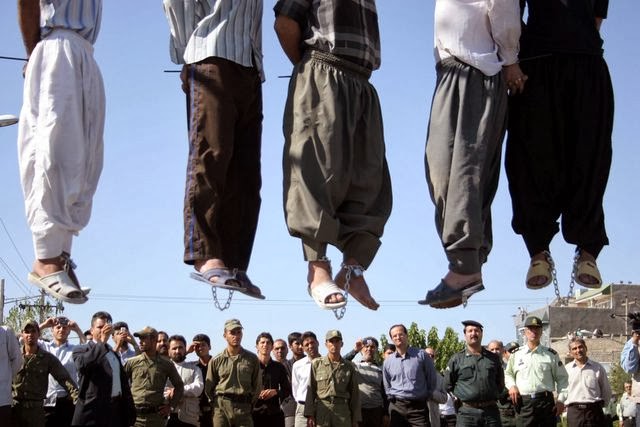
The number of executions carried out by Iranian authorities — often hanging dubiously convicted citizens from construction cranes in public — has risen sharply since President Hassan Rouhani took office in August, a surge most likely because of a secret power struggle within Iran’s notoriously veiled political system.

Away from positive news coverage of the Obama administration’s push for nuclear detente with Iran, the Islamic republic is executing about 66 people per month, 19 more per month than during the 2-year period before Mr. Rouhani took office, according to an analysis of figures compiled by nonpartisan groups including Amnesty International, the Iran Human Rights Documentation Center and various Iranian opposition activists in Washington.

Critics of the nuclear deal are citing the executions as evidence that Mr. Rouhani is far from the moderate reformer that many portrayed him to be upon his ascension to the presidency.

But U.S. intelligence sources, human rights advocates and high-level sources on Capitol Hill caution against jumping to that conclusion. In interviews with The Washington Times, several sources said reasons for the surge in executions are complex.

“There are indications that the Iranian regime is executing more people now compared to just a year ago,” one U.S. intelligence official told The Times on the condition of anonymity in order to speak freely about sensitive issues. “But it’s difficult to identify any overarching political strategy behind Tehran’s actions.”

Mr. Rouhani may have a political mandate from Iran’s supreme leader, Ayatollah Ali Khamenei, to thaw relations with the West. But sources say the president may have limited control over the nation’s judiciary, where decisions are made by other players — including Islamist hard-liners with mandates of their own from Ayatollah Khamenei.

A leading theory is that the leader of the Iranian judiciary, Sadeq Larijani, is green-lighting more executions in an attempt to smear Mr. Rouhani’s image as a moderate. The spike in hangings also may result from Ayatollah Khamenei’s desire to hammer home to Iranians that the mullahs’ grip on society remains tight — even if Mr. Rouhani is seen to be spreading the rhetoric of reform on the world stage.

Human rights outrage

Either way, human rights advocates say, Iran is flagrantly violating international law.

After Amnesty International’s claim that 33 people were hanged in a single week last month, the top human rights office at the United Nations noted that “28 women and a number of political prisoners” were among those executed in 2013. The office also said the killings were based on convictions that do not meet the “most serious crimes” threshold under international law.

“The persistent execution of individuals for exercising their rights to freedom of assembly, association and affiliation to minority groups contravenes universally accepted human rights principles and norms,” said Ahmed Shaheed, U.N. special rapporteur for the situation of human rights in Iran.

[...]

Some believe Iran’s executions will derail prospects for a long-term thaw in relations with West.

“Iranian authorities’ attempts to change their international image are meaningless if at the same time executions continue to increase,” said Hassiba Hadj Sahraoui, a deputy director at Amnesty International, which opposes all executions everywhere.

The situation is adding to unease in Washington, where lawmakers are split over the recent push for diplomacy with Tehran. Most Democrats, including Sen. Dianne Feinstein of California, who heads the Senate Select Committee on Intelligence, call for patience while nuclear negotiations proceed.

Many Republicans say Tehran simply can’t be trusted.

“History has taught us that we are not dealing with an honest broker,” Rep. George Holding, North Carolina Republican and member of the House Committee on Foreign Affairs, said on the House floor last week. “The election of President Rouhani does nothing to change the fact that the supreme leader is still in charge.”

Others argue that Mr. Rouhani is under immense pressure, walking a tightrope between easing tensions with the West and preventing disruption inside Iran.

“We’re clearly seeing a power struggle playing out in Iran between the hard-liners, who aren’t willing to compromise an inch on the nuclear program, and Rouhani, who has placed great emphasis on engagement with the West,” said Rep. Eliot L. Engel of New York, the ranking Democrat on the House Committee on Foreign Affairs.

“The hard-liners,” Mr. Engel told The Times, “are willing to do what it takes to sully the image of Rouhani in the eyes of the West.”

The Larijani theory

The U.S. intelligence official said Iranian Judiciary Chief Sadeq Larijani “could be trying to send a message that tolerance has its limits.”

Iranian sources highlight Mr. Larijani as the face of Tehran’s resistance to international criticism over executions. He responded harshly to the United Nations last week, declaring at a meeting with religious and political leaders in Iran that the Islamic republic “will never cave to this type of pressure” from Western-backed entities, according to a report by Al-Monitor, which cited a pro-regime Persian-language website as its source.

There are signs that some in Mr. Rouhani’s inner circle are at odds with Mr. Larijani and have been angered by the executions. As hangings spiked in November, Ali Younesi, a reformist member of Iran’s parliament and Mr. Rouhani’s special assistant in ethnic and minority affairs, said “extremist elements” in the government were responsible.

His comments were cited by the New York-based International Campaign for Human Rights in Iran, which said “sources close to the Rouhani government” privately claimed that some executions were “actions as sabotage.”

According to those sources, the execution surge is “intended to deprive the government of the chance to present a more positive portrayal of Iran on the international arena, and to discredit Rouhani and his team, casting doubt on whether he is able to deliver his campaign promises to safeguard the nation’s basic rights.”

But the extent to which blame should fall on Mr. Larijani is not clear. Another source who spoke with The Times said human rights advocates may be overlooking evidence of closeness between the judiciary chief and Mr. Rouhani.

One of Mr. Larijani’s brothers is parliament Chairman Ali Larijani, who is believed to be closely aligned with Mr. Rouhani in the push for a nuclear deal with the West.

Others point out that Mr. Rouhani named Mostafa Pourmohammadi in August to become justice minister. At the time, Human Rights Watch noted that Mr. Pourmohammadi, previously a deputy intelligence minister, has long been implicated in the government’s 1988 executions of thousands of political dissidents, as well as the assassinations of several intellectuals in 1998.

Supreme leader’s power

Overanalysis of the politics behind the spike in executions may be irrelevant, said some Iran analysts. They said that whatever is playing out in Tehran is occurring beneath the gaze of the supreme leader — the only figure truly capable of changing the nation’s policies.

After Tehran’s violent crackdown on pro-reform demonstrators in 2009, it has been a common perception in Washington that widespread public frustration burns deeply beneath the Islamic republic’s surface.

“At times of widespread popular discontent, the regime in Tehran uses executions, in particular public hanging of convicts, as a means of terrorizing the public and reminding Iranians of the power of the central government,” said Ali Alfoneh, a researcher at the Foundation for Defense of Democracies specializing in the inner workings of the Iranian regime.

“Therefore,” Mr. Alfoneh said, “the rise in the number of executions signifies both popular discontent and the regime’s nervousness.” [...]
While the situation is complex, and there are many factions with competing agendas on all sides, the one constant factor that does not seem to change, is that the Supreme Leader Ayatollah Ali Khamenei is always in charge, and pulling all the strings. And I'll bet he is nervous, lest he end up like Mubarak or Qaddafi or any number of other deposed Dictators.

Iran has a high number of young, restless, unemployed people, who want change. Killing large numbers of them is one way to try to keep them under control. Meanwhile:


Iran stocks are booming, and nuclear talks are why
As Iran's government and a group of global powers creep forward on talks about easing economic sanctions slapped on that country, the Iranian street is showing signs of breaking free from the economic stagnation that has crippled the country for years.

Iran and the United States, United Kingdom, France, Russia, China and Germany agreed on Thursday to a timeline and framework for further talks next month on restraining the Islamic state's nuclear ambitions. At the same time, United Nations inspectors have reported improved access to Iran's nuclear facilities.

All parties involved continue to warn that serious differences remain in the talks, and hopes for a final deal by July have been called ambitious.

[...]

Despite the market's rise, there are lingering questions about the economy. Inflation has lowered somewhat, but it still comes in at a staggering 35 percent a year. Rabii said he's optimistic, however, that the new government understands the economy and that inflation will be in the 20 percent range next year as a result.

Unemployment is also relatively high: Government estimates put it at 12 percent. However that's much lower than many European countries that were caught up in the financial crisis.

Economists who follow Iran add that it has a young and well-educated population. Because jobs have been hard to come by, many young people have chosen to stay in school and earn higher degrees. Many analysts believe Iran will be eager to attract new foreign investment in order to create jobs for the up-and-coming segment of the population.

Alireza Nader, an Iran expert for the think tank Rand Corp., is one of those analysts. Nader said he sees evidence that Iran's economy has improved since the initial November deal. Still, he noted, most of the sanctions levied against Iran over its nuclear program remain intact.

"Iran is losing more money than it is earning, especially since it can't export all of its oil," Nader said. He agreed with Rabii that confidence in the new government of President Hassan Rouhani is helping the public's mood and giving strength to the Iranian currency, the rial.

Cliff Kupchan, who studies Iran for the Eurasia Group, told CNBC that he sees an immediate improvement in Iran's economy since the initial deal was reached about three months ago. But he said Iran's economic gains would be cut if a nuclear deal falls through and full sanctions are restored.

"The rial would plummet again, Iran's deficit would grow, access to foreign cash reserves would vanish, I think most of the gains Iran has seen would disappear," he said.

Turquoise's Rabii agreed that a deal would help Iran's financial situation more than an impasse would. [...]
I have mixed feeling about all this. On the one hand, if foreign in vestment were to pour into Iran, in theory, that would give the West some leverage with Iran, by tying Irans economy and prosperity in with Western Markets.

I say "in theory", because whatever seems to be happening in Iran, it's always the Supreme Leader who is in charge. He could welcome Western investment in Iran, to build up and strengthen it's economy, and then at some point confiscate those assets and throw the Westerners out, as Iran has done in the past. If they could use those new assets and corresponding strength to then wage war against Iraq, or otherwise gain access to Iraq's oilfields, they could disregard the West completely, as they would then be in a position of great power, and could pursue their nuclear ambitions without restraint.

That is the danger of allowing Iran to strengthen, while the Supreme Leader Khamenei is still in charge. His agenda is his own. It seems to me unwise to risk encouraging or advancing it. And look and see what "reform" means in Iran currently.

We have to ask ourselves, is this is a country we wish to strengthen? We kept pressure on the former Soviet Union until it self-destructed. Should we not do the same here?


Some of my previous posts about Iran:


Is it time for regime change in Iran yet?

Iran, under the surface... is it crumbling?

Hangings in Iran increase, to silence dissent

Iran's pressing needs and Iraq's vulnerability.

Purging Western Influences from Islamic minds

Iranian Fashion Police Publicly Bludgeon Women

Amadinejad talks crazy on Iranian TV, with help from a "Death to Amercia" chorus

Amadinejad supports Pop Islam, Iranian nationalism, to serve the goal of Martydom


Saturday, July 06, 2013

WHO gets ready for MERS


WHO Sets Up Emergency Committee on MERS Virus
GENEVA — The World Health Organization is forming an emergency committee of international experts to prepare for a possible worsening of the Middle East coronavirus, also known as Middle East Respiratory Syndrome (MERS), which has killed 40 people, WHO flu expert Keiji Fukuda said on Friday.

Fukuda said there was currently no emergency or pandemic but the experts would advise on how to tackle the disease if the number of cases suddenly grows. Most of the cases of MERS so far have been in Saudi Arabia, which hosts millions of Muslim visitors every year for the annual haj pilgrimage.

"We want to make sure we can move as quickly as possible if we need to," Fukuda told a news conference.

"If in the future we do see some kind of explosion or if there is some big outbreak or we think the situation has really changed, we will already have a group of emergency committee experts who are already up to speed so we don't have to go through a steep learning curve." [...]
I did a blog post previously about MERS.
     

Tuesday, June 04, 2013

"Middle East respiratory symptom coronavirus, or MERS-CoV"

Newly discovered virus takes more lives, spreads
(CNN) -- A new SARS-like virus recently found in humans continues to spread -- with the worldwide total now at 49, the World Health Organization said Wednesday.

Of the 49 known infections with the MERS-CoV virus, 27 have resulted in death, the organization said.

The latest deaths were reported in Saudi Arabia.

The Saudi health ministry said Wednesday that three people died from their infections in the country's eastern region.

The virus is "a threat to the entire world," the WHO's general director said Monday.

[...]

On Tuesday, a patient died in France after having contracted the virus during a trip to the Middle East, the WHO reported.

Coronaviruses cause illnesses ranging from the common cold to SARS, or Severe Acute Respiratory Syndrome, as well as a variety of animal diseases.

However, the new virus is not SARS.

The WHO recently gave it a more specific name: Middle East respiratory symptom coronavirus, or MERS-CoV.

It acts like a cold virus and attacks the respiratory system, the Centers for Disease Control and Prevention has said. But symptoms, which include fever and a cough, are severe and can lead to pneumonia and kidney failure.

Health officials do not yet know much about how the virus spreads, which makes it hard for scientists to prevent infections, Chan said. [...]


Thursday, February 09, 2012

Intervention in Syria = American Military

And here are some good reasons why it shouldn't happen:

West must not intervene militarily in Syria
(CNN) -- Some of the bravest, noblest women and men I have met are members of the United States armed forces. To them, military intervention is not about winning a debate on television or sounding smart on Twitter. With the United Nations ruling out support for military options to stop the bloodbath in Homs in Syria, leading U.S. commentators are calling for NATO and the Arab League to intervene militarily.

In reality, this would mean the United States would once again carry the heavy burden of war. In NATO's recent operation in Libya, the United States provided 75% of the reconnaissance data, surveillance, intelligence and refueling planes. Syria is not Libya, and NATO without the United States is not up to the job.

The Arab League is no match for a brutal Syrian regime backed by Russia, China and Iran.

In essence, therefore, we must stop pretending about NATO or the Arab League intervening and accept that it is not "international intervention," but U.S. military intervention that is being sought in yet another Muslim-majority country. The Muslim dimension is important because the lessons of Lebanon, Iraq, Palestine and Afghanistan are that, invariably, intervention leads to occupation, which leads to varying degrees of Islamist radicalization.

Whatever the motivations to advance U.S. military intervention, we need to address the following questions before contemplating placing U.S. armed forces in harm's way again, and demanding the U.S. taxpayer foot the bill. [...]

The author goes on to spell it out. He has spent time living in Syria, and has many good insights, on both Syria and the larger picture.


Also see:

Syria: Alawites, Sunnis, the Russia factor...
     

Sunday, February 05, 2012

Is the Current Egyptian Government even More Repressive than the Previous One?

So far, it's not looking good:

Egypt to charge 43 over NGOs
Cairo (CNN) -- Forty-three people, including 19 Americans, face prosecution in an Egyptian criminal court on charges of illegal foreign funding as part of an ongoing crackdown on nongovernmental organizations, a prosecution spokesman said Sunday.

Those referred to court also include five Serbs, two Germans and three Arabs, said Adel Saeed, spokesman for the general prosecutor. The remaining people are Egyptian, he said.

The defendants include Sam LaHood, International Republican Institute country director and the son of U.S. Transportation Secretary Ray LaHood, Saeed said.

[...]

"We had been assured by leaders in the Egyptian government that this issue would be resolved, that harassment would end, that NGOs would be allowed to go back to business as usual and that their property would be returned," State Department spokesman Victoria Nuland said last month. "It is, frankly, unacceptable to us that that situation has not been returned to normal."

Defense Secretary Leon Panetta and U.S. Ambassador Anne Patterson both spoke with high-ranking Egyptian officials following the raids to voice their concern.

Nuland said last month there are apparently "some Mubarak holdovers in the government who don't seem to understand how these organizations operate in a democratic society, and are putting out lots of disinformation about them."

Human Rights Watch called Sunday for Egyptian authorities to drop the charges and stop the criminal investigation into the NGOs.

"The Egyptian authorities are using a discredited Mubarak-era law to prosecute nongovernmental groups while proposing even more restrictive legislation," said Joe Stork, Human Rights Watch's deputy Middle East director, in a statement. "The government should stop using the old law, halt the criminal investigations and propose a law that respects international standards."

[...]

The Supreme Council of the Armed Forces, Egypt's ruling military council, assumed control of the government following the ouster of longtime President Hosni Mubarak last year.

"We're being accused of things we've never done," IRI President Lorne Craner said last month. "We are told we have operated without registration, and that is true because we filed our registration papers five and a half years ago. We were told the papers are complete and we're still waiting."

"We've operated for 30 years, everywhere from (dictator Augusto) Pinochet's Chile to Nicaragua, to the Soviet Union when it was the Soviet Union, to Central Europe, to Indonesia under Suharto," he said. "We work in China, Belarus. This has never, ever happened in the 30 years where we get our offices raided. And Egypt is supposed to be an American friend."

Is the "Arab Spring" is having a late frost?

Egypt sends American workers to trial
CAIRO (AP) – Ignoring a U.S. threat to cut off aid, Egypt on Sunday referred 19 Americans and 24 other employees of nonprofit groups to trial before a criminal court on accusations they illegally used foreign funds to foment unrest in the country.

[...]

On Saturday, U.S. Secretary of State Hillary Rodham Clinton warned Egypt that failure to resolve the dispute may lead to the loss of American aid. The Egyptian minister, Mohammed Amr, responded Sunday by saying the government cannot interfere in the work of the judiciary.

"We are doing our best to contain this but … we cannot actually exercise any influence on the investigating judges right now when it comes to the investigation," Amr told reporters at a security conference in Munich, Germany. A few hours later, word of the referral to trials came.

The Egyptian investigation into the work of nonprofit groups in the country is closely linked to the political turmoil that has engulfed the nation since the ouster of Mubarak, a close U.S. ally who ruled Egypt for nearly 30 years.

Egypt's military rulers have been under fire by liberal and secular groups for bungling what was supposed to be a transition to democracy after Mubarak's ouster. The ruling generals who took power after the uprising, led by a man who was Mubarak's defense minister for 20 years, have tried to deflect the criticism by claiming "foreign hands" are behind protests against their rule and frequently depict the protesters as receiving funds from abroad in a plot to destabilize the country.

Those allegations have cost the youth activists that spearheaded Mubarak's ouster support among a wider public that is sensitive to allegations of foreign meddling and which sees a conspiracy to destabilize Egypt in nearly every move by a foreign nation.

Egypt has just been plunged into a new cycle of violence with 12 killed in four days of clashes. The clashes were sparked by anger at the authorities inability to prevent a riot after a soccer match last week left 74 people dead.

International Cooperation Minister Faiza Aboul Naga, a remnant of the Mubarak regime who retained her post after his ouster, is leading the crackdown on nonprofit groups. On Sunday, she vowed to pursue the issue to the very end. The investigation into the funding issue, she claimed, has uncovered "plots aimed at striking at Egypt's stability." [...]

When all else fails... blame the foreigners.
     

Is lsrael really ready to strike Iran? Why now?

Just a bluff? Fears grow of Israeli attack on Iran
[...] Is Israel bluffing? Israeli leaders have been claiming Iran is pursuing nuclear weapons since the early 1990s, and defense officials have issued a series of ever-changing estimates on how close Iran is to the bomb. But the saber-rattling has become much more direct and vocal.

[...]

Israel views Iran as a mortal threat, citing Iranian calls for Israel's destruction, Iran's support for anti-Israel militant groups and Iranian missile technology capable of hitting Israel.

On Friday, Iran's supreme leader, Ayatollah Ali Khamenei, called Israel a "cancerous tumor that should be cut and will be cut," and boasted of supporting any group that will challenge the Jewish state.

When faced with such threats, Israeli has a history of lashing out in the face of world opposition. That legacy that includes the game-changing 1967 Middle East war, which left Israel in control of vast Arab lands, a brazen 1981 airstrike that destroyed an unfinished Iraqi nuclear reactor, and a stealthy 2007 airstrike in Syria that is believed to have destroyed a nuclear reactor in the early stages of construction.

Armed with a fleet of ultramodern U.S.-made fighter planes and unmanned drones, and reportedly possessing intermediate-range Jericho missiles, Israel has the capability to take action against Iran too, though it would carry grave risks.

It would require flying over Jordan, Saudi Arabia, Iraq, Syria or Turkey. It is uncertain whether any of these Muslim countries would knowingly allow Israel to use their airspace.

With targets some 1,000 miles (1,600 kilometers) away, Israeli planes would likely have the complicated task of refueling in flight. Iran's antiquated air force, however, is unlikely to provide much of a challenge.

Many in the region cannot believe Israel would take such a step without a green light from the United States, its most important ally. That sense is deepened by the heightened stakes of a U.S. election year and the feeling that if Israel acts alone, the West would not escape unscathed.

The U.S. has been trying to push both sides, leading the charge for international sanctions while also pressing Israel to give the sanctions more time. In recent weeks, both the U.S. and European Union have imposed harsher sanctions on Iran's oil sector, the lifeblood of its economy, and its central bank. Israeli officials say they want the sanctions to be imposed faster and for more countries to join them.

Last week, The Associated Press reported that officials in Israel — all of whom spoke on condition of anonymity because they were not authorized to discuss Iran — were concerned that the measures, while welcome, were constraining Israel in its ability to act because the world expected the effort to be given a chance.

Even a limited Israeli operation could well unleash regionwide fighting. Iran could launch its Shihab 3 missiles at Israel, and have its local proxies, Hezbollah in Lebanon and Hamas in the Gaza Strip, unleash rockets. Israel's military intelligence chief, Aviv Kochavi, warned last week that Israel's enemies possess some 200,000 rockets.

While sustained rocket and missile fire would certainly make life uncomfortable in Israel, Barak himself has said he believes casualties would be low — suggesting it would be in the hundreds.

Iran might also try to attack Western targets in the region, including the thousands of U.S. forces based in the Gulf with the 5th Fleet.

An Israeli attack might have other unintended consequences. A European diplomat based in Pakistan, permitted to speak only under condition of anonymity, said that if Israel attacks, Islamabad will have no choice but to support any Iranian retaliation. That raises the specter of putting a nuclear-armed Pakistan at odds with Israel, widely believed to have its own significant nuclear arsenal.

To some, the greatest risk is to the moribund world economy.

Analysts believe an Israeli attack would cause oil prices to spike, since global markets so far have largely dismissed the Israeli threats and not "price in" the threat. According to one poll conducted by the Rapidan Group, an energy consulting firm in Bethesda, Maryland, prices would surge by $23 a barrel. The price of oil settled Friday at $97.84 a barrel.

"Traders don't believe there's anything but bluster going on," said Robert McNally, president of Rapidan and an energy adviser to former President George W. Bush. "A potential Israeli attack on Iran is different than almost every scenario that we've seen before."

McNally said Iran could rattle oil markets by targeting oil fields in southern Iraq or export facilities in Saudi Arabia or Qatar — and withhold sales of its own oil and natural gas from countries not boycotting.

Iran also could attempt to carry out its biggest threat: to shut the Strait of Hormuz, a strategic waterway through which a fifth of the world's oil passes. That could send oil prices soaring beyond $200 a barrel. But analysts note Iran's navy is overmatched.

If a surge in oil prices proved lasting, financial markets would probably plummet on concerns that global economic growth would slow and on the fear that any conflict could worsen and spread.

For the U.S. economy, higher gasoline prices would likely result in lower consumer spending, which accounts for 70 percent of U.S. economic activity. That could have devastating consequences for an incumbent president seeking re-election.

Nick Witney, former head of the EU's European Defense Agency, said "the political and economic consequences of an Israeli attack would be catastrophic for Europe" since the likely spike in the price of oil alone "could push the entire EU, including Germany, into recession."

He said this could lead to "messy defaults" by countries like Greece and Italy, and possibly cause a collapse of the already-wobbly euro. Witney, a senior fellow at the European Council on Foreign Relations, added that "the Iranians would probably retaliate against European interests in the region, and conceivably more directly with terrorism aimed at Western countries and societies."

Oil disruptions or higher oil prices will also dent growth in Asia. China, India, South Korea and Japan all buy substantial amounts of Iranian crude and could face temporary shortages.

China's fast-growing economy, which gets 11 percent of its oil from Iran, has urged all sides to avoid disrupting supplies. Any impact on China's economy, the world's second-largest, could send out global shockwaves if it dented Chinese demand for industrial components and raw materials.

Why is the issue coming to a head with such unfortunate timing, with the U.S. election looming and the global economy hanging by a razor's edge?

The urgency is fueled by a belief in Israel that Iran is moving centrifuges and key installations deep underground by the summer — combined with doubts about whether either Israel or the United States have the bunker-busting capacity to act effectively thereafter. [...]

But the global repercussions of trying to stop it, are enormous. Could the be a case of the cure being worse than the disease?
     

Wednesday, February 01, 2012

Syria: Alawites, Sunnis, the Russia factor...


What a mess:

Where is Syria crisis heading?
[...] Individual states in the Arab League have called for al-Assad to step down, but the organization as a whole has failed to table a similar resolution -- and Phillips says that is unlikely to change anytime soon.

"While it seems likely there is going to be some internal negotiation (on a resolution) taking place, it certainly seems very unlikely Lebanon or Iraq -- states who are allied effectively to Iran and Syria -- will ever join calls for Assad to stand down," said Phillips.

Will the international community intervene like it did in Libya?

Nothing will happen in terms of military intervention in Syria unless Russia changes its current stance, according to Phillips.

"Russia have said quite clearly that they're not going to support anything that would risk al-Assad being forced from power," Phillips told CNN.

"If Russia gave the same kind of green light for Syria that it did for Libya, there's every possibility that you'd see military intervention, probably coming out of Turkey," Phillips said. "But Turkey have said they're highly reluctant to intervene unless they have NATO or U.N. backing."

Is the opposition united against the al-Assad regime?

The longer the fighting goes on in Syria, activists and Western diplomats say, the more radicalized the revolution is becoming.

Fringe elements of Muslim extremist groups are moving in and sectarian rifts are widening as feelings of despair descend on some flashpoint Syrian cities.

While the besieged city of Homs has traditionally been a place of religious tolerance, "there is a real sense now that that is changing and being manipulated by people on both sides" of the conflict, according to Phillips.

President al-Assad belongs to the Alawite Muslim sect while Sunni Muslims form the majority in Syria.

"The older Sunni merchant class that feel the city is theirs rightfully are now turning on the Alawites, who they see as these recent migrants that don't actually belong in the city," said Phillips.

Many Christians have fled to Damascus as communities begin to divide on sectarian lines. Salafists -- Islamic radicals, many of whom have brought terror tactics honed in neighboring Iraq -- are moving into Homs.

Hard-liners inside and outside the country are already jockeying for post-al-Assad power, while the Alawite community fears the prospect of persecution if the government falls.

"The regime is trying to persuade the Alawites that if they abandon the government, they will be wiped out in the dog-eat-dog aftermath," Phillips said.

No easy answers for this dilemma.


At U.N., Pressure Is on Russia for Refusal to Condemn Syria
[...] Fundamentally, the argument over Syria reflects a deeper divide between those who would use the Security Council to confront nations over how their governments treat civilians, versus those who consider that it has no role whatsoever in settling domestic disputes. Syria is the latest example in an argument that stretches back through all recent conflicts.

Russia, backed discreetly by China and India, rejects the idea that the world organization can interfere in the domestic politics of any country to force a leadership change. They all feel that they were duped into supporting a no-fly zone over Libya, which was promoted as a means to protect civilians last March. Instead, they said, NATO used it as a license to help overthrow the Libyan leader, Col. Muammar el-Qaddafi.

The Russian envoy, Vitaly I. Churkin, adopted a “where will it all end” argument, telling reporters that the Security Council cannot prescribe ready recipes for the outcome of a domestic political process.

“Once you start, it is difficult to stop,” he said, adding that pretty soon the Council would start pronouncing “what king needs to resign, or what prime minister needs to step down.”

To a certain extent, the Arab League and the much of the world were ready to dump the eccentric Colonel Qaddafi because he had made many enemies. Mr. Assad, despite hostile relations with some neighbors and the West, continues to have a strong ally in Russia, yet analysts described Moscow as preoccupied with leadership change.

“That the Morocco resolution ‘calls for’ Assad to step aside is their worst example and fear,” said George Lopez, a professor at the University of Notre Dame’s Kroc Institute for International Peace Studies and a sometime adviser to the United Nations. “If today it is Assad, tomorrow Putin? They worry.” [...]


Wednesday, February 16, 2011

TheTchijevsky Index of Mass Human Excitability

Excitability, due to solar activity? I had previously posted about this last May. But with the recent increase in solar activity as we enter our Solar Maximum, I can't help but think of the Middle East. Compare what Tchijevsky said, and what is happening there now:

A. L. Tchijevsky’s Theory of Sunspot Activity and Human Activity
[...] That sunspot cycle activity increased and decreased in a cycle of approximately 11 years was established in the 1750s when astronomers began to make the first charts of the numbers of sunspots over time. During World War I, A. L. Tchijevsky, a Russian professor of Astronomy and Biological Physics who continued his studies at the war front, noticed that particularly severe battles regularly followed each solar flare during the sunspot peak period of 1916-17.

To test his hypothesis that sunspot cycle influenced human activity, Tchijevsky constructed an Index of Mass Human Excitability covering each year form 500 BC to 1922 AD. He then investigated the histories of 72 countries during that period, noting signs of human unrest such as wars, revolutions, riots, expeditions and migrations, plus the numbers of humans involved.

Tchijevsky found that fully 80% of the most significant events occurred during the 5 years of maximum sunspot activity. (Tchijevsky's merely noting that the 1917 Russian Revolution occurred during the height of the sunspot cycle earned him almost 30 years in Soviet prisons because his theory challenged Marxist dialectics.)

Tchijevsky divided the eleven year sunspot cycle into four social periods:

Period 1: (approximately 3 years, minimum sunspot activity). Peace, lack of unity among the masses, election of conservatives, autocratic, minority rule.

Period 2: (approx. 2 years, increasing sunspot activity). Increasing mass excitability, new leaders rise, new ideas and challenges to the elite.

Period 3: (Approximately 3 years, maximum sunspot activity). Maximum excitability, election of liberals or radicals, mass demonstrations, riots, revolutions, wars and resolution of most pressing demands.

Period 4: (Approximately 3 years, decreasing sunspot activity). Decrease in excitability, masses become apathetic, seek peace.

Tchijevsky did not believe solar disturbances caused discontent as much as they acted as detonators that set off the smoldering discontent of the masses--discontent often channeled into war by their rulers. Nor did he deny that even during minimum solar activity some people would rebel against intolerable conditions or that nations would seek advantage through war and conquest. Some have since noted that the number of sunspots during any period may not be as significant as whether there is a rapid increase in the numbers, triggering unexpected passions. [...]

In terms of solar activity, we are in a "period 3" now. Sunspot activity has been steadily increasing. Recently, we've had an X-class solar flare, with a coronal mass ejection. Does that count as a "sudden increase"?

Aurora borealis activity possible February 17-18, NOAA X-class solar flare
The National Oceanic and Atmospheric Administration (NOAA) reports that the most energetic solar flare in four years occurred on February 15, 2011. This X2 class solar flare also produced a coronal mass ejection which will increase the likelihood of aurora borealis activity, also known as the northern lights, on the night of February 17/18.

The solar flare originated from Sunspot 1158. X class solar flares are the most energetic solar flares. Flares also have sub classifications represented by numbers from 1 to 9, with the larger numbers representing more energetic flares. This X2 flare is energetic but near the lower end of X class flares.

This flare also produced a coronal mass ejection (CME) which is likely to strike Earth on February 18 (UTC date). During a CME the Sun spews out charged particles which can interact with Earth's magnetic field to cause aurora. The most likely night to see aurora activity (northern or southern lights) from this solar flare is the night of February 17/18, but it is also possible on the night of February 16/17.

This illustration shows how Earth's magnetosphere deflects, for the
most part, a magnetic cloud of plasma from a coronal mass ejection.


At high latitudes, NOAA predicts a 45% chance of aurora causing geomagnetic activity and a 25% chance of a minor geomagnetic storm. At mid latitudes the probabilities are 35% and 20%. [...]

It goes on to predict continuing activity from this sunspot.

I know that scientifically, there is insufficient data to prove any connection with political unrest in the Middle East. But still, I think it's "interesting" none the less.

But even if one considers that people are affected by solar activity, is the affect necessarily a negative one? Other research has shown that the peaks of solar activity have also been times of great advancement in human endevors, such as the arts and sciences:

Sunspots and Human Behavior
[...] In another historical study Suitbert Ertel writes in his article “Synchronous Bursts of Activity in Independent Cultures; Evidence for Extraterrestrial Connections” that evidence has been reported suggesting a link between historical oscillations of scientific creativity and solar cyclic variation. Eddy’s discovery of abnormal secular periods of solar inactivity (Maunders minimum type) offered the opportunity to put the present hypothesis to a crucial test. Using time series of flourish years of creators in science, literature, and painting (A.D. 600-1800) It was found as expected:

1. Cultural flourish curves show marked discontinuities (bursts) after the onset of secular solar excursions synchronously in Europe and China;

2. during periods of extended solar excursions, bursts of creativity in painting, literature, and science succeeded one another with lags of about 10-15 years;

3. The reported regularities of cultural output are prominent throughout with eminent creators. They decrease with ordinary professionals. The hypothesized extraterrestrial connection of human culture has thus been strengthened.

The evidence seems to show that during the maxima of sunspot activity human behavior is stimulated. [...]

Could it be that, solar maximums don't stimulate people in ways that make them agitated, but rather, they stimulate human creativity, causing people to strive for improvement. But in places where that creativity is stifled and repressed, where their creative energy has no creative outlet, no chance of improvement, that energy would then be directed to removing obstacles to the manifestation of that creativity and improvement? It's an interesting idea.
     

Tuesday, February 08, 2011

Egypt's "Facebook" Revolution. Being hyjacked?

Perhaps not yet. And hopefully, not at all. But can the youth hang on to it?


Is it really the internet, things like Facebook, Twitter and Google, that sparked the revolution? And is it now being usurped by others? Many of the younger Egyptians seem to think so:

Freed young leader energizes Egyptian protests
CAIRO – A young leader of Egypt's anti-government protesters, newly released from detention, joined a massive crowd in Cairo's Tahrir Square for the first time Tuesday and was greeted with cheers, whistling and thunderous applause when he declared: "We will not abandon our demand and that is the departure of the regime."

Many in the crowd said they were inspired by Wael Ghonim, the 30-year-old Google Inc. marketing manager who was a key organizer of the online campaign that sparked the first protest on Jan. 25 to demand the ouster of President Hosni Mubarak. Straight from his release from 12 days of detention, Ghonim gave an emotionally charged television interview Monday night where he sobbed over those who have been killed in two weeks of clashes.

He arrived in the square when it was packed shoulder-to-shoulder, a crowd comparable in size to the biggest demonstration so far that drew a quarter-million people. He spoke softly and briefly to the huge crowd from a stage and began by offering his condolences to the families of those killed.

"I'm not a hero but those who were martyred are the heroes," he said, breaking into a chant of "Mubarak leave, leave." When he finished, the crowd erupted in cheering, whistling and deafening applause.

Ghonim has emerged as a rallying point for protesters, who reject a group of traditional Egyptian opposition groups that have met with the government amid the most sweeping concessions the regime has made in its three decades in power.

Protesters have lacked a clear, representative voice and many worry the traditional parties are trying to hijack the uprising, which began when activists used the Internet to mobilize protester. The mostly youthful protesters are insisting that no concessions will do unless Mubarak steps down.

In his first television interview Monday night, Ghonim dubbed the protests "the revolution of the youth of the Internet" and proclaimed defiantly: "We are not traitors."

About 130,000 people have joined a Facebook group nominating Ghonim as the spokesman of their uprising. The page is called "I delegate Wael Ghonim to speak in the name of Egypt's revolutionaries." [...]

Not only is this story not over yet, it's clearly just beginning. Where it's going, I don't think anyone knows for sure. The Facebook youth may have opened the door, but is it creating the "void" that Hillary Clinton warned about, where whoever has the most brute force on the ground can rush in and seize power? Can that be prevented?

And while the internet certainly is playing a role, I believe the actual spark has more to do with economics:

The Economic Roots Of the Revolt
Few countries have been less integrated into the global economy than Egypt.
The mass movement engulfing Egypt exposes a fact that has been hiding in plain sight: In a decade during which China has brought more people out of poverty at a faster rate than ever in human history, in a period of time where economic reform has been sweeping the world from Brazil to Indonesia, Egypt has missed out.

A decade ago, IBM ran a series of commercials featuring its global reach. One included a fisherman sailing on the Nile, tapping into a wireless network. It was an enticing image—and almost completely fictional. Few countries have been less integrated into the global economy.

The country ranks 137 in the world in per-capita income (just behind Tonga and ahead of Kirbati), with a population in the top 20. And while GDP growth for the past few years has been respectable, averaging 4%-5% save for 2009 (when all countries suffered), even that is at best middle of the pack in a period where the more competitive dynamic nations have been surging ahead.

Egypt has long been famous for crony inefficiency. Yet Hosni Mubarak was graced with nearly $2 billion in annual U.S. aid, another $5 billion from dues from the Suez Canal, and $10 billion in tourism, so he could buy off a considerable portion of the 80 million Egyptians. [...]

It goes on into a lot of detail. While some of the problems are unique to Egypt, others are endemic to the region.

Many countries of the Middle East are borrowing money to keep food prices down, instead of creating jobs. Like the Western nations, they are also accumulating massive debts. It's an unsustainable situation. Where is it going to lead to?


Also see: Tahrir photos


Sunday, January 30, 2011

Islamists to gain ground in Middle East politics

At least that's the way it looks to be unfolding:

As Tunisians Cheer Egypt, Islamist Leader Returns

Now it's being predicted that the Islamist Muslim Brotherhood will also rise to power in Egypt, and replace the current Dictatorship of Mubarak.

Years ago, I posted about the Nazi roots of the Muslim Brotherhood, and the actual, strong, historical connections. It begs the question: how much are they still like that, today? Or can we say, "That was then, this is now?"

There are people who claim that the Muslim Brotherhood is more moderate. It has defenders like Omar Sharif, who see it as a force for good. Can it be? Will it be? Is it possible?

In the late 70's, the Islamists in Iran claimed to be moderate, but we saw what happened when they got power. I think it's that kind of drastic change that Hillary Clinton wants to avoid, while at the same time recognizing that change IS coming:

Clinton: U.S. not taking sides in Egypt
[...] Clinton waffled Sunday on the political upheaval in Egypt, praising and decrying the process in a Fox News interview.

Clinton's diplomatic skills were tested in the interview when pressed about the uprising that has killed more than 50 people in Egypt, where the 30-year autocratic rule of Mubarak is being challenged.

She also hinted the United States sees an end to Mubarak's reign.

"We want to see an orderly transition so that no one fills a void, that there's not a void, that there be a well thought-out plan that will bring about a democratic, participatory government," Clinton said.

Despite the "transition" reference, Clinton said there was confidence in Washington about Mubarak's governance. [...]

I'm sure the White House is hedging it's bets, because they are uncertain about who's going to come out on top. We have just a little influence, but no control, over that. I think that the "orderly transition" that she spoke of is going to be their main focus. It sounds like the best plan. Helping to avoid that "void".

The U.S. is often accused by Leftists of tolerating dictators. But if we over-throw a dictator, like we did in Iraq, we are accused of meddling in foreign affairs where we don't belong. Damned if we do, and damned if we don't.

The fact is, we often have to deal with governments we would rather not deal with, because we have no control and little influence over their internal affairs.

In another interview I read, Clinton said that the Egyptian people are going to choose who their leadership is. I suspect she's right, and we will just have to deal with it.

And if the Muslim Brotherhood is "it", well, lets hope that Omar Sharif's optimism regarding them is at least somewhat justified.
     

Thursday, June 03, 2010

Flotilla participants got what they wanted

Martyrdom:

Arab Media Reports on Flotilla Participants: Writing Wills, Preparing for Martyrdom, Determined to Reach Gaza or Die
Flotilla Participants

Following is information from the Arab media about some of the flotilla participants. It should be noted that many of these were from the Muslim Brotherhood across the Muslim world.

(For more on this subject, see also MEMRI Special Dispatch No. 2986, "MEMRI TV Clips on the Gaza Flotilla: Activists On Board Chant Songs of Martyrdom at Departure," http://www.memri.org/report/en/0/0/0/0/0/0/4249.htm.)

Egypt

In Friday sermons, Muslim Brotherhood General Guide Muhammad Badi' expressed support for Hamas, frequently reiterating harsh statements in favor of jihad and of the armed struggle in Palestine, Iraq, and Afghanistan (see http://www.memri.org/report/en/0/0/0/0/0/0/4254.htm).

The Egyptian flotilla delegation included two members of the Muslim Brotherhood bloc in the Egyptian parliament: Muhammad Al-Baltaji and Hazem Farouq.

Al-Baltaji, who is deputy secretary-general of the Muslim Brotherhood parliamentary bloc in Egypt, said at a March 2010 conference, "A nation that excels at dying will be blessed by Allah with a life of dignity and with eternal paradise." He also said that his movement "will never recognize Israel and will never abandon the resistance," and that "resistance is the only road map that can save Jerusalem, restore the Arab honor, and prevent Palestine from becoming a second Andalusia.[1] [...]

It goes on to list news reports from Lebanon, Jordan, Syria, Yemen, Kuwait, Bahrain, and more, confirming that they were Jihadis preparing to die.

These are Middle Eastern news sources acknowledging this. So why does the Western media keep insisting it was "just humanitarian aid", when everyone in the Middle East knows it wasn't?

President Obama is criticizing Israel for not handling the situation better. Given that many of the flotilla participants were armed to the teeth and ready to die as martyrs, how could it have turned out any differently than it did?

Of course the Muslim Brotherhood was deeply involved, as well as an assortment of Western commies. They have so much in common.
     

Wednesday, November 11, 2009

Iran's objectives, and internal political struggle

Here is an interview for CNN with Fareed Zakaria, author and foreign affairs analyst. It starts off about the hikers/hostages, but then Zakaria has some interesting things to say about Iran's internal politics:

Zakaria: No one thinks hikers are spies
[...]

CNN: It's been reported that Ahmadinejad said the U.S. must abandon support for Israel to move ahead on better relations with Iran.

Zakaria: This has been a consistent theme of Ahmadinejad's. We read it too much as an expression of some kind of ideology. What it really is is Ahmadinejad's effort to appropriate, to take over the core central issue of the Arab world -- the Palestinian issue -- and make it his own. Iran is trying to become the dominant power of the Middle East.

It makes it very difficult for Arab countries to be critical of Iran because, on the Arab street, Ahmadinejad is seen as the great upholder of the Palestinian cause. He is trying to keep the Arabs on the defensive by constantly reminding people that he is the great opponent of Israel in the region. It's a very clever political calculation.

CNN: How can the Obama administration negotiate with Iran when it seems their stance on the nuclear issue is constantly shifting?

[...]

It's worth reading the whole thing, it's not very long.


For updates on current events in Iran, see the blog of Iranian ex-pat Azarmehr:

For a democratic secular Iran. For peace and prosperity in the Middle East.
     

Monday, August 17, 2009

Is the Iraqi government aligning itself with Iran?

There are signs that it may be so. Consider the recent massacre of Iranian dissidents that took place in Iraq:

Iran’s hand is seen behind camp massacre
KIRKUK, IRAQ // Residents at an Iraqi camp for Iranian dissidents have started a hunger strike to protest against alleged human rights abuses inflicted by Iraqi security forces this week, amid fears that the Iranian regime’s influence is growing in the Iraqi government.

On Tuesday, Iraqi police entered Camp Ashraf in Diyala province, where, according to residents, they attacked an unarmed group of people with machine guns and batons, killing 12 and seriously wounding 500.

Iraqi security forces initially denied the casualty figures, but on Thursday, Ali al Dabbagh, the Iraqi government spokesman, acknowledged that six Iranians had been killed and promised an investigation.

“We were empty-handed, with only slogans,” Shahriar Kia, a camp press officer, said. “We were shouting that Ashraf is a city of peace, and they started shooting and beating us.”

Iraqi police are now in position at junctions within the camp, which is around six square kilometres, and in control of the squares and public places, he said. They were restricting movement, said Mr Kia. “They don’t let people move around. They have shot car windows and tyres as people were driving.”

Mr al Dabbagh said a police station had been set up and that there were 1,000 Iraqi troops inside the camp. It was the setting up of a police post inside the camp that sparked the first clashes on Tuesday.

[...]

Residents claim that since Iraqi forces took charge, food and medical supplies have been restricted, and visiting family members and lawyers have not been allowed in.

The clashes this week have stoked fears that the residents will be evicted from the camp and returned to Iran, where they would probably face arrest amid an extensive clampdown on the opposition movement since the disputed June 12 election.

“This is the Iranian regime who is trying to survive by destroying opposition,” said Mr Kia. “The same thing is happening here as on the streets of Tehran – killing and beating.”


Residents had begun a hunger strike, he said, which they would maintain until the UN and other international groups came to Ashraf, and residents were allowed to see their lawyers.

“I think that the Iranian government, which is facing a summer of discontent back home, is using its influence over the Iraqi government to send a message that it is still in control,” said Maysun al Damluji, an MP of the secular National List coalition.

The Iranian authorities, she said, were trying to ensure that parties sympathetic to them win in Iraqi elections scheduled for January 2010. They will, she said, “do everything in their power to bring Iraqi political entities that are loyal or close to Iran’s conservatives to power in Iraq … they will also rid Iraq of all of Iran’s opponents, not only in Ashraf, but even outside it.” She described Ashraf as a “simple exercise of muscle flexing”.

Iran’s parliament speaker, Ali Larijani, has welcomed the seizure of the camp, describing the action as “praiseworthy” albeit “rather late”. [...]

If religious extremists in the Iraqi government join forces with the religious extremists currently ruling Iran, we would have the worst of both worlds.

Other news in Iraq:

Gay men attacked, executed in Iraq, rights group says
BAGHDAD, Iraq (CNN) -- Hundreds of gay men have been tortured and killed in Iraq in recent months, some by the nation's security forces, Human Rights Watch said Monday.

Interviews with doctors indicate hundreds of men had been killed, but the exact number was unclear because of the stigma associated with homosexuality in Iraq, the New York-based watchdog group said in its report.

"Iraq's leaders are supposed to defend all Iraqis, not abandon them to armed agents of hate," said Scott Long, director of the Lesbian, Gay, Bisexual and Transgender Rights Program at Human Rights Watch. "Turning a blind eye to torture and murder threatens the rights and life of every Iraqi."

Four victims who spoke to CNN gave accounts of the attacks, which they say have intensified in the past few months.

"In 2004, militias and unknown groups started to go after the gays ... but the peak was six months ago," said Qaisar, who uses a pseudonym for fear of reprisal. "It has become wide scale war against gays in Iraq." [...]

The more we withdraw from Iraq, the more it acts like Iran. If Iraq becomes just like Iran, and joins forces with them, we will have achieved nothing, at great cost to ourselves.

Also see: Iran's pressing needs and Iraq's vulnerability.
     

Sunday, June 08, 2008

Iran, Nukes, and No Second Chances


I generally like to think optimistically about world affairs. I like to think that no matter how screwed up a situation becomes, that it can be reversed or corrected later. But there are some instances where that's extremely unlikely. Iran, nuclear weapons technology and Amadinejad are a prime example.

Thomas Sowell spells it out plain and simple:

Obama and McCain and Iran
[...] While all sorts of gushing is going on in the media, and posturing is going on in politics, the biggest national sponsor of terrorism in the world-- Iran-- is moving step by step toward building a nuclear bomb.

The point when they get that bomb will be the point of no return. Iran's nuclear bomb will be the terrorists' nuclear bomb-- and they can make 9/11 look like child's play.

All the options that are on the table right now will be swept off the table forever. Our choices will be to give in to whatever the terrorists demand-- however outrageous those demands might be-- or to risk seeing American cities start disappearing in radioactive mushroom clouds.

All the things we are preoccupied with today, from the price of gasoline to health care to global warming, will suddenly no longer matter.

Just as the Nazis did not find it enough to simply kill people in their concentration camps, but had to humiliate and dehumanize them first, so we can expect terrorists with nuclear weapons to both humiliate us and force us to humiliate ourselves, before they finally start killing us.

They have already telegraphed their punches with their sadistic beheadings of innocent civilians, and with the popularity of videotapes of those beheadings in the Middle East.

They have already telegraphed their intention to dictate to us with such things as Osama bin Laden's threats to target those places in America that did not vote the way he prescribed in the 2004 elections. He could not back up those threats then but he may be able to in a very few years.

The terrorists have given us as clear a picture of what they are all about as Adolf Hitler and the Nazis did during the 1930s-- and our "leaders" and intelligentsia have ignored the warning signs as resolutely as the "leaders" and intelligentsia of the 1930s downplayed the dangers of Hitler.

We are much like people drifting down the Niagara River, oblivious to the waterfalls up ahead. Once we go over those falls, we cannot come back up again.

What does this have to do with today's presidential candidates? It has everything to do with them. [...]

(bold emphasis mine) As much as I like to be optimistic, I also believe in being a realist. Hitler did not have the Atom Bomb, and we defeated him before he got it. If he had succeeded in getting the Atom Bomb... can you imagine the horror?

We are facing a very similar situation now. The term of our next president will likely be the last window of opportunity to stop this. Will we? If we don't, Sowell is right, nothing else we're fussing about now is going to matter.

Sowell is not a McCain fan. But Sowell compares McCain to Obama on the Iran issue, and makes a compelling case as to why it's important not to "sit this one out". Now is not the time for moral paralysis. We need to support the Republican candidate now, more than ever. Our very lives may depend on it.


Related Links:

Amadinejad talks crazy on Iranian TV, with help from a "Death to Amercia" chorus

Iranian Theocracy prepares the Iranian people for the "Return of the Mahdi"

Iran's pressing needs and Iraq's vulnerability

Why Obama Must Go to Iraq